

P(t) = lim n→∞ P n (t)
One can show that this formula does indeed represent
a CONTINUOUS FUNCTION from the unit interval [0,1]
to all points in the unit square. Since any continuous
function defined on an interval can be thought of as the
PARAMETRIC EQUATION of a curve, it is indeed appropriate to think of Peano’s function then as a curve in
two-dimensional space.
Notice that if we take the side-length of the
square to be 1 unit, then the length of the diagonal is
√
–
2 units long. Each iteration of the procedure produces a curve three times as long as the curve in the
previous step.
See also CARDINALITY; INFINITY.
Peano’s postulates In 1889 Italian mathematician
GIUSEPPE PEANO (1858–1932) presented a first set of
basic postulates that he hoped would characterize precisely the properties of the natural numbers. He revised
his system 10 years later to state:
There is a set N whose elements are called “numbers” with the following properties:
1. To every number a one can assign another number a′
called its successor. (We normally think of a′ as a + 1.)
2. No two different numbers have the same successor.
3. There is at least one number which is not the successor of any other number.
4. Induction axiom: If a subset M of numbers contains
at least one number that is not a successor, but has
the property that for any number a in M, its successor a′ is in M, then M = N. (That is, every number
is in M.)
It is worth noting that it follows from these axioms
that there is just one number that is not the successor
of any other number. (Let e be any number that is not a
successor and let M be the set of all numbers that are
successors along with the number e. By the induction
axiom, M = N. It follows then that e is the only number that fails to be a successor.) This special number is
usually called ZERO.
From these very basic postulates Peano was able
to define an operation of addition on numbers and
from there derive all the properties of arithmetic we
use today.
See also INDUCTION; NATURAL NUMBERS.
Pearson, Karl (1857–1936) British Statistics Born
on March 27, 1857, in London, England, mathematician Karl Pearson is remembered for his influence in
the development of statistics as applied to biology and
the social sciences. Pearson introduced, for the first
time, such basic concepts as STANDARD DEVIATION and
the notion of a CORRELATION COEFFICIENT. He also
developed the invaluable CHI-SQUARED TEST.
Educated at Cambridge University, Pearson held a
faculty position at University College, London, for the
most part of his career, studying the analysis of heredity
and evolution in biology. Beginning in 1893 Pearson
published a series of 18 papers all titled “Mathematical
386 Peano’s postulates
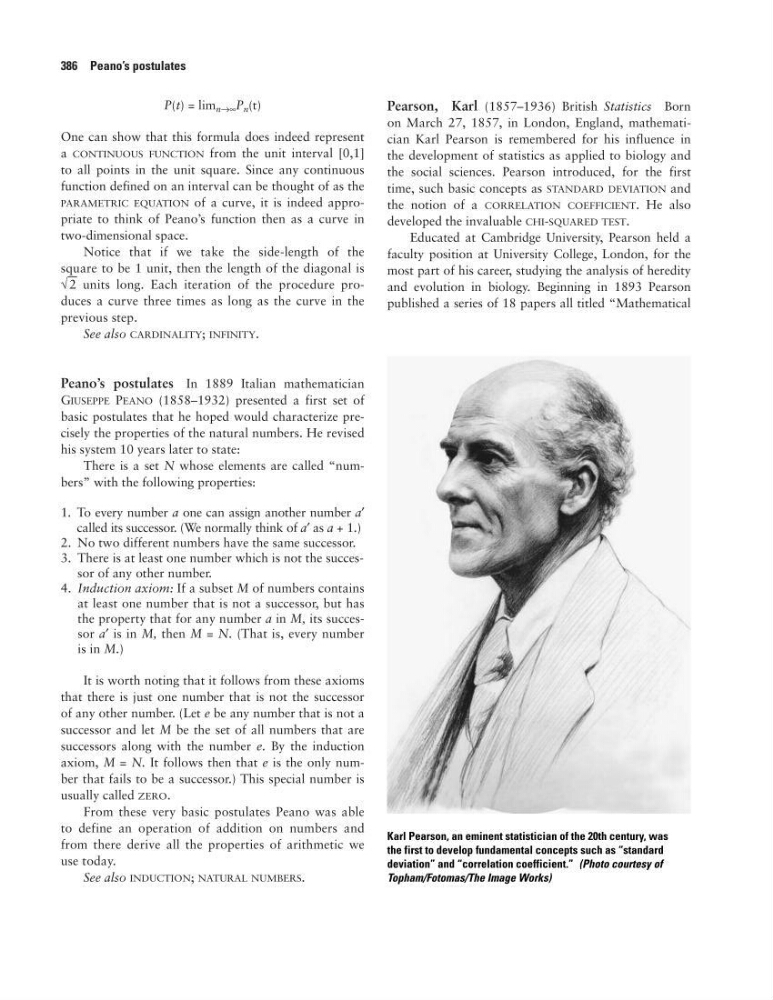
Karl Pearson, an eminent statistician of the 20th century, was
the first to develop fundamental concepts such as “standard
deviation” and “correlation coefficient.” (Photo courtesy of
Topham/Fotomas/The Image Works)
One can show that this formula does indeed represent
a CONTINUOUS FUNCTION from the unit interval [0,1]
to all points in the unit square. Since any continuous
function defined on an interval can be thought of as the
PARAMETRIC EQUATION of a curve, it is indeed appropriate to think of Peano’s function then as a curve in
two-dimensional space.
Notice that if we take the side-length of the
square to be 1 unit, then the length of the diagonal is
√
–
2 units long. Each iteration of the procedure produces a curve three times as long as the curve in the
previous step.
See also CARDINALITY; INFINITY.
Peano’s postulates In 1889 Italian mathematician
GIUSEPPE PEANO (1858–1932) presented a first set of
basic postulates that he hoped would characterize precisely the properties of the natural numbers. He revised
his system 10 years later to state:
There is a set N whose elements are called “numbers” with the following properties:
1. To every number a one can assign another number a′
called its successor. (We normally think of a′ as a + 1.)
2. No two different numbers have the same successor.
3. There is at least one number which is not the successor of any other number.
4. Induction axiom: If a subset M of numbers contains
at least one number that is not a successor, but has
the property that for any number a in M, its successor a′ is in M, then M = N. (That is, every number
is in M.)
It is worth noting that it follows from these axioms
that there is just one number that is not the successor
of any other number. (Let e be any number that is not a
successor and let M be the set of all numbers that are
successors along with the number e. By the induction
axiom, M = N. It follows then that e is the only number that fails to be a successor.) This special number is
usually called ZERO.
From these very basic postulates Peano was able
to define an operation of addition on numbers and
from there derive all the properties of arithmetic we
use today.
See also INDUCTION; NATURAL NUMBERS.
Pearson, Karl (1857–1936) British Statistics Born
on March 27, 1857, in London, England, mathematician Karl Pearson is remembered for his influence in
the development of statistics as applied to biology and
the social sciences. Pearson introduced, for the first
time, such basic concepts as STANDARD DEVIATION and
the notion of a CORRELATION COEFFICIENT. He also
developed the invaluable CHI-SQUARED TEST.
Educated at Cambridge University, Pearson held a
faculty position at University College, London, for the
most part of his career, studying the analysis of heredity
and evolution in biology. Beginning in 1893 Pearson
published a series of 18 papers all titled “Mathematical
386 Peano’s postulates
Karl Pearson, an eminent statistician of the 20th century, was
the first to develop fundamental concepts such as “standard
deviation” and “correlation coefficient.” (Photo courtesy of
Topham/Fotomas/The Image Works)