

any CONIC SECTION, then the three points of intersection of opposite pairs of sides lie on a straight line. (A
pair of two straight lines can be thought of as a degenerate HYPERBOLA.)
parabola As one of the three CONIC SECTIONS, a
parabola is the plane curve consisting of all points P
that are equally distant from a given fixed point F, and
a given fixed line L. The fixed point is called the focus
of the parabola, and the fixed line its directrix. A
parabola also arises as the curve produced by the intersection of a plane through a right circular CONE held
parallel to the slant side of the cone.
The equation of a parabola can be found by introducing a coordinate system in which the focus is the
point F = (0,a), for some positive number a, and the
directrix is the horizontal line y = –a. If P = (x,y) is an
arbitrary point on the parabola, then the DISTANCE FORMULA describes the defining condition as
=
y + a. Squaring and simplifying yields the equation:
Conversely, reversing these steps shows that any
equation of the form y = A(x – p)
2 + q is the equation
of a parabola with focus F = (p,q +
) and directrix
y = q –
. Thus the graph of any quadratic equation
is a parabola.
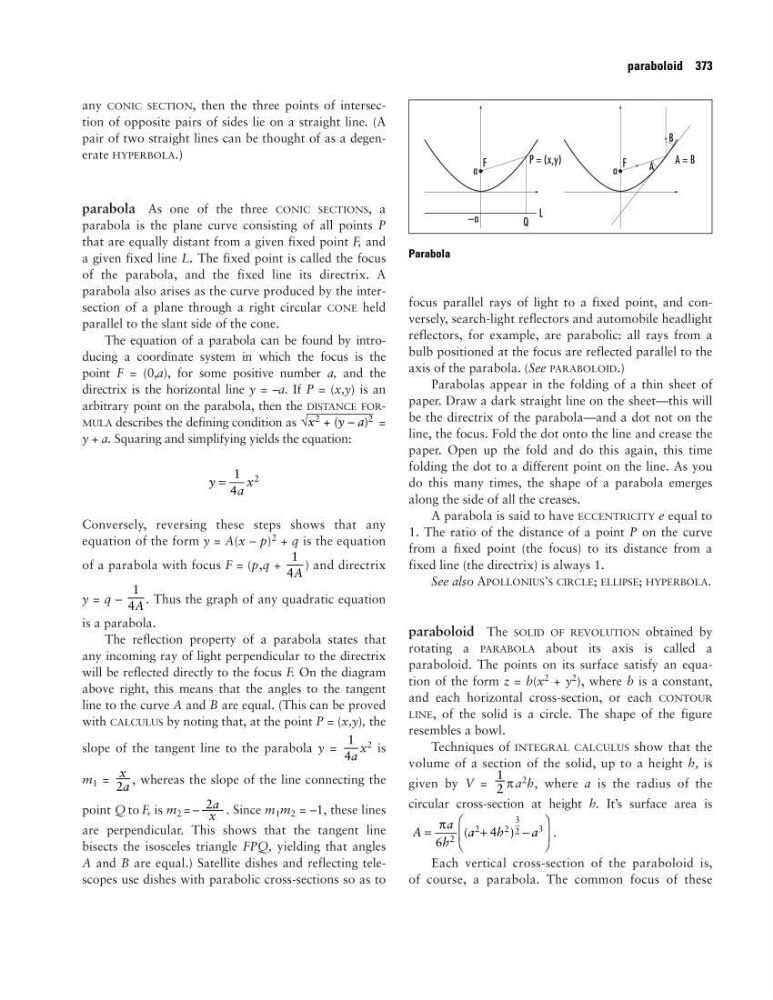
The reflection property of a parabola states that
any incoming ray of light perpendicular to the directrix
will be reflected directly to the focus F. On the diagram
above right, this means that the angles to the tangent
line to the curve A and B are equal. (This can be proved
with CALCULUS by noting that, at the point P = (x,y), the
slope of the tangent line to the parabola y =
x
2 is
m 1 =
, whereas the slope of the line connecting the
point Q to F, is m 2 = –
. Since m 1 m 2 = –1, these lines
are perpendicular. This shows that the tangent line
bisects the isosceles triangle FPQ, yielding that angles
A and B are equal.) Satellite dishes and reflecting telescopes use dishes with parabolic cross-sections so as to
focus parallel rays of light to a fixed point, and conversely, search-light reflectors and automobile headlight
reflectors, for example, are parabolic: all rays from a
bulb positioned at the focus are reflected parallel to the
axis of the parabola. (See PARABOLOID.)
Parabolas appear in the folding of a thin sheet of
paper. Draw a dark straight line on the sheet—this will
be the directrix of the parabola—and a dot not on the
line, the focus. Fold the dot onto the line and crease the
paper. Open up the fold and do this again, this time
folding the dot to a different point on the line. As you
do this many times, the shape of a parabola emerges
along the side of all the creases.
A parabola is said to have ECCENTRICITY e equal to
1. The ratio of the distance of a point P on the curve
from a fixed point (the focus) to its distance from a
fixed line (the directrix) is always 1.
See also APOLLONIUS’S CIRCLE; ELLIPSE; HYPERBOLA.
paraboloid The SOLID OF REVOLUTION obtained by
rotating a PARABOLA about its axis is called a
paraboloid. The points on its surface satisfy an equation of the form z = b(x
2 + y
2
), where b is a constant,
and each horizontal cross-section, or each CONTOUR
LINE, of the solid is a circle. The shape of the figure
resembles a bowl.
Techniques of INTEGRAL CALCULUS show that the
volume of a section of the solid, up to a height h, is
given by V =
π a
2 h, where a is the radius of the
circular cross-section at height h. It’s surface area is
.
Each vertical cross-section of the paraboloid is,
of course, a parabola. The common focus of these
A
a
h
a
h
a
=
+
−
π
6
4
2
2
2
3
2
3
(
)
1
–
2
2a
–––
x
x
––
2a
1
––
4a
1
––
4A
1
––
4A
y
a
x
=
1
4
2
√x
2 + (y – a)
2
paraboloid 373
Parabola
pair of two straight lines can be thought of as a degenerate HYPERBOLA.)
parabola As one of the three CONIC SECTIONS, a
parabola is the plane curve consisting of all points P
that are equally distant from a given fixed point F, and
a given fixed line L. The fixed point is called the focus
of the parabola, and the fixed line its directrix. A
parabola also arises as the curve produced by the intersection of a plane through a right circular CONE held
parallel to the slant side of the cone.
The equation of a parabola can be found by introducing a coordinate system in which the focus is the
point F = (0,a), for some positive number a, and the
directrix is the horizontal line y = –a. If P = (x,y) is an
arbitrary point on the parabola, then the DISTANCE FORMULA describes the defining condition as
=
y + a. Squaring and simplifying yields the equation:
Conversely, reversing these steps shows that any
equation of the form y = A(x – p)
2 + q is the equation
of a parabola with focus F = (p,q +
) and directrix
y = q –
. Thus the graph of any quadratic equation
is a parabola.
The reflection property of a parabola states that
any incoming ray of light perpendicular to the directrix
will be reflected directly to the focus F. On the diagram
above right, this means that the angles to the tangent
line to the curve A and B are equal. (This can be proved
with CALCULUS by noting that, at the point P = (x,y), the
slope of the tangent line to the parabola y =
x
2 is
m 1 =
, whereas the slope of the line connecting the
point Q to F, is m 2 = –
. Since m 1 m 2 = –1, these lines
are perpendicular. This shows that the tangent line
bisects the isosceles triangle FPQ, yielding that angles
A and B are equal.) Satellite dishes and reflecting telescopes use dishes with parabolic cross-sections so as to
focus parallel rays of light to a fixed point, and conversely, search-light reflectors and automobile headlight
reflectors, for example, are parabolic: all rays from a
bulb positioned at the focus are reflected parallel to the
axis of the parabola. (See PARABOLOID.)
Parabolas appear in the folding of a thin sheet of
paper. Draw a dark straight line on the sheet—this will
be the directrix of the parabola—and a dot not on the
line, the focus. Fold the dot onto the line and crease the
paper. Open up the fold and do this again, this time
folding the dot to a different point on the line. As you
do this many times, the shape of a parabola emerges
along the side of all the creases.
A parabola is said to have ECCENTRICITY e equal to
1. The ratio of the distance of a point P on the curve
from a fixed point (the focus) to its distance from a
fixed line (the directrix) is always 1.
See also APOLLONIUS’S CIRCLE; ELLIPSE; HYPERBOLA.
paraboloid The SOLID OF REVOLUTION obtained by
rotating a PARABOLA about its axis is called a
paraboloid. The points on its surface satisfy an equation of the form z = b(x
2 + y
2
), where b is a constant,
and each horizontal cross-section, or each CONTOUR
LINE, of the solid is a circle. The shape of the figure
resembles a bowl.
Techniques of INTEGRAL CALCULUS show that the
volume of a section of the solid, up to a height h, is
given by V =
π a
2 h, where a is the radius of the
circular cross-section at height h. It’s surface area is
.
Each vertical cross-section of the paraboloid is,
of course, a parabola. The common focus of these
A
a
h
a
h
a
=
+
−
π
6
4
2
2
2
3
2
3
(
)
1
–
2
2a
–––
x
x
––
2a
1
––
4a
1
––
4A
1
––
4A
y
a
x
=
1
4
2
√x
2 + (y – a)
2
paraboloid 373
Parabola