

and it is a greatest lower bound if l is larger than any
other lower bound for a and b. In our example, the
greatest lower bound of {A,B} and {B,C} is their intersection {B}. A partially ordered set is called a lattice if
every pair of elements has a least upper bound and a
greatest lower bound. The existence of unions and
intersections shows that the set of all subsets of any
given set is a lattice. The set of natural numbers under
the relation “is a factor of” is also a lattice: the least
upper bound of any two natural numbers is their lowest COMMON MULTIPLE, and the greatest lower bound is
their GREATEST COMMON FACTOR. Many results from
NUMBER THEORY can be interpreted as statements
about this order relation of the natural numbers.
Any totally ordered set is a lattice. For example,
the least upper bound of any two real numbers a and b
is simply the one that is the larger of the two, and their
greatest lower bound is the smaller number.
See also BOUND; ORDER PROPERTIES.
order of a matrix (dimension of a matrix) An m × n
MATRIX, that is, a matrix with m rows and n columns, is
said to be of order m × n (read as “m by n”). An n × n
matrix is sometimes called a square matrix of order n.
In GROUP THEORY an element g of a GROUP is said
to be of order n if n is the first positive integer such that
g
n = e, assuming there is such an integer. (Here e is the
IDENTITY ELEMENT of the group.) If, in some mathematical work, one is thinking of matrices as elements of a
group, one usually reserves the word order for a group
theoretic meaning, and uses the word dimension to
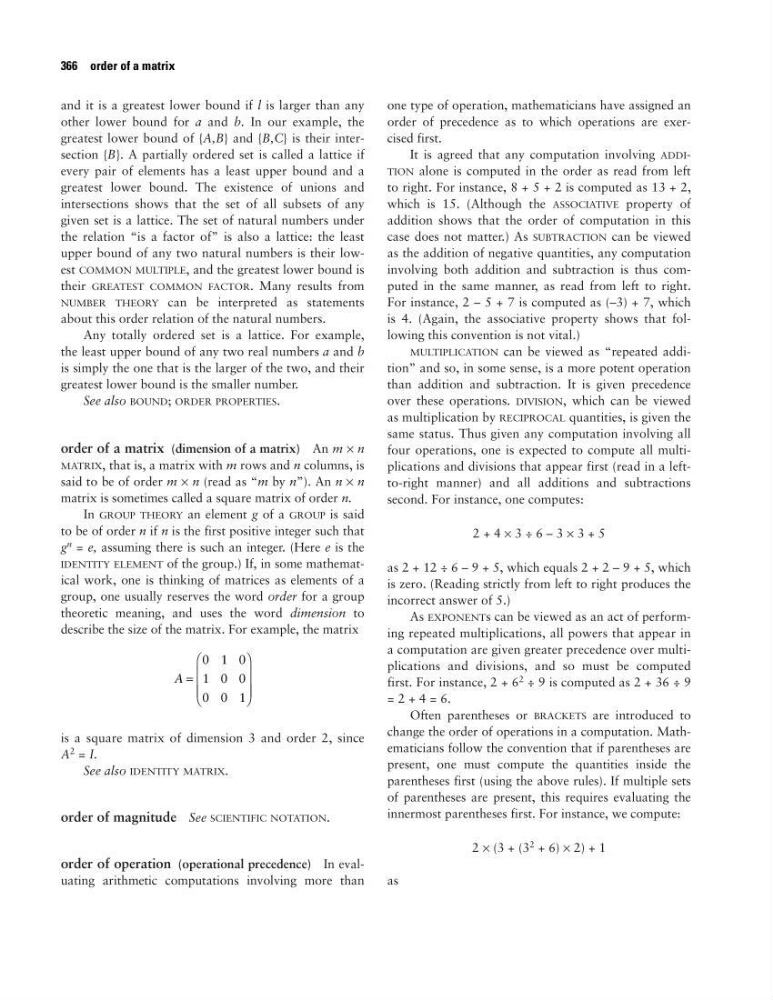
describe the size of the matrix. For example, the matrix
is a square matrix of dimension 3 and order 2, since
A
2 = I.
See also IDENTITY MATRIX.
order of magnitude See SCIENTIFIC NOTATION.
order of operation (operational precedence) In evaluating arithmetic computations involving more than
one type of operation, mathematicians have assigned an
order of precedence as to which operations are exercised first.
It is agreed that any computation involving ADDITION alone is computed in the order as read from left
to right. For instance, 8 + 5 + 2 is computed as 13 + 2,
which is 15. (Although the ASSOCIATIVE property of
addition shows that the order of computation in this
case does not matter.) As SUBTRACTION can be viewed
as the addition of negative quantities, any computation
involving both addition and subtraction is thus computed in the same manner, as read from left to right.
For instance, 2 – 5 + 7 is computed as (–3) + 7, which
is 4. (Again, the associative property shows that following this convention is not vital.)
MULTIPLICATION can be viewed as “repeated addition” and so, in some sense, is a more potent operation
than addition and subtraction. It is given precedence
over these operations. DIVISION, which can be viewed
as multiplication by RECIPROCAL quantities, is given the
same status. Thus given any computation involving all
four operations, one is expected to compute all multiplications and divisions that appear first (read in a leftto-right manner) and all additions and subtractions
second. For instance, one computes:
2 + 4 × 3 ÷ 6 – 3 × 3 + 5
as 2 + 12 ÷ 6 – 9 + 5, which equals 2 + 2 – 9 + 5, which
is zero. (Reading strictly from left to right produces the
incorrect answer of 5.)
As EXPONENTs can be viewed as an act of performing repeated multiplications, all powers that appear in
a computation are given greater precedence over multiplications and divisions, and so must be computed
first. For instance, 2 + 6
2 ÷ 9 is computed as 2 + 36 ÷ 9
= 2 + 4 = 6.
Often parentheses or BRACKETS are introduced to
change the order of operations in a computation. Mathematicians follow the convention that if parentheses are
present, one must compute the quantities inside the
parentheses first (using the above rules). If multiple sets
of parentheses are present, this requires evaluating the
innermost parentheses first. For instance, we compute:
2 × (3 + (3
2 + 6) × 2) + 1
as
A =
0 1 0
1 0 0
0 0 1
366 order of a matrix
other lower bound for a and b. In our example, the
greatest lower bound of {A,B} and {B,C} is their intersection {B}. A partially ordered set is called a lattice if
every pair of elements has a least upper bound and a
greatest lower bound. The existence of unions and
intersections shows that the set of all subsets of any
given set is a lattice. The set of natural numbers under
the relation “is a factor of” is also a lattice: the least
upper bound of any two natural numbers is their lowest COMMON MULTIPLE, and the greatest lower bound is
their GREATEST COMMON FACTOR. Many results from
NUMBER THEORY can be interpreted as statements
about this order relation of the natural numbers.
Any totally ordered set is a lattice. For example,
the least upper bound of any two real numbers a and b
is simply the one that is the larger of the two, and their
greatest lower bound is the smaller number.
See also BOUND; ORDER PROPERTIES.
order of a matrix (dimension of a matrix) An m × n
MATRIX, that is, a matrix with m rows and n columns, is
said to be of order m × n (read as “m by n”). An n × n
matrix is sometimes called a square matrix of order n.
In GROUP THEORY an element g of a GROUP is said
to be of order n if n is the first positive integer such that
g
n = e, assuming there is such an integer. (Here e is the
IDENTITY ELEMENT of the group.) If, in some mathematical work, one is thinking of matrices as elements of a
group, one usually reserves the word order for a group
theoretic meaning, and uses the word dimension to
describe the size of the matrix. For example, the matrix
is a square matrix of dimension 3 and order 2, since
A
2 = I.
See also IDENTITY MATRIX.
order of magnitude See SCIENTIFIC NOTATION.
order of operation (operational precedence) In evaluating arithmetic computations involving more than
one type of operation, mathematicians have assigned an
order of precedence as to which operations are exercised first.
It is agreed that any computation involving ADDITION alone is computed in the order as read from left
to right. For instance, 8 + 5 + 2 is computed as 13 + 2,
which is 15. (Although the ASSOCIATIVE property of
addition shows that the order of computation in this
case does not matter.) As SUBTRACTION can be viewed
as the addition of negative quantities, any computation
involving both addition and subtraction is thus computed in the same manner, as read from left to right.
For instance, 2 – 5 + 7 is computed as (–3) + 7, which
is 4. (Again, the associative property shows that following this convention is not vital.)
MULTIPLICATION can be viewed as “repeated addition” and so, in some sense, is a more potent operation
than addition and subtraction. It is given precedence
over these operations. DIVISION, which can be viewed
as multiplication by RECIPROCAL quantities, is given the
same status. Thus given any computation involving all
four operations, one is expected to compute all multiplications and divisions that appear first (read in a leftto-right manner) and all additions and subtractions
second. For instance, one computes:
2 + 4 × 3 ÷ 6 – 3 × 3 + 5
as 2 + 12 ÷ 6 – 9 + 5, which equals 2 + 2 – 9 + 5, which
is zero. (Reading strictly from left to right produces the
incorrect answer of 5.)
As EXPONENTs can be viewed as an act of performing repeated multiplications, all powers that appear in
a computation are given greater precedence over multiplications and divisions, and so must be computed
first. For instance, 2 + 6
2 ÷ 9 is computed as 2 + 36 ÷ 9
= 2 + 4 = 6.
Often parentheses or BRACKETS are introduced to
change the order of operations in a computation. Mathematicians follow the convention that if parentheses are
present, one must compute the quantities inside the
parentheses first (using the above rules). If multiple sets
of parentheses are present, this requires evaluating the
innermost parentheses first. For instance, we compute:
2 × (3 + (3
2 + 6) × 2) + 1
as
A =
0 1 0
1 0 0
0 0 1
366 order of a matrix