

never, as he hoped he would, found workable algebraic
techniques. Nonetheless, Khayyám did manage to classify
all cubic equations and was the first to recognize that
such equations might possess two different solutions. (It
is not clear whether or not Khayyám understood that
cubics might, in fact, possess three distinct solutions.)
Much of Khayyám’s work on NUMBER THEORY and
methods of numerical computation has been lost. His
development of PASCAL’S TRIANGLE, as it is called today,
and its use in the BINOMIAL THEOREM, for instance, are
only mentioned in passing in his famous algebraic work.
Khayyám also wrote about the founding principles of
geometry. He tried to establish that the famous PARALLEL
POSTULATE is a consequence of other postulates (failing,
of course), but did discover along the way a number of
significant results about non-Euclidean figures. He is
best remembered for his contributions to algebra.
Khayyám died in the city of Nishapur, Persia (now
Iran), ca. December 4, 1122.
operation Any mechanistic procedure on the elements of a set that produces a unique result for those
elements is called an operation on that set. For example, addition is an operation on the set of integers: for
any collection of integers there is a unique value called
their sum. The act of finding the union of two sets is an
operation on the collection of all sets.
A UNARY OPERATION is a rule that associates a
result with each element of a set S. The act of squaring
a number, for instance, is a unary operation on the set
of real numbers. A BINARY OPERATION provides a result
for every two elements of a set S. The addition of two
integers is a binary operation on the set of all integers.
In ARITHMETIC, addition, subtraction, multiplication, division, and the extraction of square roots are
called elementary operations. On the other hand, the
rule that associates with each natural number the sum
of its digits, for instance, is not elementary.
A symbol used to denote an operation is sometimes
called an operator. For instance, +, –, ×, ÷,√
–
, and log 10
are operators.
operations research (operational research, OR) The
study of the role of mathematics and STATISTICS in solving problems that arise in business, commerce, and the
production of goods and services is called operations
research. Often an OPTIMIZATION problem will arise in
any attempt to minimize costs or to maximize profits,
and techniques of LINEAR PROGRAMMING may be
required. The problem of scheduling interrelated tasks
can be analyzed via GRAPH THEORY, and the search for
a CRITICAL PATH in a schematic diagram can lead to
improved business practices. The TRAVELING-SALESMAN
PROBLEM also illustrates the role of graph theory in
determining the efficient delivery of goods. Problems
about production quality and reliability rely heavily on
techniques of statistical inference, and the mathematics
of GAME THEORY has helped businesses devise market
strategies and mutually beneficial trade practices.
opposite A side of a TRIANGLE is said to be opposite
a given angle in the triangle if that side is not one of the
arms forming the angle. For example, the side opposite
the largest angle in a triangle is the longest side of the
triangle. (This follows from the LAW OF COSINES.)
Two lines intersecting at a point (often called the
vertex) form four angles. Any pair of angles sharing this
vertex, but having no arm in common, is called a pair of
opposite or vertical angles. They have the same measure.
If a geometric figure has a center of symmetry, then
two sides or two angles are said to be opposite if they
are joined by a line through this center.
optimization The process of finding the best possible solution to a problem is called optimization. In
364 operation
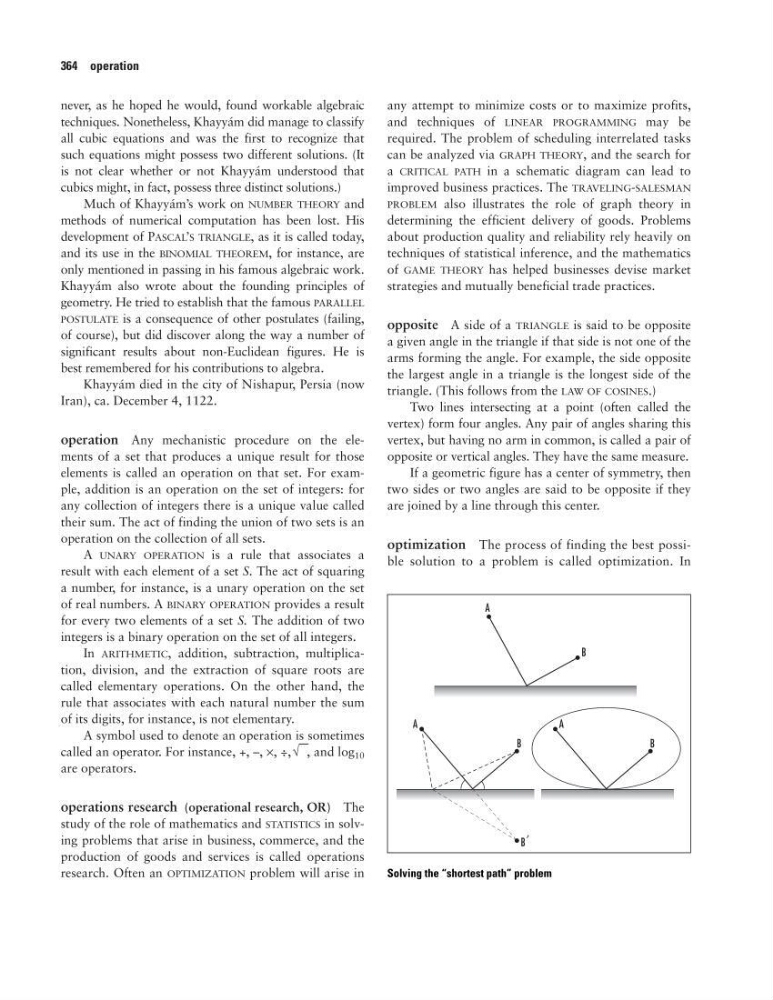
Solving the “shortest path” problem
techniques. Nonetheless, Khayyám did manage to classify
all cubic equations and was the first to recognize that
such equations might possess two different solutions. (It
is not clear whether or not Khayyám understood that
cubics might, in fact, possess three distinct solutions.)
Much of Khayyám’s work on NUMBER THEORY and
methods of numerical computation has been lost. His
development of PASCAL’S TRIANGLE, as it is called today,
and its use in the BINOMIAL THEOREM, for instance, are
only mentioned in passing in his famous algebraic work.
Khayyám also wrote about the founding principles of
geometry. He tried to establish that the famous PARALLEL
POSTULATE is a consequence of other postulates (failing,
of course), but did discover along the way a number of
significant results about non-Euclidean figures. He is
best remembered for his contributions to algebra.
Khayyám died in the city of Nishapur, Persia (now
Iran), ca. December 4, 1122.
operation Any mechanistic procedure on the elements of a set that produces a unique result for those
elements is called an operation on that set. For example, addition is an operation on the set of integers: for
any collection of integers there is a unique value called
their sum. The act of finding the union of two sets is an
operation on the collection of all sets.
A UNARY OPERATION is a rule that associates a
result with each element of a set S. The act of squaring
a number, for instance, is a unary operation on the set
of real numbers. A BINARY OPERATION provides a result
for every two elements of a set S. The addition of two
integers is a binary operation on the set of all integers.
In ARITHMETIC, addition, subtraction, multiplication, division, and the extraction of square roots are
called elementary operations. On the other hand, the
rule that associates with each natural number the sum
of its digits, for instance, is not elementary.
A symbol used to denote an operation is sometimes
called an operator. For instance, +, –, ×, ÷,√
–
, and log 10
are operators.
operations research (operational research, OR) The
study of the role of mathematics and STATISTICS in solving problems that arise in business, commerce, and the
production of goods and services is called operations
research. Often an OPTIMIZATION problem will arise in
any attempt to minimize costs or to maximize profits,
and techniques of LINEAR PROGRAMMING may be
required. The problem of scheduling interrelated tasks
can be analyzed via GRAPH THEORY, and the search for
a CRITICAL PATH in a schematic diagram can lead to
improved business practices. The TRAVELING-SALESMAN
PROBLEM also illustrates the role of graph theory in
determining the efficient delivery of goods. Problems
about production quality and reliability rely heavily on
techniques of statistical inference, and the mathematics
of GAME THEORY has helped businesses devise market
strategies and mutually beneficial trade practices.
opposite A side of a TRIANGLE is said to be opposite
a given angle in the triangle if that side is not one of the
arms forming the angle. For example, the side opposite
the largest angle in a triangle is the longest side of the
triangle. (This follows from the LAW OF COSINES.)
Two lines intersecting at a point (often called the
vertex) form four angles. Any pair of angles sharing this
vertex, but having no arm in common, is called a pair of
opposite or vertical angles. They have the same measure.
If a geometric figure has a center of symmetry, then
two sides or two angles are said to be opposite if they
are joined by a line through this center.
optimization The process of finding the best possible solution to a problem is called optimization. In
364 operation
Solving the “shortest path” problem