

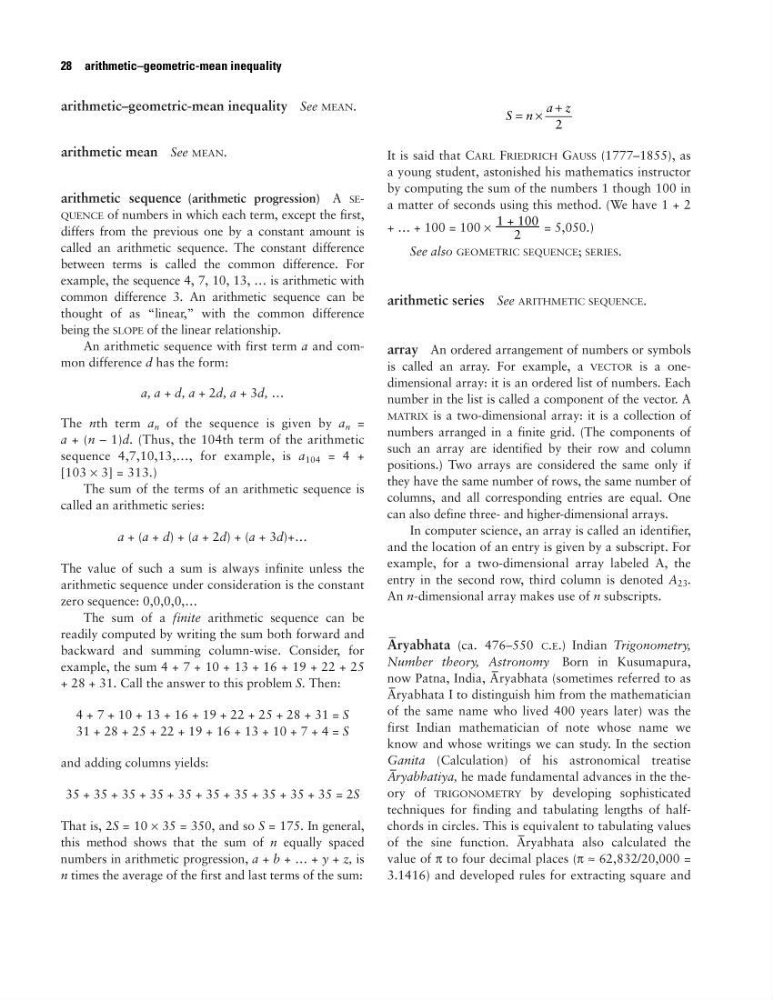
arithmetic–geometric-mean inequality See MEAN.
arithmetic mean See MEAN.
arithmetic sequence (arithmetic progression) A SEQUENCE of numbers in which each term, except the first,
differs from the previous one by a constant amount is
called an arithmetic sequence. The constant difference
between terms is called the common difference. For
example, the sequence 4, 7, 10, 13, … is arithmetic with
common difference 3. An arithmetic sequence can be
thought of as “linear,” with the common difference
being the SLOPE of the linear relationship.
An arithmetic sequence with first term a and common difference d has the form:
a, a + d, a + 2d, a + 3d, …
The nth term a n of the sequence is given by a n =
a + (n – 1)d. (Thus, the 104th term of the arithmetic
sequence 4,7,10,13,…, for example, is a 104 = 4 +
[103 × 3] = 313.)
The sum of the terms of an arithmetic sequence is
called an arithmetic series:
a + (a + d) + (a + 2d) + (a + 3d)+…
The value of such a sum is always infinite unless the
arithmetic sequence under consideration is the constant
zero sequence: 0,0,0,0,…
The sum of a finite arithmetic sequence can be
readily computed by writing the sum both forward and
backward and summing column-wise. Consider, for
example, the sum 4 + 7 + 10 + 13 + 16 + 19 + 22 + 25
+ 28 + 31. Call the answer to this problem S. Then:
4 + 7 + 10 + 13 + 16 + 19 + 22 + 25 + 28 + 31 = S
31 + 28 + 25 + 22 + 19 + 16 + 13 + 10 + 7 + 4 = S
and adding columns yields:
35 + 35 + 35 + 35 + 35 + 35 + 35 + 35 + 35 + 35 = 2S
That is, 2S = 10 × 35 = 350, and so S = 175. In general,
this method shows that the sum of n equally spaced
numbers in arithmetic progression, a + b + … + y + z, is
n times the average of the first and last terms of the sum:
It is said that CARL FRIEDRICH GAUSS (1777–1855), as
a young student, astonished his mathematics instructor
by computing the sum of the numbers 1 though 100 in
a matter of seconds using this method. (We have 1 + 2
+ … + 100 = 100 ×
= 5,050.)
See also GEOMETRIC SEQUENCE; SERIES.
arithmetic series See ARITHMETIC SEQUENCE.
array An ordered arrangement of numbers or symbols
is called an array. For example, a VECTOR is a onedimensional array: it is an ordered list of numbers. Each
number in the list is called a component of the vector. A
MATRIX is a two-dimensional array: it is a collection of
numbers arranged in a finite grid. (The components of
such an array are identified by their row and column
positions.) Two arrays are considered the same only if
they have the same number of rows, the same number of
columns, and all corresponding entries are equal. One
can also define three- and higher-dimensional arrays.
In computer science, an array is called an identifier,
and the location of an entry is given by a subscript. For
example, for a two-dimensional array labeled A, the
entry in the second row, third column is denoted A 23 .
An n-dimensional array makes use of n subscripts.
A
_
ryabhata (ca. 476–550 C.E.) Indian Trigonometry,
Number theory, Astronomy Born in Kusumapura,
now Patna, India, A
– ryabhata (sometimes referred to as
A
– ryabhata I to distinguish him from the mathematician
of the same name who lived 400 years later) was the
first Indian mathematician of note whose name we
know and whose writings we can study. In the section
Ganita (Calculation) of his astronomical treatise
A
–
ryabhatiya, he made fundamental advances in the theory of TRIGONOMETRY by developing sophisticated
techniques for finding and tabulating lengths of halfchords in circles. This is equivalent to tabulating values
of the sine function. A
– ryabhata also calculated the
value of π to four decimal places (π ≈ 62,832/20,000 =
3.1416) and developed rules for extracting square and
1 + 100
2
S n
a z
= ×
+
2
28 arithmetic–geometric-mean inequality
arithmetic mean See MEAN.
arithmetic sequence (arithmetic progression) A SEQUENCE of numbers in which each term, except the first,
differs from the previous one by a constant amount is
called an arithmetic sequence. The constant difference
between terms is called the common difference. For
example, the sequence 4, 7, 10, 13, … is arithmetic with
common difference 3. An arithmetic sequence can be
thought of as “linear,” with the common difference
being the SLOPE of the linear relationship.
An arithmetic sequence with first term a and common difference d has the form:
a, a + d, a + 2d, a + 3d, …
The nth term a n of the sequence is given by a n =
a + (n – 1)d. (Thus, the 104th term of the arithmetic
sequence 4,7,10,13,…, for example, is a 104 = 4 +
[103 × 3] = 313.)
The sum of the terms of an arithmetic sequence is
called an arithmetic series:
a + (a + d) + (a + 2d) + (a + 3d)+…
The value of such a sum is always infinite unless the
arithmetic sequence under consideration is the constant
zero sequence: 0,0,0,0,…
The sum of a finite arithmetic sequence can be
readily computed by writing the sum both forward and
backward and summing column-wise. Consider, for
example, the sum 4 + 7 + 10 + 13 + 16 + 19 + 22 + 25
+ 28 + 31. Call the answer to this problem S. Then:
4 + 7 + 10 + 13 + 16 + 19 + 22 + 25 + 28 + 31 = S
31 + 28 + 25 + 22 + 19 + 16 + 13 + 10 + 7 + 4 = S
and adding columns yields:
35 + 35 + 35 + 35 + 35 + 35 + 35 + 35 + 35 + 35 = 2S
That is, 2S = 10 × 35 = 350, and so S = 175. In general,
this method shows that the sum of n equally spaced
numbers in arithmetic progression, a + b + … + y + z, is
n times the average of the first and last terms of the sum:
It is said that CARL FRIEDRICH GAUSS (1777–1855), as
a young student, astonished his mathematics instructor
by computing the sum of the numbers 1 though 100 in
a matter of seconds using this method. (We have 1 + 2
+ … + 100 = 100 ×
= 5,050.)
See also GEOMETRIC SEQUENCE; SERIES.
arithmetic series See ARITHMETIC SEQUENCE.
array An ordered arrangement of numbers or symbols
is called an array. For example, a VECTOR is a onedimensional array: it is an ordered list of numbers. Each
number in the list is called a component of the vector. A
MATRIX is a two-dimensional array: it is a collection of
numbers arranged in a finite grid. (The components of
such an array are identified by their row and column
positions.) Two arrays are considered the same only if
they have the same number of rows, the same number of
columns, and all corresponding entries are equal. One
can also define three- and higher-dimensional arrays.
In computer science, an array is called an identifier,
and the location of an entry is given by a subscript. For
example, for a two-dimensional array labeled A, the
entry in the second row, third column is denoted A 23 .
An n-dimensional array makes use of n subscripts.
A
_
ryabhata (ca. 476–550 C.E.) Indian Trigonometry,
Number theory, Astronomy Born in Kusumapura,
now Patna, India, A
– ryabhata (sometimes referred to as
A
– ryabhata I to distinguish him from the mathematician
of the same name who lived 400 years later) was the
first Indian mathematician of note whose name we
know and whose writings we can study. In the section
Ganita (Calculation) of his astronomical treatise
A
–
ryabhatiya, he made fundamental advances in the theory of TRIGONOMETRY by developing sophisticated
techniques for finding and tabulating lengths of halfchords in circles. This is equivalent to tabulating values
of the sine function. A
– ryabhata also calculated the
value of π to four decimal places (π ≈ 62,832/20,000 =
3.1416) and developed rules for extracting square and
1 + 100
2
S n
a z
= ×
+
2
28 arithmetic–geometric-mean inequality