

An argument that does not lead to a tautology in
symbolic logic is invalid. For example,
If a bird is a crow, then it is black.
This bird is black.
Therefore it is a crow.
is an invalid argument: ((p → q) q) → p is not a tautology. (Informally, we can assert that a black bird need
not be a crow.)
The following table contains the standard forms of
argument commonly used, along with some invalid
arguments commonly used in error.
In the mid-1700s LEONHARD EULER invented an
elegant way to determine the validity of syllogisms, that
is, arguments whose premises contain the words all,
some, or no. For example,
All poodles are dogs.
All dogs bark.
Therefore all poodles bark.
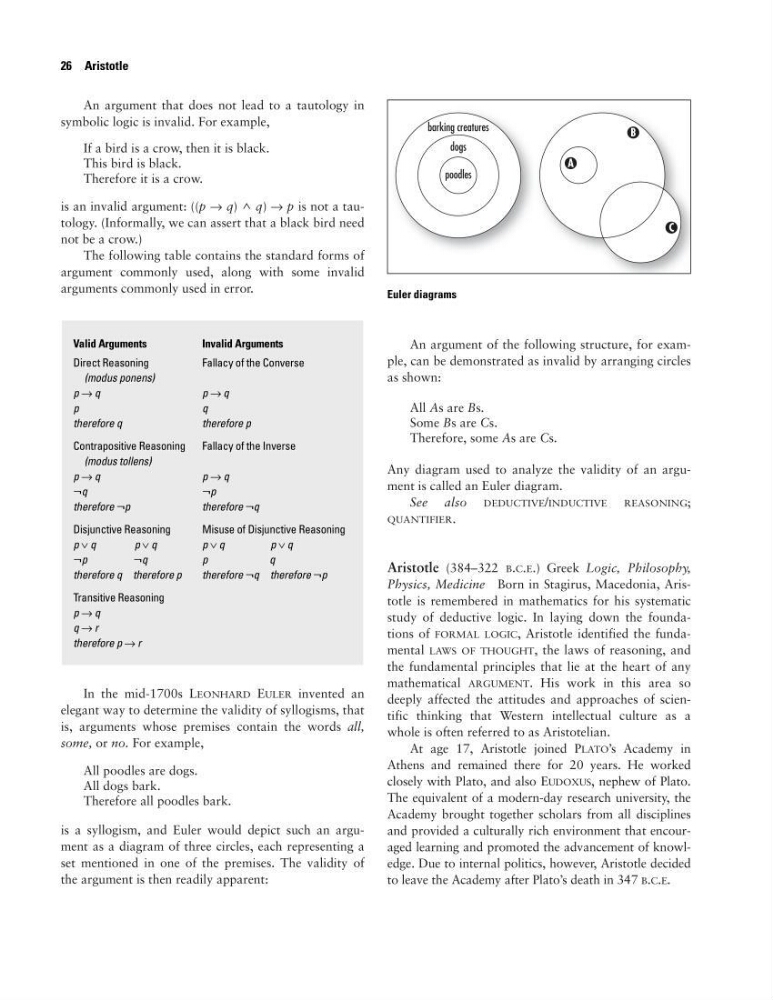
is a syllogism, and Euler would depict such an argument as a diagram of three circles, each representing a
set mentioned in one of the premises. The validity of
the argument is then readily apparent:
An argument of the following structure, for example, can be demonstrated as invalid by arranging circles
as shown:
All As are Bs.
Some Bs are Cs.
Therefore, some As are Cs.
Any diagram used to analyze the validity of an argument is called an Euler diagram.
See also DEDUCTIVE/INDUCTIVE REASONING;
QUANTIFIER.
Aristotle (384–322 B.C.E.) Greek Logic, Philosophy,
Physics, Medicine Born in Stagirus, Macedonia, Aristotle is remembered in mathematics for his systematic
study of deductive logic. In laying down the foundations of FORMAL LOGIC, Aristotle identified the fundamental LAWS OF THOUGHT, the laws of reasoning, and
the fundamental principles that lie at the heart of any
mathematical ARGUMENT. His work in this area so
deeply affected the attitudes and approaches of scientific thinking that Western intellectual culture as a
whole is often referred to as Aristotelian.
At age 17, Aristotle joined PLATO’s Academy in
Athens and remained there for 20 years. He worked
closely with Plato, and also EUDOXUS, nephew of Plato.
The equivalent of a modern-day research university, the
Academy brought together scholars from all disciplines
and provided a culturally rich environment that encouraged learning and promoted the advancement of knowledge. Due to internal politics, however, Aristotle decided
to leave the Academy after Plato’s death in 347 B.C.E.
Valid Arguments
Invalid Arguments
Direct Reasoning
Fallacy of the Converse
(modus ponens)
p → q
p → q
p
q
therefore q
therefore p
Contrapositive Reasoning Fallacy of the Inverse
(modus tollens)
p → q
p → q
¬q
¬p
therefore ¬p
therefore ¬q
Disjunctive Reasoning
Misuse of Disjunctive Reasoning
p ∨ q
p∨ q
p∨ q
p∨ q
¬p
¬q
p
q
therefore q therefore p
therefore ¬q therefore ¬p
Transitive Reasoning
p → q
q → r
therefore p → r
∨
26 Aristotle
Euler diagrams
symbolic logic is invalid. For example,
If a bird is a crow, then it is black.
This bird is black.
Therefore it is a crow.
is an invalid argument: ((p → q) q) → p is not a tautology. (Informally, we can assert that a black bird need
not be a crow.)
The following table contains the standard forms of
argument commonly used, along with some invalid
arguments commonly used in error.
In the mid-1700s LEONHARD EULER invented an
elegant way to determine the validity of syllogisms, that
is, arguments whose premises contain the words all,
some, or no. For example,
All poodles are dogs.
All dogs bark.
Therefore all poodles bark.
is a syllogism, and Euler would depict such an argument as a diagram of three circles, each representing a
set mentioned in one of the premises. The validity of
the argument is then readily apparent:
An argument of the following structure, for example, can be demonstrated as invalid by arranging circles
as shown:
All As are Bs.
Some Bs are Cs.
Therefore, some As are Cs.
Any diagram used to analyze the validity of an argument is called an Euler diagram.
See also DEDUCTIVE/INDUCTIVE REASONING;
QUANTIFIER.
Aristotle (384–322 B.C.E.) Greek Logic, Philosophy,
Physics, Medicine Born in Stagirus, Macedonia, Aristotle is remembered in mathematics for his systematic
study of deductive logic. In laying down the foundations of FORMAL LOGIC, Aristotle identified the fundamental LAWS OF THOUGHT, the laws of reasoning, and
the fundamental principles that lie at the heart of any
mathematical ARGUMENT. His work in this area so
deeply affected the attitudes and approaches of scientific thinking that Western intellectual culture as a
whole is often referred to as Aristotelian.
At age 17, Aristotle joined PLATO’s Academy in
Athens and remained there for 20 years. He worked
closely with Plato, and also EUDOXUS, nephew of Plato.
The equivalent of a modern-day research university, the
Academy brought together scholars from all disciplines
and provided a culturally rich environment that encouraged learning and promoted the advancement of knowledge. Due to internal politics, however, Aristotle decided
to leave the Academy after Plato’s death in 347 B.C.E.
Valid Arguments
Invalid Arguments
Direct Reasoning
Fallacy of the Converse
(modus ponens)
p → q
p → q
p
q
therefore q
therefore p
Contrapositive Reasoning Fallacy of the Inverse
(modus tollens)
p → q
p → q
¬q
¬p
therefore ¬p
therefore ¬q
Disjunctive Reasoning
Misuse of Disjunctive Reasoning
p ∨ q
p∨ q
p∨ q
p∨ q
¬p
¬q
p
q
therefore q therefore p
therefore ¬q therefore ¬p
Transitive Reasoning
p → q
q → r
therefore p → r
∨
26 Aristotle
Euler diagrams