

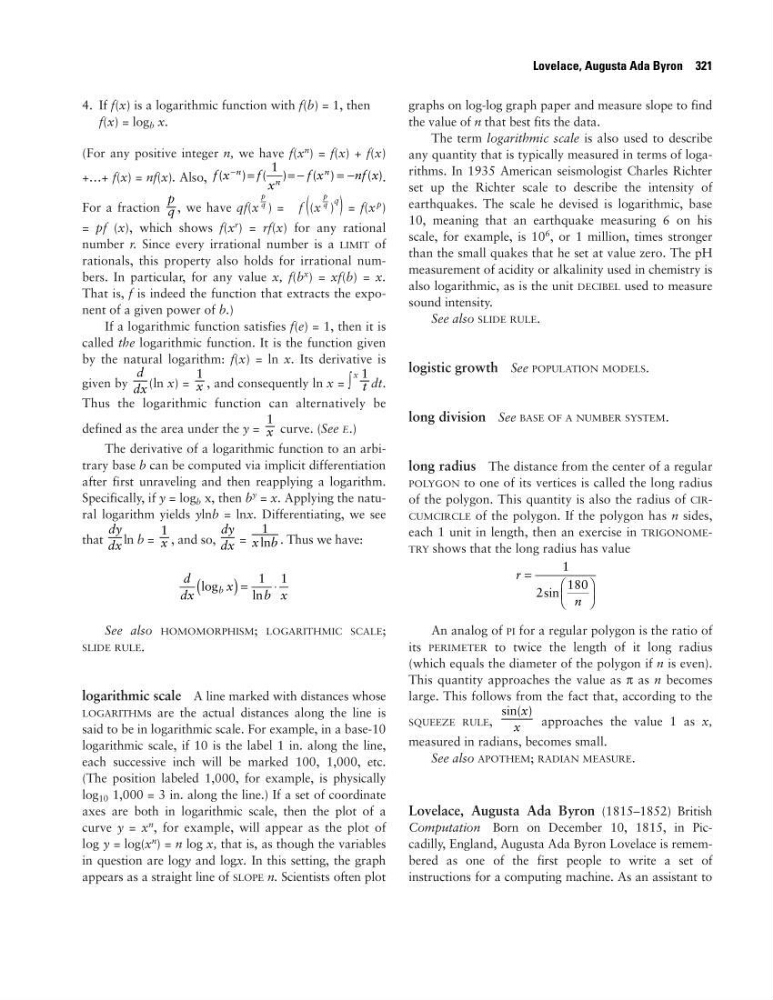
4. If f(x) is a logarithmic function with f(b) = 1, then
f(x) = log b x.
(For any positive integer n, we have f(x
n
) = f(x) + f(x)
+…+ f(x) = nf(x). Also,
.
For a fraction , we have qf(x ) = f ((x )
q
) = f(x
p
)
= pf (x), which shows f(x
r
) = rf(x) for any rational
number r. Since every irrational number is a LIMIT of
rationals, this property also holds for irrational numbers. In particular, for any value x, f(b
x
) = xf(b) = x.
That is, f is indeed the function that extracts the exponent of a given power of b.)
If a logarithmic function satisfies f(e) = 1, then it is
called the logarithmic function. It is the function given
by the natural logarithm: f(x) = ln x. Its derivative is
given by
(ln x) = , and consequently ln x = ∫
x dt.
Thus the logarithmic function can alternatively be
defined as the area under the y =
curve. (See E.)
The derivative of a logarithmic function to an arbitrary base b can be computed via implicit differentiation
after first unraveling and then reapplying a logarithm.
Specifically, if y = log b x, then b
y = x. Applying the natural logarithm yields ylnb = lnx. Differentiating, we see
that
ln b = , and so,
=
. Thus we have:
See also HOMOMORPHISM; LOGARITHMIC SCALE;
SLIDE RULE.
logarithmic scale A line marked with distances whose
LOGARITHMs are the actual distances along the line is
said to be in logarithmic scale. For example, in a base-10
logarithmic scale, if 10 is the label 1 in. along the line,
each successive inch will be marked 100, 1,000, etc.
(The position labeled 1,000, for example, is physically
log 10 1,000 = 3 in. along the line.) If a set of coordinate
axes are both in logarithmic scale, then the plot of a
curve y = x
n , for example, will appear as the plot of
log y = log(x
n
) = n log x, that is, as though the variables
in question are logy and logx. In this setting, the graph
appears as a straight line of SLOPE n. Scientists often plot
graphs on log-log graph paper and measure slope to find
the value of n that best fits the data.
The term logarithmic scale is also used to describe
any quantity that is typically measured in terms of logarithms. In 1935 American seismologist Charles Richter
set up the Richter scale to describe the intensity of
earthquakes. The scale he devised is logarithmic, base
10, meaning that an earthquake measuring 6 on his
scale, for example, is 10
6
, or 1 million, times stronger
than the small quakes that he set at value zero. The pH
measurement of acidity or alkalinity used in chemistry is
also logarithmic, as is the unit DECIBEL used to measure
sound intensity.
See also SLIDE RULE.
logistic growth See POPULATION MODELS.
long division See BASE OF A NUMBER SYSTEM.
long radius The distance from the center of a regular
POLYGON to one of its vertices is called the long radius
of the polygon. This quantity is also the radius of CIRCUMCIRCLE of the polygon. If the polygon has n sides,
each 1 unit in length, then an exercise in TRIGONOMETRY shows that the long radius has value
An analog of PI for a regular polygon is the ratio of
its PERIMETER to twice the length of it long radius
(which equals the diameter of the polygon if n is even).
This quantity approaches the value as π as n becomes
large. This follows from the fact that, according to the
SQUEEZE RULE,
approaches the value 1 as x,
measured in radians, becomes small.
See also APOTHEM; RADIAN MEASURE.
Lovelace, Augusta Ada Byron (1815–1852) British
Computation Born on December 10, 1815, in Piccadilly, England, Augusta Ada Byron Lovelace is remembered as one of the first people to write a set of
instructions for a computing machine. As an assistant to
sin(x)
––
x
r
n
=
1
2
180
sin
d
dx
x
b x
b
log
ln
(
) = ⋅
1 1
1
–––
xlnb
dy
––
dx
1
– x
dy
––
dx
1
– x
1
– t
1
– x
d
––
dx
p
– q
p
– q
p
– q
f x
f
x
f x
nf x
n
n
n
( ) ( )
( )
( )
−
=
=−
=−
1
Lovelace, Augusta Ada Byron 321
f(x) = log b x.
(For any positive integer n, we have f(x
n
) = f(x) + f(x)
+…+ f(x) = nf(x). Also,
.
For a fraction , we have qf(x ) = f ((x )
q
) = f(x
p
)
= pf (x), which shows f(x
r
) = rf(x) for any rational
number r. Since every irrational number is a LIMIT of
rationals, this property also holds for irrational numbers. In particular, for any value x, f(b
x
) = xf(b) = x.
That is, f is indeed the function that extracts the exponent of a given power of b.)
If a logarithmic function satisfies f(e) = 1, then it is
called the logarithmic function. It is the function given
by the natural logarithm: f(x) = ln x. Its derivative is
given by
(ln x) = , and consequently ln x = ∫
x dt.
Thus the logarithmic function can alternatively be
defined as the area under the y =
curve. (See E.)
The derivative of a logarithmic function to an arbitrary base b can be computed via implicit differentiation
after first unraveling and then reapplying a logarithm.
Specifically, if y = log b x, then b
y = x. Applying the natural logarithm yields ylnb = lnx. Differentiating, we see
that
ln b = , and so,
=
. Thus we have:
See also HOMOMORPHISM; LOGARITHMIC SCALE;
SLIDE RULE.
logarithmic scale A line marked with distances whose
LOGARITHMs are the actual distances along the line is
said to be in logarithmic scale. For example, in a base-10
logarithmic scale, if 10 is the label 1 in. along the line,
each successive inch will be marked 100, 1,000, etc.
(The position labeled 1,000, for example, is physically
log 10 1,000 = 3 in. along the line.) If a set of coordinate
axes are both in logarithmic scale, then the plot of a
curve y = x
n , for example, will appear as the plot of
log y = log(x
n
) = n log x, that is, as though the variables
in question are logy and logx. In this setting, the graph
appears as a straight line of SLOPE n. Scientists often plot
graphs on log-log graph paper and measure slope to find
the value of n that best fits the data.
The term logarithmic scale is also used to describe
any quantity that is typically measured in terms of logarithms. In 1935 American seismologist Charles Richter
set up the Richter scale to describe the intensity of
earthquakes. The scale he devised is logarithmic, base
10, meaning that an earthquake measuring 6 on his
scale, for example, is 10
6
, or 1 million, times stronger
than the small quakes that he set at value zero. The pH
measurement of acidity or alkalinity used in chemistry is
also logarithmic, as is the unit DECIBEL used to measure
sound intensity.
See also SLIDE RULE.
logistic growth See POPULATION MODELS.
long division See BASE OF A NUMBER SYSTEM.
long radius The distance from the center of a regular
POLYGON to one of its vertices is called the long radius
of the polygon. This quantity is also the radius of CIRCUMCIRCLE of the polygon. If the polygon has n sides,
each 1 unit in length, then an exercise in TRIGONOMETRY shows that the long radius has value
An analog of PI for a regular polygon is the ratio of
its PERIMETER to twice the length of it long radius
(which equals the diameter of the polygon if n is even).
This quantity approaches the value as π as n becomes
large. This follows from the fact that, according to the
SQUEEZE RULE,
approaches the value 1 as x,
measured in radians, becomes small.
See also APOTHEM; RADIAN MEASURE.
Lovelace, Augusta Ada Byron (1815–1852) British
Computation Born on December 10, 1815, in Piccadilly, England, Augusta Ada Byron Lovelace is remembered as one of the first people to write a set of
instructions for a computing machine. As an assistant to
sin(x)
––
x
r
n
=
1
2
180
sin
d
dx
x
b x
b
log
ln
(
) = ⋅
1 1
1
–––
xlnb
dy
––
dx
1
– x
dy
––
dx
1
– x
1
– t
1
– x
d
––
dx
p
– q
p
– q
p
– q
f x
f
x
f x
nf x
n
n
n
( ) ( )
( )
( )
−
=
=−
=−
1
Lovelace, Augusta Ada Byron 321