

from x = 1,000,000 onwards. In fact, for any small value
ε it is possible to locate a value x = N so that all outputs
of the function from that position onward are within a
distance ε from zero. (For example, N =
will do.)
If a function f(x) has a limit value L as x becomes
large, we write: lim x→ ∞ f(x) = L. One can similarly
define the notion of a limit as x becomes large and negative: lim x→–∞ f(x) = L.
One can also consider the possibility of the outputs
of a function f(x) approaching a value L as x approaches
a finite value a. Loosely speaking, we say the “limit of
f(x) as x tends to a is L” if, as x gets closer and closer to
a, the outputs f(x) get closer and closer to L. If this is
indeed the case, we write: lim x→a f(x) = L.
To make this notion precise, we need to assume
one is given a desired degree of precision ε, and show
that it is indeed possible to specify a “degree of closeness to a” that ensures all the outputs f(x) are within a
distance ε of L. This leads to Weierstrass’s famous
epsilon-delta definition of a limit:
A function f(x) has “limit L as x tends to a” if
one can demonstrate that for any positive
number ε (no matter how small), the outputs
of the function can be made this close to L by
restricting x to values very close, but not equal,
to a. That is, one can produce a number δ so
that if x, different from a, lies between a – δ
and a + δ, then we can be sure that f(x) lies
between L – ε and L + ε.
This says that no matter which level of precision
you care to choose (ε), all outputs of the function f(x)
for values x close to a (namely, within a distance δ of a)
will be within a distance ε from L. Consider, for example, the function f(x) = 5x for values close to x = 2.
Notice that all outputs of the function are within a distance 0.1 from 10 if x is within a distance 0.02 from 2.
All outputs of the function are within a distance 0.001
from 10 if x is within a distance 0.0002 from 2. In fact,
for any small value ε, it is possible to describe a number δ so that if x is within a distance δ from 2, then
f(x) = 5x is within a distance ε from 10. (In fact, δ =
will do.) This shows lim x→2 5x = 10.
If a function f(x) is continuous at x = a, then the
limit lim x→a f(x) exists and equals f(a). This, however,
need not always be the case (in which case we say that
f is discontinuous at a).
It is sometimes convenient to describe limit “just
from the left” or “just from the right.” Written as
lim x→a – f(x), a limit from the left is defined as a value L
so that outputs of the function f(x) can be made as
close to L as we please by restricting x to values close
to and to the left of a (that is, for values of x between
a – δ and a, for some number δ). A limit from the right,
written lim x→a + f(x), is a value L so that outputs of the
function f(x) can be made as close to L as we please by
restricting x to values close to and to the right of a
(that is, for values of x between a and a + δ, for some
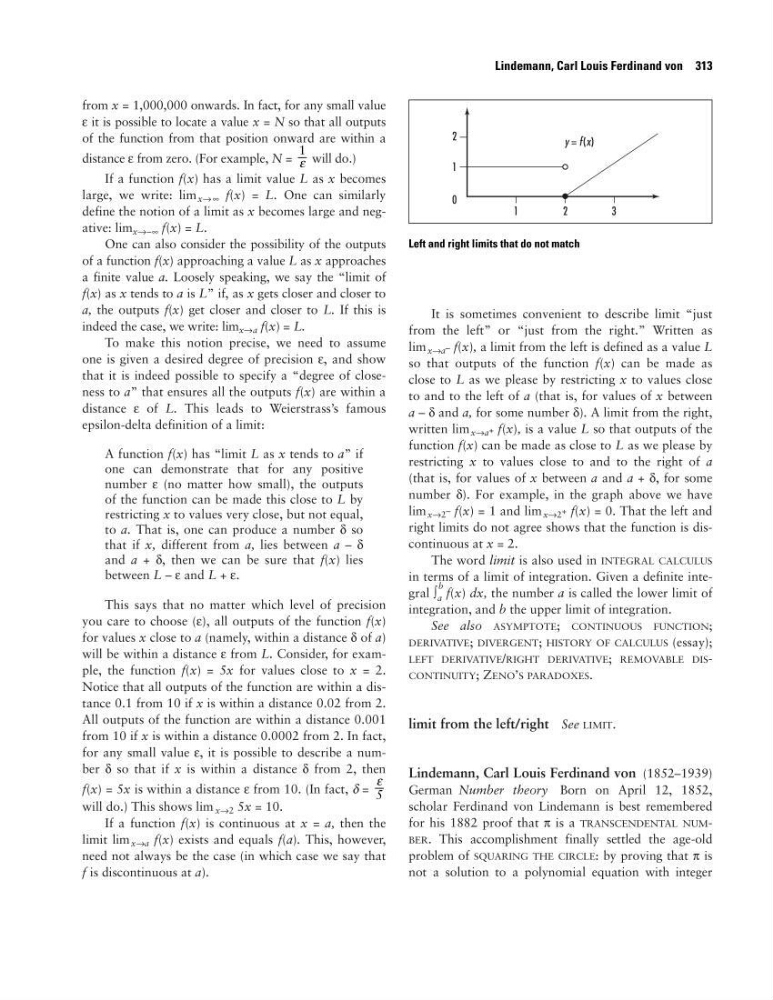
number δ). For example, in the graph above we have
lim x→2 – f(x) = 1 and lim x→2 + f(x) = 0. That the left and
right limits do not agree shows that the function is discontinuous at x = 2.
The word limit is also used in INTEGRAL CALCULUS
in terms of a limit of integration. Given a definite integral ∫
b
a f(x) dx, the number a is called the lower limit of
integration, and b the upper limit of integration.
See also ASYMPTOTE; CONTINUOUS FUNCTION;
DERIVATIVE; DIVERGENT; HISTORY OF CALCULUS (essay);
LEFT DERIVATIVE/RIGHT DERIVATIVE; REMOVABLE DISCONTINUITY; ZENO’S PARADOXES.
limit from the left/right See LIMIT.
Lindemann, Carl Louis Ferdinand von (1852–1939)
German Number theory Born on April 12, 1852,
scholar Ferdinand von Lindemann is best remembered
for his 1882 proof that π is a TRANSCENDENTAL NUMBER. This accomplishment finally settled the age-old
problem of SQUARING THE CIRCLE: by proving that π is
not a solution to a polynomial equation with integer
ε
–
5
1
– ε
Lindemann, Carl Louis Ferdinand von 313
Left and right limits that do not match
ε it is possible to locate a value x = N so that all outputs
of the function from that position onward are within a
distance ε from zero. (For example, N =
will do.)
If a function f(x) has a limit value L as x becomes
large, we write: lim x→ ∞ f(x) = L. One can similarly
define the notion of a limit as x becomes large and negative: lim x→–∞ f(x) = L.
One can also consider the possibility of the outputs
of a function f(x) approaching a value L as x approaches
a finite value a. Loosely speaking, we say the “limit of
f(x) as x tends to a is L” if, as x gets closer and closer to
a, the outputs f(x) get closer and closer to L. If this is
indeed the case, we write: lim x→a f(x) = L.
To make this notion precise, we need to assume
one is given a desired degree of precision ε, and show
that it is indeed possible to specify a “degree of closeness to a” that ensures all the outputs f(x) are within a
distance ε of L. This leads to Weierstrass’s famous
epsilon-delta definition of a limit:
A function f(x) has “limit L as x tends to a” if
one can demonstrate that for any positive
number ε (no matter how small), the outputs
of the function can be made this close to L by
restricting x to values very close, but not equal,
to a. That is, one can produce a number δ so
that if x, different from a, lies between a – δ
and a + δ, then we can be sure that f(x) lies
between L – ε and L + ε.
This says that no matter which level of precision
you care to choose (ε), all outputs of the function f(x)
for values x close to a (namely, within a distance δ of a)
will be within a distance ε from L. Consider, for example, the function f(x) = 5x for values close to x = 2.
Notice that all outputs of the function are within a distance 0.1 from 10 if x is within a distance 0.02 from 2.
All outputs of the function are within a distance 0.001
from 10 if x is within a distance 0.0002 from 2. In fact,
for any small value ε, it is possible to describe a number δ so that if x is within a distance δ from 2, then
f(x) = 5x is within a distance ε from 10. (In fact, δ =
will do.) This shows lim x→2 5x = 10.
If a function f(x) is continuous at x = a, then the
limit lim x→a f(x) exists and equals f(a). This, however,
need not always be the case (in which case we say that
f is discontinuous at a).
It is sometimes convenient to describe limit “just
from the left” or “just from the right.” Written as
lim x→a – f(x), a limit from the left is defined as a value L
so that outputs of the function f(x) can be made as
close to L as we please by restricting x to values close
to and to the left of a (that is, for values of x between
a – δ and a, for some number δ). A limit from the right,
written lim x→a + f(x), is a value L so that outputs of the
function f(x) can be made as close to L as we please by
restricting x to values close to and to the right of a
(that is, for values of x between a and a + δ, for some
number δ). For example, in the graph above we have
lim x→2 – f(x) = 1 and lim x→2 + f(x) = 0. That the left and
right limits do not agree shows that the function is discontinuous at x = 2.
The word limit is also used in INTEGRAL CALCULUS
in terms of a limit of integration. Given a definite integral ∫
b
a f(x) dx, the number a is called the lower limit of
integration, and b the upper limit of integration.
See also ASYMPTOTE; CONTINUOUS FUNCTION;
DERIVATIVE; DIVERGENT; HISTORY OF CALCULUS (essay);
LEFT DERIVATIVE/RIGHT DERIVATIVE; REMOVABLE DISCONTINUITY; ZENO’S PARADOXES.
limit from the left/right See LIMIT.
Lindemann, Carl Louis Ferdinand von (1852–1939)
German Number theory Born on April 12, 1852,
scholar Ferdinand von Lindemann is best remembered
for his 1882 proof that π is a TRANSCENDENTAL NUMBER. This accomplishment finally settled the age-old
problem of SQUARING THE CIRCLE: by proving that π is
not a solution to a polynomial equation with integer
ε
–
5
1
– ε
Lindemann, Carl Louis Ferdinand von 313
Left and right limits that do not match