

function f(x) = x + |x|, for example, at the position
The
left
derivative
(with
h
negative)
is
where
as the right derivative (with h positive) is
. The tangent line to the curve has slope zero just to the left of
x = 0 and slope 2 just to its right. This inconsistency
shows that there is no well-defined tangent line to the
graph f(x) = x + |x| at x = 0.
Legendre, Adrien-Marie (1752–1833) French Geometry, Number theory Born on September 18, 1752, in
Paris, France, Adrien-Marie Legendre is remembered as
a capable French mathematician who devoted his life to
the subject but had the unfortunate luck to see the bulk
of his work rendered obsolete by the discoveries and
abilities of younger, brighter mathematicians.
Legendre published in the fields of NUMBER THEORY,
elliptic functions, EUCLIDEAN GEOMETRY, and celestial
mechanics. His name is associated with a number of
mathematical concepts, including Legendre polynomials,
an important class of functions useful for solving certain
types of DIFFERENTIAL EQUATIONs; the LEAST SQUARES
METHOD; and the Legendre symbol in number theory.
He published an elementary geometry text, Eléments de
géométrie (Elements of geometry), which dominated the
teaching of geometry in America and Europe throughout
the 19th century. In 1791 the Académie des Sciences
undertook the task to standardize weights and measures
and directed Legendre to make the necessary astronomical observations to compute the length of a meter.
Little is known of Legendre’s early life. Born into a
family of wealth, Legendre had access to an excellent
formal education and the means to pursue scholarly
interests. In 1770 Legendre defended a thesis in mathematics and physics at the Collège Mazarin. His 1782
mathematical research on the path of projectiles earned
him an award from the Berlin Academy and garnered
him some attention as a scholar of mathematics. A year
later Legendre was appointed an adjoint position at the
Académie des Sciences in Paris, later renamed the Institut National des Sciences et des Arts. He remained
there until 1824, rising appropriately in rank and position throughout the decades. However, due to a political disagreement with the running of the Institut,
Legendre was denied a pension in his retirement and
died in poverty 9 years later on January 9, 1833.
Despite his work being seen as obsolete, Legendre
did raise a number of fundamental questions in the
fields of number theory and elliptical function theory
that spurred a great deal of mathematical investigation
during the century that followed him.
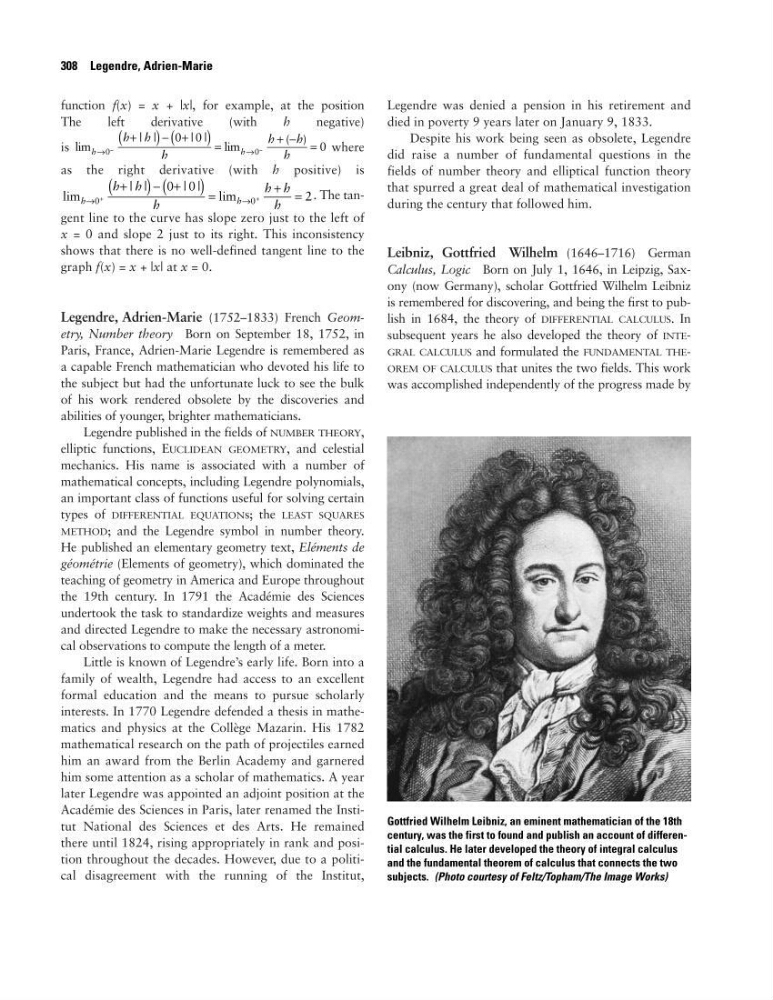
Leibniz, Gottfried Wilhelm (1646–1716) German
Calculus, Logic Born on July 1, 1646, in Leipzig, Saxony (now Germany), scholar Gottfried Wilhelm Leibniz
is remembered for discovering, and being the first to publish in 1684, the theory of DIFFERENTIAL CALCULUS. In
subsequent years he also developed the theory of INTEGRAL CALCULUS and formulated the FUNDAMENTAL THEOREM OF CALCULUS that unites the two fields. This work
was accomplished independently of the progress made by
lim
| |
| |
lim
h
h
h h
h
h h
h
→
→
+
+
+
(
) − +
(
) =
+ =
0
0
0 0
2
lim
| |
| |
lim
( )
–
–
h
h
h h
h
h
h
h
→
→
+
(
) − +
(
) =
+ − =
0
0
0 0
0
308 Legendre, Adrien-Marie
Gottfried Wilhelm Leibniz, an eminent mathematician of the 18th
century, was the first to found and publish an account of differential calculus. He later developed the theory of integral calculus
and the fundamental theorem of calculus that connects the two
subjects. (Photo courtesy of Feltz/Topham/The Image Works)
The
left
derivative
(with
h
negative)
is
where
as the right derivative (with h positive) is
. The tangent line to the curve has slope zero just to the left of
x = 0 and slope 2 just to its right. This inconsistency
shows that there is no well-defined tangent line to the
graph f(x) = x + |x| at x = 0.
Legendre, Adrien-Marie (1752–1833) French Geometry, Number theory Born on September 18, 1752, in
Paris, France, Adrien-Marie Legendre is remembered as
a capable French mathematician who devoted his life to
the subject but had the unfortunate luck to see the bulk
of his work rendered obsolete by the discoveries and
abilities of younger, brighter mathematicians.
Legendre published in the fields of NUMBER THEORY,
elliptic functions, EUCLIDEAN GEOMETRY, and celestial
mechanics. His name is associated with a number of
mathematical concepts, including Legendre polynomials,
an important class of functions useful for solving certain
types of DIFFERENTIAL EQUATIONs; the LEAST SQUARES
METHOD; and the Legendre symbol in number theory.
He published an elementary geometry text, Eléments de
géométrie (Elements of geometry), which dominated the
teaching of geometry in America and Europe throughout
the 19th century. In 1791 the Académie des Sciences
undertook the task to standardize weights and measures
and directed Legendre to make the necessary astronomical observations to compute the length of a meter.
Little is known of Legendre’s early life. Born into a
family of wealth, Legendre had access to an excellent
formal education and the means to pursue scholarly
interests. In 1770 Legendre defended a thesis in mathematics and physics at the Collège Mazarin. His 1782
mathematical research on the path of projectiles earned
him an award from the Berlin Academy and garnered
him some attention as a scholar of mathematics. A year
later Legendre was appointed an adjoint position at the
Académie des Sciences in Paris, later renamed the Institut National des Sciences et des Arts. He remained
there until 1824, rising appropriately in rank and position throughout the decades. However, due to a political disagreement with the running of the Institut,
Legendre was denied a pension in his retirement and
died in poverty 9 years later on January 9, 1833.
Despite his work being seen as obsolete, Legendre
did raise a number of fundamental questions in the
fields of number theory and elliptical function theory
that spurred a great deal of mathematical investigation
during the century that followed him.
Leibniz, Gottfried Wilhelm (1646–1716) German
Calculus, Logic Born on July 1, 1646, in Leipzig, Saxony (now Germany), scholar Gottfried Wilhelm Leibniz
is remembered for discovering, and being the first to publish in 1684, the theory of DIFFERENTIAL CALCULUS. In
subsequent years he also developed the theory of INTEGRAL CALCULUS and formulated the FUNDAMENTAL THEOREM OF CALCULUS that unites the two fields. This work
was accomplished independently of the progress made by
lim
| |
| |
lim
h
h
h h
h
h h
h
→
→
+
+
+
(
) − +
(
) =
+ =
0
0
0 0
2
lim
| |
| |
lim
( )
–
–
h
h
h h
h
h
h
h
→
→
+
(
) − +
(
) =
+ − =
0
0
0 0
0
308 Legendre, Adrien-Marie
Gottfried Wilhelm Leibniz, an eminent mathematician of the 18th
century, was the first to found and publish an account of differential calculus. He later developed the theory of integral calculus
and the fundamental theorem of calculus that connects the two
subjects. (Photo courtesy of Feltz/Topham/The Image Works)