

Archytas lived in southern Italy during the time of
Greek control. The region, then called Magna Graecia,
included the town of Tarentum, which was home to
members of the Pythagorean sect. Like the Pythagoreans, Archytas believed that mathematics provided the
path to understanding all things. However, much to
the disgust of the Pythagoreans, Archytas applied his
mathematical skills to solve practical problems. He is
sometimes referred to as the Founder of Mechanics
and is said to have invented several innovative mechanical devices, including a mechanical bird and an
innovative child’s rattle.
Only fragments of Archytas’s original work survive
today, and we learn of his mathematics today chiefly
through the writings of later scholars. Many results
established by Archytas appear in EUCLID’s famous text
THE ELEMENTS, for instance.
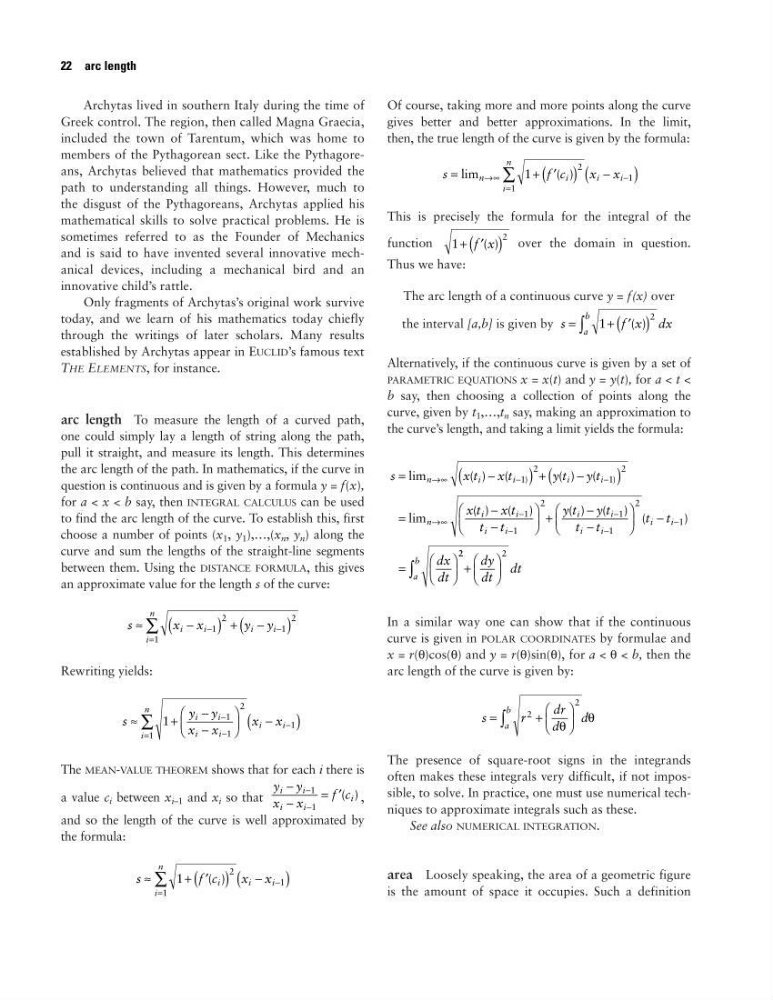
arc length To measure the length of a curved path,
one could simply lay a length of string along the path,
pull it straight, and measure its length. This determines
the arc length of the path. In mathematics, if the curve in
question is continuous and is given by a formula y = f(x),
for a < x < b say, then INTEGRAL CALCULUS can be used
to find the arc length of the curve. To establish this, first
choose a number of points (x 1 , y 1 ),…,(x n , y n ) along the
curve and sum the lengths of the straight-line segments
between them. Using the DISTANCE FORMULA, this gives
an approximate value for the length s of the curve:
Rewriting yields:
The MEAN-VALUE THEOREM shows that for each i there is
a value c i between x i–1 and x i so that
,
and so the length of the curve is well approximated by
the formula:
Of course, taking more and more points along the curve
gives better and better approximations. In the limit,
then, the true length of the curve is given by the formula:
This is precisely the formula for the integral of the
function
over the domain in question.
Thus we have:
The arc length of a continuous curve y = f(x) over
the interval [a,b] is given by
Alternatively, if the continuous curve is given by a set of
PARAMETRIC EQUATIONS x = x(t) and y = y(t), for a < t <
b say, then choosing a collection of points along the
curve, given by t 1 ,…,t n say, making an approximation to
the curve’s length, and taking a limit yields the formula:
In a similar way one can show that if the continuous
curve is given in POLAR COORDINATES by formulae and
x = r(θ)cos(θ) and y = r(θ)sin(θ), for a < θ < b, then the
arc length of the curve is given by:
The presence of square-root signs in the integrands
often makes these integrals very difficult, if not impossible, to solve. In practice, one must use numerical techniques to approximate integrals such as these.
See also NUMERICAL INTEGRATION.
area Loosely speaking, the area of a geometric figure
is the amount of space it occupies. Such a definition
s
r
dr
d
d
a
b
=
+
⎛
⎝
⎜
⎞
⎠
⎟
∫
2
2
θ
θ
s
xt
xt
yt
yt
x t
x t
t t
y t
y t
t t
t t
dx
dt
n
i
i
i
i
n
i
i
i
i
i
i
i
i
i
i
=
−
(
) +
−
(
)
=
−
−
⎛
⎝
⎜
⎞
⎠
⎟ +
−
−
⎛
⎝
⎜
⎞
⎠
⎟
−
=
⎛
⎝
⎜
⎞
⎠
⎟
→∞
−
−
→∞
−
−
−
−
−
lim
( ) (
( ) (
lim
( ) ( )
( ) ( ) (
)
)
)
1
2
1
2
1
1
2
1
1
2
1
2 2
2
+
⎛
⎝
⎜
⎞
⎠
⎟
∫
dy
dt
dt
a
b
s
f x d x
a
b
=
+ ′
( )
∫ 1
2
( )
1
2
+ ′
( )
f x
( )
s
fc
x x
n
i
i
n
i
i
=
+ ′
( ) −
(
)
→∞
=
−
∑
lim
( )
1
2
1
1
s
f c
x x
i
i
n
i
i
≈
+ ′
( ) −
(
)
=
−
∑ 1
2
1
1
( )
y y
x x
f c
i
i
i
i
i
−
−
= ′
−
−
1
1
( )
s
y y
x x
x x
i
i
i
i
i
n
i
i
≈
+
−
−
⎛
⎝
⎜
⎞
⎠
⎟
−
(
)
−
−
=
−
∑ 1
1
1
2
1
1
s
x x
y y
i
i
i
i
i
n
≈
−
(
) + −
(
)
−
−
=
∑
1
2
1
2
1
22 arc length
Greek control. The region, then called Magna Graecia,
included the town of Tarentum, which was home to
members of the Pythagorean sect. Like the Pythagoreans, Archytas believed that mathematics provided the
path to understanding all things. However, much to
the disgust of the Pythagoreans, Archytas applied his
mathematical skills to solve practical problems. He is
sometimes referred to as the Founder of Mechanics
and is said to have invented several innovative mechanical devices, including a mechanical bird and an
innovative child’s rattle.
Only fragments of Archytas’s original work survive
today, and we learn of his mathematics today chiefly
through the writings of later scholars. Many results
established by Archytas appear in EUCLID’s famous text
THE ELEMENTS, for instance.
arc length To measure the length of a curved path,
one could simply lay a length of string along the path,
pull it straight, and measure its length. This determines
the arc length of the path. In mathematics, if the curve in
question is continuous and is given by a formula y = f(x),
for a < x < b say, then INTEGRAL CALCULUS can be used
to find the arc length of the curve. To establish this, first
choose a number of points (x 1 , y 1 ),…,(x n , y n ) along the
curve and sum the lengths of the straight-line segments
between them. Using the DISTANCE FORMULA, this gives
an approximate value for the length s of the curve:
Rewriting yields:
The MEAN-VALUE THEOREM shows that for each i there is
a value c i between x i–1 and x i so that
,
and so the length of the curve is well approximated by
the formula:
Of course, taking more and more points along the curve
gives better and better approximations. In the limit,
then, the true length of the curve is given by the formula:
This is precisely the formula for the integral of the
function
over the domain in question.
Thus we have:
The arc length of a continuous curve y = f(x) over
the interval [a,b] is given by
Alternatively, if the continuous curve is given by a set of
PARAMETRIC EQUATIONS x = x(t) and y = y(t), for a < t <
b say, then choosing a collection of points along the
curve, given by t 1 ,…,t n say, making an approximation to
the curve’s length, and taking a limit yields the formula:
In a similar way one can show that if the continuous
curve is given in POLAR COORDINATES by formulae and
x = r(θ)cos(θ) and y = r(θ)sin(θ), for a < θ < b, then the
arc length of the curve is given by:
The presence of square-root signs in the integrands
often makes these integrals very difficult, if not impossible, to solve. In practice, one must use numerical techniques to approximate integrals such as these.
See also NUMERICAL INTEGRATION.
area Loosely speaking, the area of a geometric figure
is the amount of space it occupies. Such a definition
s
r
dr
d
d
a
b
=
+
⎛
⎝
⎜
⎞
⎠
⎟
∫
2
2
θ
θ
s
xt
xt
yt
yt
x t
x t
t t
y t
y t
t t
t t
dx
dt
n
i
i
i
i
n
i
i
i
i
i
i
i
i
i
i
=
−
(
) +
−
(
)
=
−
−
⎛
⎝
⎜
⎞
⎠
⎟ +
−
−
⎛
⎝
⎜
⎞
⎠
⎟
−
=
⎛
⎝
⎜
⎞
⎠
⎟
→∞
−
−
→∞
−
−
−
−
−
lim
( ) (
( ) (
lim
( ) ( )
( ) ( ) (
)
)
)
1
2
1
2
1
1
2
1
1
2
1
2 2
2
+
⎛
⎝
⎜
⎞
⎠
⎟
∫
dy
dt
dt
a
b
s
f x d x
a
b
=
+ ′
( )
∫ 1
2
( )
1
2
+ ′
( )
f x
( )
s
fc
x x
n
i
i
n
i
i
=
+ ′
( ) −
(
)
→∞
=
−
∑
lim
( )
1
2
1
1
s
f c
x x
i
i
n
i
i
≈
+ ′
( ) −
(
)
=
−
∑ 1
2
1
1
( )
y y
x x
f c
i
i
i
i
i
−
−
= ′
−
−
1
1
( )
s
y y
x x
x x
i
i
i
i
i
n
i
i
≈
+
−
−
⎛
⎝
⎜
⎞
⎠
⎟
−
(
)
−
−
=
−
∑ 1
1
1
2
1
1
s
x x
y y
i
i
i
i
i
n
≈
−
(
) + −
(
)
−
−
=
∑
1
2
1
2
1
22 arc length