

geometry of the PLATONIC SOLIDs, for his discovery of
two nonconvex regular polyhedra, and for his mathematical treatment of the close-packing properties of
SPHEREs. (He also explained why the honeycomb shape
is the most efficient design for dividing a planar region
into separate cells.) More importantly, Kepler devised
a method for computing the volumes of many SOLIDs
OF REVOLUTION with the aid of INFINITESIMALs. Today
this is seen as a significant contribution to the development of CALCULUS.
Kepler studied astronomy and theology at the University of Tübingen, Germany. At the time, only six
planets were known to astronomers, and all were
assumed to be in circular orbit about the Sun. In 1596
Kepler published Mysterium cosmographicum (Mystery of the cosmos), in which he presented a mathematical theory explaining the relative sizes of the planets’
orbits. Convinced that God had created the universe
according to a mathematical plan, Kepler posed that if
a sphere were drawn about the path of Saturn and a
CUBE inscribed in this sphere, then the orbit of Jupiter
lies on a sphere inscribed in this cube. Moreover,
inscribing a TETRAHEDRON in this second sphere and a
sphere within the tetrahedron captures the orbital path
of Mars. Continuing in this way, with a dodecahedron
between Mars and Earth, an icosahedron between
Earth and Venus, and an octahedron between Venus
and Mercury, Kepler produced a model for orbit sizes
that is accurate to within 10 percent of observed values, well within experimental error. As there are only
five Platonic solids, this model also explained why, supposedly, there were only six planets. Of course Kepler’s
Platonic model of the solar system is not correct—three
more planets were later discovered and, as Kepler himself later established, no orbit of a planet is circular.
Kepler moved to Prague near the turn of the century to work with one of the foremost astronomers of
the time, Tycho Brahe (1546–1601). When Brahe died,
Kepler succeeded him as imperial mathematician.
Brahe had kept extensive records on the orbit of
Mars, and from them, Kepler was forced to conclude
that its orbit was an ellipse. He also noted, from the
data, that the velocity of the planet altered in such a
way that the line connecting the Sun to the planet swept
out equal areas in equal times. These two laws, when
extended to all planets, are today called Kepler’s first
two laws. He published them in his 1609 piece Astronomia nova (New astronomy). Ten years later he added a
third law: the squares of the times taken by the planets
to complete an orbit are proportional to the cubes of
the lengths of the major axes of their elliptical orbits.
Kepler had no explanation as to why these laws
were true other than the compelling evidence of the
data. It was not until SIR ISAAC NEWTON (1642–1727)
formulated his famous law of gravitation that Kepler’s
laws could be mathematically deduced.
During his marriage ceremony in 1613 to his second wife Susanna (his first wife Barbara died in 1611),
Kepler noticed that the servants would measure the volume of a wine barrel by slipping a rod diagonally
through the bunghole and measuring the length that fit.
He began to wonder why this method worked. This led
him to his study of the solids of revolutions and the
292 Kepler, Johannes
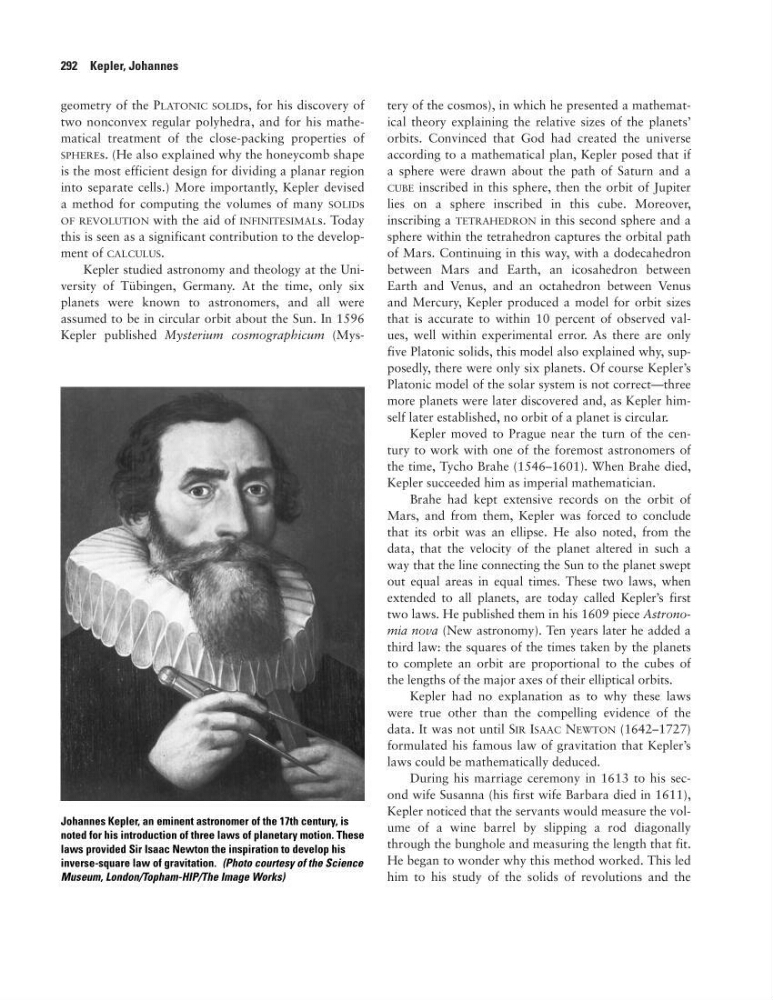
Johannes Kepler, an eminent astronomer of the 17th century, is
noted for his introduction of three laws of planetary motion. These
laws provided Sir Isaac Newton the inspiration to develop his
inverse-square law of gravitation. (Photo courtesy of the Science
Museum, London/Topham-HIP/The Image Works)
two nonconvex regular polyhedra, and for his mathematical treatment of the close-packing properties of
SPHEREs. (He also explained why the honeycomb shape
is the most efficient design for dividing a planar region
into separate cells.) More importantly, Kepler devised
a method for computing the volumes of many SOLIDs
OF REVOLUTION with the aid of INFINITESIMALs. Today
this is seen as a significant contribution to the development of CALCULUS.
Kepler studied astronomy and theology at the University of Tübingen, Germany. At the time, only six
planets were known to astronomers, and all were
assumed to be in circular orbit about the Sun. In 1596
Kepler published Mysterium cosmographicum (Mystery of the cosmos), in which he presented a mathematical theory explaining the relative sizes of the planets’
orbits. Convinced that God had created the universe
according to a mathematical plan, Kepler posed that if
a sphere were drawn about the path of Saturn and a
CUBE inscribed in this sphere, then the orbit of Jupiter
lies on a sphere inscribed in this cube. Moreover,
inscribing a TETRAHEDRON in this second sphere and a
sphere within the tetrahedron captures the orbital path
of Mars. Continuing in this way, with a dodecahedron
between Mars and Earth, an icosahedron between
Earth and Venus, and an octahedron between Venus
and Mercury, Kepler produced a model for orbit sizes
that is accurate to within 10 percent of observed values, well within experimental error. As there are only
five Platonic solids, this model also explained why, supposedly, there were only six planets. Of course Kepler’s
Platonic model of the solar system is not correct—three
more planets were later discovered and, as Kepler himself later established, no orbit of a planet is circular.
Kepler moved to Prague near the turn of the century to work with one of the foremost astronomers of
the time, Tycho Brahe (1546–1601). When Brahe died,
Kepler succeeded him as imperial mathematician.
Brahe had kept extensive records on the orbit of
Mars, and from them, Kepler was forced to conclude
that its orbit was an ellipse. He also noted, from the
data, that the velocity of the planet altered in such a
way that the line connecting the Sun to the planet swept
out equal areas in equal times. These two laws, when
extended to all planets, are today called Kepler’s first
two laws. He published them in his 1609 piece Astronomia nova (New astronomy). Ten years later he added a
third law: the squares of the times taken by the planets
to complete an orbit are proportional to the cubes of
the lengths of the major axes of their elliptical orbits.
Kepler had no explanation as to why these laws
were true other than the compelling evidence of the
data. It was not until SIR ISAAC NEWTON (1642–1727)
formulated his famous law of gravitation that Kepler’s
laws could be mathematically deduced.
During his marriage ceremony in 1613 to his second wife Susanna (his first wife Barbara died in 1611),
Kepler noticed that the servants would measure the volume of a wine barrel by slipping a rod diagonally
through the bunghole and measuring the length that fit.
He began to wonder why this method worked. This led
him to his study of the solids of revolutions and the
292 Kepler, Johannes
Johannes Kepler, an eminent astronomer of the 17th century, is
noted for his introduction of three laws of planetary motion. These
laws provided Sir Isaac Newton the inspiration to develop his
inverse-square law of gravitation. (Photo courtesy of the Science
Museum, London/Topham-HIP/The Image Works)