

Jacobi, Carl Gustav Jacob (1804–1851) German
Analysis Born on December 10, 1804, in Potsdam,
Prussia (now Germany), Carl Jacobi is remembered for
his important work on the theory of elliptic functions
and for applying his work in astonishing ways to the
theory of numbers. He proved a famous conjecture of
PIERRE DE FERMAT (1601–65) stating that every number can be written as the sum of four perfect squares.
(Previously, CARL FRIEDRICH GAUSS had proved that
every number is the sum of the three triangular FIGURATE NUMBERS.) He also made important contributions
to the theory of dynamics in physics and made a careful study of the theory of DETERMINANTs. The generalized CHANGE OF VARIABLE formula for DOUBLE
INTEGRALs (and higher-multiple integrals) contains a
determinant that today is named in his honor.
Jacobi completed his entire secondary education
within 1 year but was forced to wait several years
before reaching the minimum of age of 16 to enter the
University of Berlin. During this time Jacobi read
advanced works in mathematics and conducted research
work on polynomial equations. Jacobi received his doctorate from Berlin in 1825 and took a teaching position
at the University of Königsberg a year later. By this
time, Jacobi had already made some fundamental discoveries in the field of NUMBER THEORY. He commenced his work on elliptic functions soon afterward.
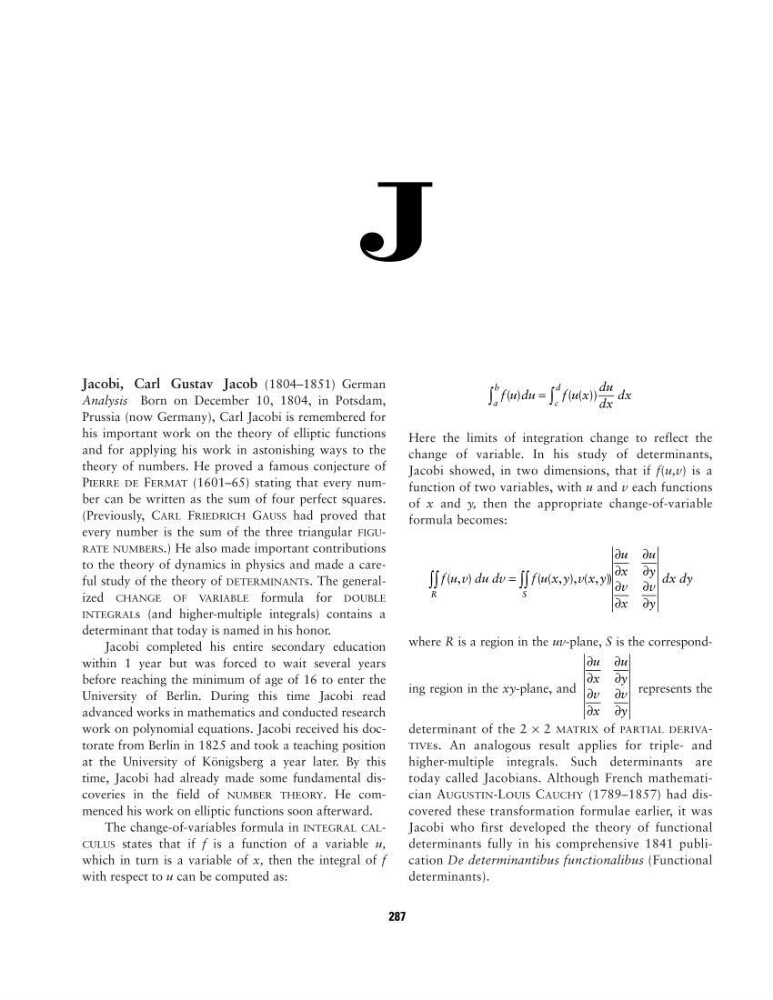
The change-of-variables formula in INTEGRAL CALCULUS states that if f is a function of a variable u,
which in turn is a variable of x, then the integral of f
with respect to u can be computed as:
Here the limits of integration change to reflect the
change of variable. In his study of determinants,
Jacobi showed, in two dimensions, that if f(u,v) is a
function of two variables, with u and v each functions
of x and y, then the appropriate change-of-variable
formula becomes:
where R is a region in the uv-plane, S is the corresponding region in the xy-plane, and
represents the
determinant of the 2 × 2 MATRIX of PARTIAL DERIVATIVEs. An analogous result applies for triple- and
higher-multiple integrals. Such determinants are
today called Jacobians. Although French mathematician AUGUSTIN-LOUIS CAUCHY (1789–1857) had discovered these transformation formulae earlier, it was
Jacobi who first developed the theory of functional
determinants fully in his comprehensive 1841 publication De determinantibus functionalibus (Functional
determinants).
∂
∂
∂
∂
∂
∂
∂
∂
u
x
u
y
v
x
v
y
f u v du dv
f u x y v x y
u
x
u
y
v
x
v
y
dx dy
S
R
( , )
( ( , ), ( , ))
=
∂
∂
∂
∂
∂
∂
∂
∂
∫∫
∫∫
f u du
f u x
du
dx
dx
c
d
a
b ( )
( ( ))
= ∫
∫
287
J
Analysis Born on December 10, 1804, in Potsdam,
Prussia (now Germany), Carl Jacobi is remembered for
his important work on the theory of elliptic functions
and for applying his work in astonishing ways to the
theory of numbers. He proved a famous conjecture of
PIERRE DE FERMAT (1601–65) stating that every number can be written as the sum of four perfect squares.
(Previously, CARL FRIEDRICH GAUSS had proved that
every number is the sum of the three triangular FIGURATE NUMBERS.) He also made important contributions
to the theory of dynamics in physics and made a careful study of the theory of DETERMINANTs. The generalized CHANGE OF VARIABLE formula for DOUBLE
INTEGRALs (and higher-multiple integrals) contains a
determinant that today is named in his honor.
Jacobi completed his entire secondary education
within 1 year but was forced to wait several years
before reaching the minimum of age of 16 to enter the
University of Berlin. During this time Jacobi read
advanced works in mathematics and conducted research
work on polynomial equations. Jacobi received his doctorate from Berlin in 1825 and took a teaching position
at the University of Königsberg a year later. By this
time, Jacobi had already made some fundamental discoveries in the field of NUMBER THEORY. He commenced his work on elliptic functions soon afterward.
The change-of-variables formula in INTEGRAL CALCULUS states that if f is a function of a variable u,
which in turn is a variable of x, then the integral of f
with respect to u can be computed as:
Here the limits of integration change to reflect the
change of variable. In his study of determinants,
Jacobi showed, in two dimensions, that if f(u,v) is a
function of two variables, with u and v each functions
of x and y, then the appropriate change-of-variable
formula becomes:
where R is a region in the uv-plane, S is the corresponding region in the xy-plane, and
represents the
determinant of the 2 × 2 MATRIX of PARTIAL DERIVATIVEs. An analogous result applies for triple- and
higher-multiple integrals. Such determinants are
today called Jacobians. Although French mathematician AUGUSTIN-LOUIS CAUCHY (1789–1857) had discovered these transformation formulae earlier, it was
Jacobi who first developed the theory of functional
determinants fully in his comprehensive 1841 publication De determinantibus functionalibus (Functional
determinants).
∂
∂
∂
∂
∂
∂
∂
∂
u
x
u
y
v
x
v
y
f u v du dv
f u x y v x y
u
x
u
y
v
x
v
y
dx dy
S
R
( , )
( ( , ), ( , ))
=
∂
∂
∂
∂
∂
∂
∂
∂
∫∫
∫∫
f u du
f u x
du
dx
dx
c
d
a
b ( )
( ( ))
= ∫
∫
287
J