

application of EULER’S THEOREM shows that any soccer
ball design that uses hexagons and pentagons, no matter how irregular those shapes may be, with three edges
meeting at each vertex, must include precisely 12 pentagons. (The number of hexagons can vary.) The count
of pentagons is thus an invariant in soccer ball design.
Some invariants can be quite surprising. For example, consider the following theoretical exercise:
Suppose 10 ft of length is added to a rope
that was just long enough to wrap snugly
around the equator of the Earth. Imagine that
the rope is again wrapped around the equator,
but this time—due to its extra length—it hovers just above the ground. How high is the
gap between the ground and the suspended
rope?
To answer this question, let R denote the radius of the
Earth. The length of the extended rope is 2πR + 10 =
feet, which corresponds to the circumference
of a circle of radius R +
feet. This shows that the
rope hovers
≈ 1.6 ft off the ground. Notice that the
answer, apart from being surprisingly large in value,
does not depend on the value of R. This means that the
size of the planet is immaterial. Thus if 10 ft of length
is added to a rope that fits snugly around the equator
of any planet—Mars, Jupiter, or a planet the size of a
pea—the extended rope will always hover
ft off the
ground. This value is an invariant for the problem.
As another example, consider the following famous
“splitting game”:
Write the number 12 at the top of a page and
below it write a pair of positive whole numbers
that sum to 12, say, 7 and 5. On the side of the
paper record the product 7 × 5 = 35. Now
write below 7 a pair of numbers that sum to 7,
say, 3 and 4, and record the product 3 × 4 =
12. Continue in this manner, “splitting” each
number that appears in the diagram into two
and recording the product of the pair of numbers chosen. Do this until the number 1
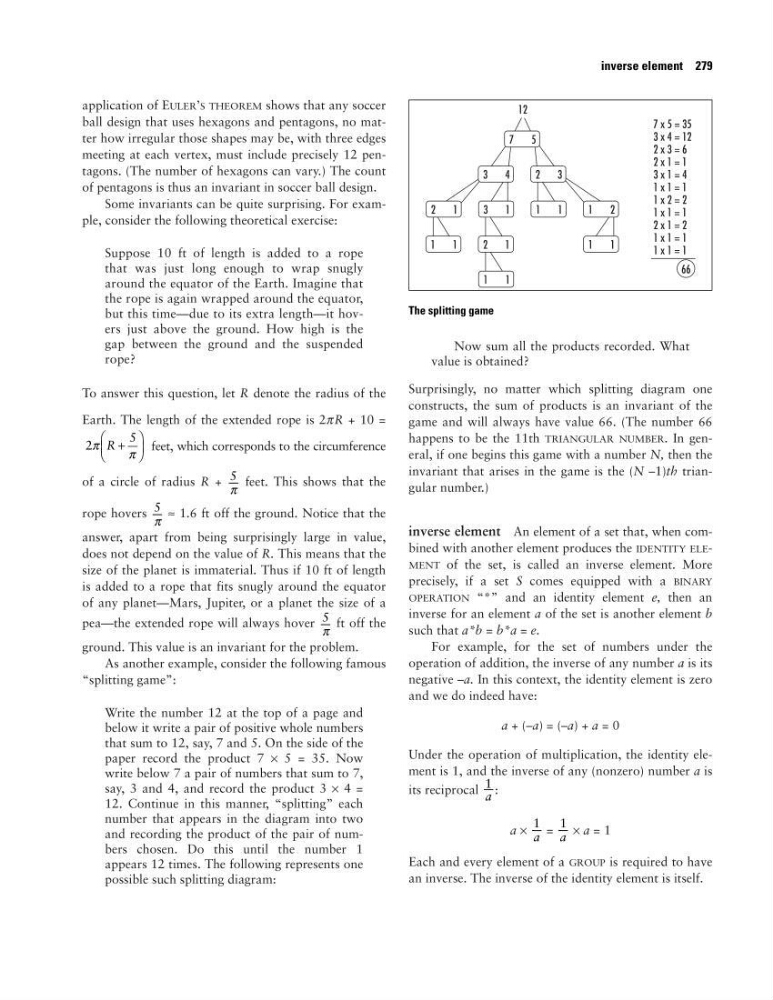
appears 12 times. The following represents one
possible such splitting diagram:
Now sum all the products recorded. What
value is obtained?
Surprisingly, no matter which splitting diagram one
constructs, the sum of products is an invariant of the
game and will always have value 66. (The number 66
happens to be the 11th TRIANGULAR NUMBER. In general, if one begins this game with a number N, then the
invariant that arises in the game is the (N –1)th triangular number.)
inverse element An element of a set that, when combined with another element produces the IDENTITY ELEMENT of the set, is called an inverse element. More
precisely, if a set S comes equipped with a BINARY
OPERATION “*” and an identity element e, then an
inverse for an element a of the set is another element b
such that a*b = b*a = e.
For example, for the set of numbers under the
operation of addition, the inverse of any number a is its
negative –a. In this context, the identity element is zero
and we do indeed have:
a + (–a) = (–a) + a = 0
Under the operation of multiplication, the identity element is 1, and the inverse of any (nonzero) number a is
its reciprocal :
a ×
=
× a = 1
Each and every element of a GROUP is required to have
an inverse. The inverse of the identity element is itself.
1
–
a
1
–
a
1
–
a
5
–
π
5
–
π
5
–
π
2
5
π
π
R +
inverse element 279
The splitting game
ball design that uses hexagons and pentagons, no matter how irregular those shapes may be, with three edges
meeting at each vertex, must include precisely 12 pentagons. (The number of hexagons can vary.) The count
of pentagons is thus an invariant in soccer ball design.
Some invariants can be quite surprising. For example, consider the following theoretical exercise:
Suppose 10 ft of length is added to a rope
that was just long enough to wrap snugly
around the equator of the Earth. Imagine that
the rope is again wrapped around the equator,
but this time—due to its extra length—it hovers just above the ground. How high is the
gap between the ground and the suspended
rope?
To answer this question, let R denote the radius of the
Earth. The length of the extended rope is 2πR + 10 =
feet, which corresponds to the circumference
of a circle of radius R +
feet. This shows that the
rope hovers
≈ 1.6 ft off the ground. Notice that the
answer, apart from being surprisingly large in value,
does not depend on the value of R. This means that the
size of the planet is immaterial. Thus if 10 ft of length
is added to a rope that fits snugly around the equator
of any planet—Mars, Jupiter, or a planet the size of a
pea—the extended rope will always hover
ft off the
ground. This value is an invariant for the problem.
As another example, consider the following famous
“splitting game”:
Write the number 12 at the top of a page and
below it write a pair of positive whole numbers
that sum to 12, say, 7 and 5. On the side of the
paper record the product 7 × 5 = 35. Now
write below 7 a pair of numbers that sum to 7,
say, 3 and 4, and record the product 3 × 4 =
12. Continue in this manner, “splitting” each
number that appears in the diagram into two
and recording the product of the pair of numbers chosen. Do this until the number 1
appears 12 times. The following represents one
possible such splitting diagram:
Now sum all the products recorded. What
value is obtained?
Surprisingly, no matter which splitting diagram one
constructs, the sum of products is an invariant of the
game and will always have value 66. (The number 66
happens to be the 11th TRIANGULAR NUMBER. In general, if one begins this game with a number N, then the
invariant that arises in the game is the (N –1)th triangular number.)
inverse element An element of a set that, when combined with another element produces the IDENTITY ELEMENT of the set, is called an inverse element. More
precisely, if a set S comes equipped with a BINARY
OPERATION “*” and an identity element e, then an
inverse for an element a of the set is another element b
such that a*b = b*a = e.
For example, for the set of numbers under the
operation of addition, the inverse of any number a is its
negative –a. In this context, the identity element is zero
and we do indeed have:
a + (–a) = (–a) + a = 0
Under the operation of multiplication, the identity element is 1, and the inverse of any (nonzero) number a is
its reciprocal :
a ×
=
× a = 1
Each and every element of a GROUP is required to have
an inverse. The inverse of the identity element is itself.
1
–
a
1
–
a
1
–
a
5
–
π
5
–
π
5
–
π
2
5
π
π
R +
inverse element 279
The splitting game