

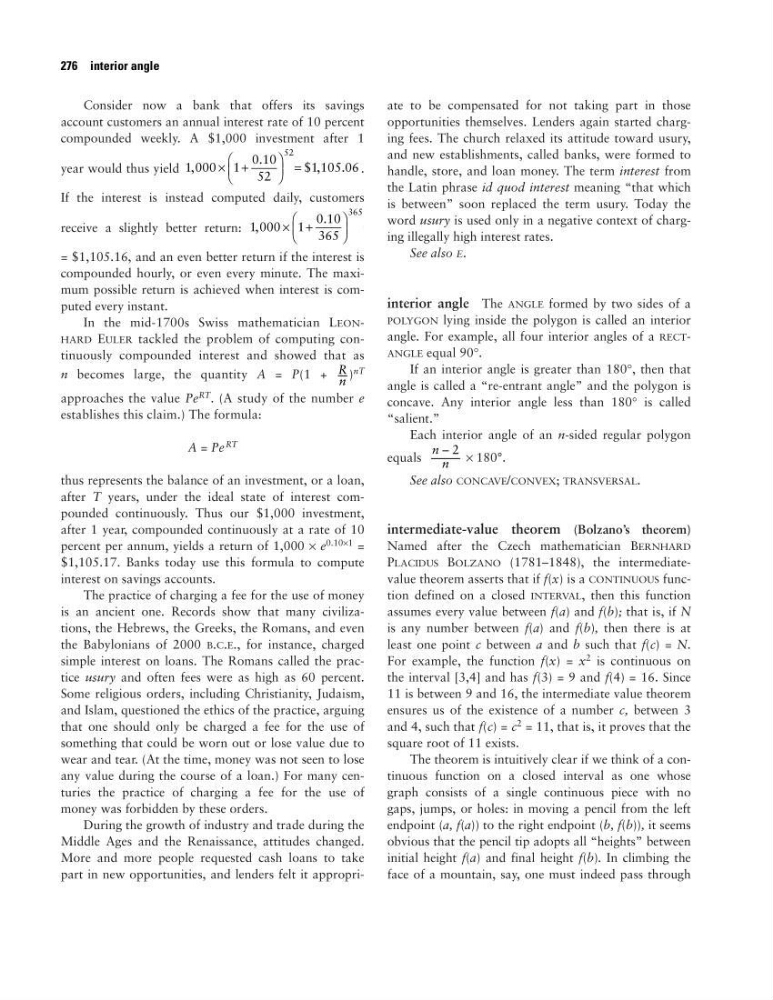
Consider now a bank that offers its savings
account customers an annual interest rate of 10 percent
compounded weekly. A $1,000 investment after 1
year would thus yield
.
If the interest is instead computed daily, customers
receive a slightly better return:
= $1,105.16, and an even better return if the interest is
compounded hourly, or even every minute. The maximum possible return is achieved when interest is computed every instant.
In the mid-1700s Swiss mathematician LEONHARD EULER tackled the problem of computing continuously compounded interest and showed that as
n becomes large, the quantity A = P(1 +
)
nT
approaches the value Pe
RT . (A study of the number e
establishes this claim.) The formula:
A = Pe
RT
thus represents the balance of an investment, or a loan,
after T years, under the ideal state of interest compounded continuously. Thus our $1,000 investment,
after 1 year, compounded continuously at a rate of 10
percent per annum, yields a return of 1,000 × e
0.10×1 =
$1,105.17. Banks today use this formula to compute
interest on savings accounts.
The practice of charging a fee for the use of money
is an ancient one. Records show that many civilizations, the Hebrews, the Greeks, the Romans, and even
the Babylonians of 2000 B.C.E., for instance, charged
simple interest on loans. The Romans called the practice usury and often fees were as high as 60 percent.
Some religious orders, including Christianity, Judaism,
and Islam, questioned the ethics of the practice, arguing
that one should only be charged a fee for the use of
something that could be worn out or lose value due to
wear and tear. (At the time, money was not seen to lose
any value during the course of a loan.) For many centuries the practice of charging a fee for the use of
money was forbidden by these orders.
During the growth of industry and trade during the
Middle Ages and the Renaissance, attitudes changed.
More and more people requested cash loans to take
part in new opportunities, and lenders felt it appropriate to be compensated for not taking part in those
opportunities themselves. Lenders again started charging fees. The church relaxed its attitude toward usury,
and new establishments, called banks, were formed to
handle, store, and loan money. The term interest from
the Latin phrase id quod interest meaning “that which
is between” soon replaced the term usury. Today the
word usury is used only in a negative context of charging illegally high interest rates.
See also E.
interior angle The ANGLE formed by two sides of a
POLYGON lying inside the polygon is called an interior
angle. For example, all four interior angles of a RECTANGLE equal 90°.
If an interior angle is greater than 180°, then that
angle is called a “re-entrant angle” and the polygon is
concave. Any interior angle less than 180° is called
“salient.”
Each interior angle of an n-sided regular polygon
equals
× 180°.
See also CONCAVE/CONVEX; TRANSVERSAL.
intermediate-value theorem (Bolzano’s theorem)
Named after the Czech mathematician BERNHARD
PLACIDUS BOLZANO (1781–1848), the intermediatevalue theorem asserts that if f(x) is a CONTINUOUS function defined on a closed INTERVAL, then this function
assumes every value between f(a) and f(b); that is, if N
is any number between f(a) and f(b), then there is at
least one point c between a and b such that f(c) = N.
For example, the function f(x) = x
2 is continuous on
the interval [3,4] and has f(3) = 9 and f(4) = 16. Since
11 is between 9 and 16, the intermediate value theorem
ensures us of the existence of a number c, between 3
and 4, such that f(c) = c
2 = 11, that is, it proves that the
square root of 11 exists.
The theorem is intuitively clear if we think of a continuous function on a closed interval as one whose
graph consists of a single continuous piece with no
gaps, jumps, or holes: in moving a pencil from the left
endpoint (a, f(a)) to the right endpoint (b, f(b)), it seems
obvious that the pencil tip adopts all “heights” between
initial height f(a) and final height f(b). In climbing the
face of a mountain, say, one must indeed pass through
n – 2
–– n
R
– n
1 000 1
0 10
365
365
,
.
× +
=
1 000 1
0 10
52
1 105 06
52
,
.
$ ,
.
× +
=
276 interior angle
account customers an annual interest rate of 10 percent
compounded weekly. A $1,000 investment after 1
year would thus yield
.
If the interest is instead computed daily, customers
receive a slightly better return:
= $1,105.16, and an even better return if the interest is
compounded hourly, or even every minute. The maximum possible return is achieved when interest is computed every instant.
In the mid-1700s Swiss mathematician LEONHARD EULER tackled the problem of computing continuously compounded interest and showed that as
n becomes large, the quantity A = P(1 +
)
nT
approaches the value Pe
RT . (A study of the number e
establishes this claim.) The formula:
A = Pe
RT
thus represents the balance of an investment, or a loan,
after T years, under the ideal state of interest compounded continuously. Thus our $1,000 investment,
after 1 year, compounded continuously at a rate of 10
percent per annum, yields a return of 1,000 × e
0.10×1 =
$1,105.17. Banks today use this formula to compute
interest on savings accounts.
The practice of charging a fee for the use of money
is an ancient one. Records show that many civilizations, the Hebrews, the Greeks, the Romans, and even
the Babylonians of 2000 B.C.E., for instance, charged
simple interest on loans. The Romans called the practice usury and often fees were as high as 60 percent.
Some religious orders, including Christianity, Judaism,
and Islam, questioned the ethics of the practice, arguing
that one should only be charged a fee for the use of
something that could be worn out or lose value due to
wear and tear. (At the time, money was not seen to lose
any value during the course of a loan.) For many centuries the practice of charging a fee for the use of
money was forbidden by these orders.
During the growth of industry and trade during the
Middle Ages and the Renaissance, attitudes changed.
More and more people requested cash loans to take
part in new opportunities, and lenders felt it appropriate to be compensated for not taking part in those
opportunities themselves. Lenders again started charging fees. The church relaxed its attitude toward usury,
and new establishments, called banks, were formed to
handle, store, and loan money. The term interest from
the Latin phrase id quod interest meaning “that which
is between” soon replaced the term usury. Today the
word usury is used only in a negative context of charging illegally high interest rates.
See also E.
interior angle The ANGLE formed by two sides of a
POLYGON lying inside the polygon is called an interior
angle. For example, all four interior angles of a RECTANGLE equal 90°.
If an interior angle is greater than 180°, then that
angle is called a “re-entrant angle” and the polygon is
concave. Any interior angle less than 180° is called
“salient.”
Each interior angle of an n-sided regular polygon
equals
× 180°.
See also CONCAVE/CONVEX; TRANSVERSAL.
intermediate-value theorem (Bolzano’s theorem)
Named after the Czech mathematician BERNHARD
PLACIDUS BOLZANO (1781–1848), the intermediatevalue theorem asserts that if f(x) is a CONTINUOUS function defined on a closed INTERVAL, then this function
assumes every value between f(a) and f(b); that is, if N
is any number between f(a) and f(b), then there is at
least one point c between a and b such that f(c) = N.
For example, the function f(x) = x
2 is continuous on
the interval [3,4] and has f(3) = 9 and f(4) = 16. Since
11 is between 9 and 16, the intermediate value theorem
ensures us of the existence of a number c, between 3
and 4, such that f(c) = c
2 = 11, that is, it proves that the
square root of 11 exists.
The theorem is intuitively clear if we think of a continuous function on a closed interval as one whose
graph consists of a single continuous piece with no
gaps, jumps, or holes: in moving a pencil from the left
endpoint (a, f(a)) to the right endpoint (b, f(b)), it seems
obvious that the pencil tip adopts all “heights” between
initial height f(a) and final height f(b). In climbing the
face of a mountain, say, one must indeed pass through
n – 2
–– n
R
– n
1 000 1
0 10
365
365
,
.
× +
=
1 000 1
0 10
52
1 105 06
52
,
.
$ ,
.
× +
=
276 interior angle