

The earliest written records of Indian culture are
the religious texts the Vedas, dating between 1500
B.C.E. and 800 B.C.E. Although not mathematical in
content, appendices to the texts give specific rules for
constructing altars, exhibiting a thorough understanding of the basic principles of geometry. Early versions
of the digits 0 through 9 were used at this time.
By 600 C.E., the Vedic religion had gone into
decline, and Jainism came to the fore. During this
period mathematics was driven by the needs of the
religion and its demands for careful astronomical
observations to pinpoint the exact times of religious
observances and the development of an accurate calendar. The decimal representation system was now
fully developed, and scholars were able to make precise and surprisingly accurate calculations. The mathematician A
– RYABHATA (ca. 500 C.E.), for instance, had
developed a theory of TRIGONOMETRY to aid astronomical calculations, had developed methods for
extracting square roots, evaluated π to a high degree
of accuracy, and was able to find integer solutions to
a large class of equations that arose from astronomical theories.
One written text from this period was discovered
in 1881 in the town of Bakhshali, now in Pakistan.
Written on birch bark, the Bakhshali manuscript shows
that mathematicians were also comfortable with fractions, basic algebraic manipulations (they used a dot to
represent an unknown quantity), and sophisticated
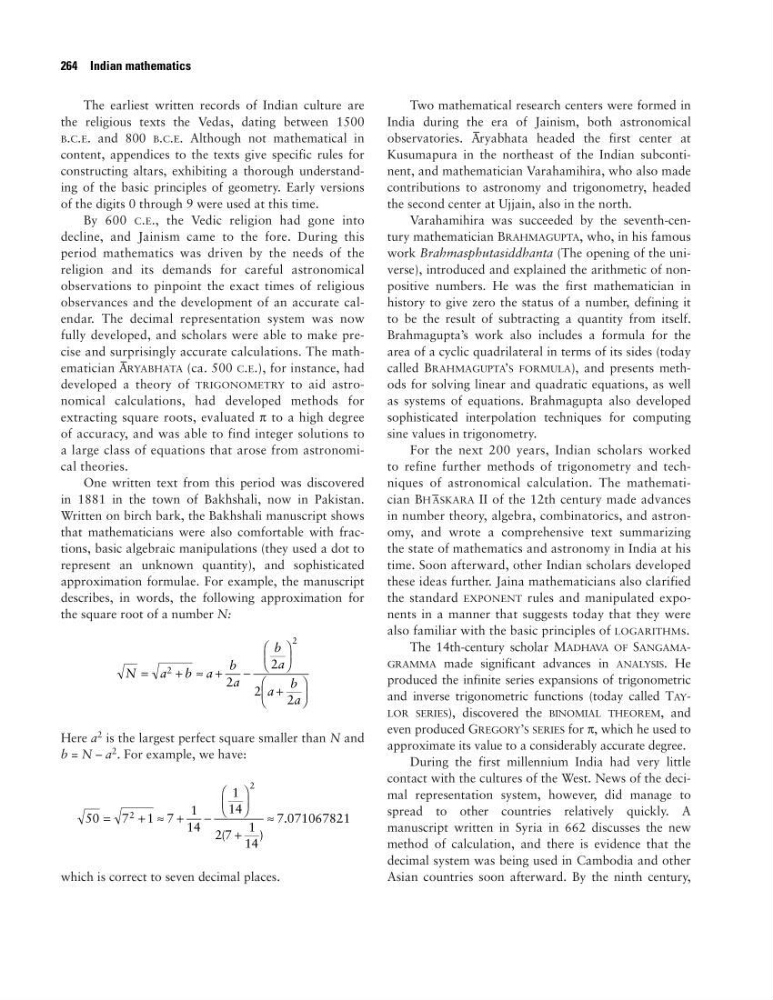
approximation formulae. For example, the manuscript
describes, in words, the following approximation for
the square root of a number N:
Here a
2 is the largest perfect square smaller than N and
b = N – a
2
. For example, we have:
which is correct to seven decimal places.
Two mathematical research centers were formed in
India during the era of Jainism, both astronomical
observatories. A
– ryabhata headed the first center at
Kusumapura in the northeast of the Indian subcontinent, and mathematician Varahamihira, who also made
contributions to astronomy and trigonometry, headed
the second center at Ujjain, also in the north.
Varahamihira was succeeded by the seventh-century mathematician BRAHMAGUPTA, who, in his famous
work Brahmasphutasiddhanta (The opening of the universe), introduced and explained the arithmetic of nonpositive numbers. He was the first mathematician in
history to give zero the status of a number, defining it
to be the result of subtracting a quantity from itself.
Brahmagupta’s work also includes a formula for the
area of a cyclic quadrilateral in terms of its sides (today
called BRAHMAGUPTA’S FORMULA), and presents methods for solving linear and quadratic equations, as well
as systems of equations. Brahmagupta also developed
sophisticated interpolation techniques for computing
sine values in trigonometry.
For the next 200 years, Indian scholars worked
to refine further methods of trigonometry and techniques of astronomical calculation. The mathematician BH – ASKARA II of the 12th century made advances
in number theory, algebra, combinatorics, and astronomy, and wrote a comprehensive text summarizing
the state of mathematics and astronomy in India at his
time. Soon afterward, other Indian scholars developed
these ideas further. Jaina mathematicians also clarified
the standard EXPONENT rules and manipulated exponents in a manner that suggests today that they were
also familiar with the basic principles of LOGARITHMs.
The 14th-century scholar MADHAVA OF SANGAMAGRAMMA made significant advances in ANALYSIS. He
produced the infinite series expansions of trigonometric
and inverse trigonometric functions (today called TAYLOR SERIES), discovered the BINOMIAL THEOREM, and
even produced GREGORY’S SERIES for π, which he used to
approximate its value to a considerably accurate degree.
During the first millennium India had very little
contact with the cultures of the West. News of the decimal representation system, however, did manage to
spread to other countries relatively quickly. A
manuscript written in Syria in 662 discusses the new
method of calculation, and there is evidence that the
decimal system was being used in Cambodia and other
Asian countries soon afterward. By the ninth century,
50
7 1 7
1
14
1
14
2 7
1
14
7 071067821
2
2
=
+ ≈ +
−
+
≈
(
)
.
N
a b a
b
a
b
a
a
b
a
=
+ ≈ +
−
+
2
2
2
2
2
2
264 Indian mathematics
the religious texts the Vedas, dating between 1500
B.C.E. and 800 B.C.E. Although not mathematical in
content, appendices to the texts give specific rules for
constructing altars, exhibiting a thorough understanding of the basic principles of geometry. Early versions
of the digits 0 through 9 were used at this time.
By 600 C.E., the Vedic religion had gone into
decline, and Jainism came to the fore. During this
period mathematics was driven by the needs of the
religion and its demands for careful astronomical
observations to pinpoint the exact times of religious
observances and the development of an accurate calendar. The decimal representation system was now
fully developed, and scholars were able to make precise and surprisingly accurate calculations. The mathematician A
– RYABHATA (ca. 500 C.E.), for instance, had
developed a theory of TRIGONOMETRY to aid astronomical calculations, had developed methods for
extracting square roots, evaluated π to a high degree
of accuracy, and was able to find integer solutions to
a large class of equations that arose from astronomical theories.
One written text from this period was discovered
in 1881 in the town of Bakhshali, now in Pakistan.
Written on birch bark, the Bakhshali manuscript shows
that mathematicians were also comfortable with fractions, basic algebraic manipulations (they used a dot to
represent an unknown quantity), and sophisticated
approximation formulae. For example, the manuscript
describes, in words, the following approximation for
the square root of a number N:
Here a
2 is the largest perfect square smaller than N and
b = N – a
2
. For example, we have:
which is correct to seven decimal places.
Two mathematical research centers were formed in
India during the era of Jainism, both astronomical
observatories. A
– ryabhata headed the first center at
Kusumapura in the northeast of the Indian subcontinent, and mathematician Varahamihira, who also made
contributions to astronomy and trigonometry, headed
the second center at Ujjain, also in the north.
Varahamihira was succeeded by the seventh-century mathematician BRAHMAGUPTA, who, in his famous
work Brahmasphutasiddhanta (The opening of the universe), introduced and explained the arithmetic of nonpositive numbers. He was the first mathematician in
history to give zero the status of a number, defining it
to be the result of subtracting a quantity from itself.
Brahmagupta’s work also includes a formula for the
area of a cyclic quadrilateral in terms of its sides (today
called BRAHMAGUPTA’S FORMULA), and presents methods for solving linear and quadratic equations, as well
as systems of equations. Brahmagupta also developed
sophisticated interpolation techniques for computing
sine values in trigonometry.
For the next 200 years, Indian scholars worked
to refine further methods of trigonometry and techniques of astronomical calculation. The mathematician BH – ASKARA II of the 12th century made advances
in number theory, algebra, combinatorics, and astronomy, and wrote a comprehensive text summarizing
the state of mathematics and astronomy in India at his
time. Soon afterward, other Indian scholars developed
these ideas further. Jaina mathematicians also clarified
the standard EXPONENT rules and manipulated exponents in a manner that suggests today that they were
also familiar with the basic principles of LOGARITHMs.
The 14th-century scholar MADHAVA OF SANGAMAGRAMMA made significant advances in ANALYSIS. He
produced the infinite series expansions of trigonometric
and inverse trigonometric functions (today called TAYLOR SERIES), discovered the BINOMIAL THEOREM, and
even produced GREGORY’S SERIES for π, which he used to
approximate its value to a considerably accurate degree.
During the first millennium India had very little
contact with the cultures of the West. News of the decimal representation system, however, did manage to
spread to other countries relatively quickly. A
manuscript written in Syria in 662 discusses the new
method of calculation, and there is evidence that the
decimal system was being used in Cambodia and other
Asian countries soon afterward. By the ninth century,
50
7 1 7
1
14
1
14
2 7
1
14
7 071067821
2
2
=
+ ≈ +
−
+
≈
(
)
.
N
a b a
b
a
b
a
a
b
a
=
+ ≈ +
−
+
2
2
2
2
2
2
264 Indian mathematics