

The three angle bisectors of a triangle are CONCURRENT.
An excircle for a triangle is a circle that lies outside
the triangle and is tangent to one side of the triangle
and tangent to extensions of the remaining two sides. A
triangle has three distinct excircles.
In a more general context, if it is possible to draw a
circle inside a POLYGON tangent to each side of the polygon, then that circle is called an incircle of the polygon.
Every regular polygon has an incircle. There is no incircle for a nonsquare rectangle.
See also CIRCUMCIRCLE.
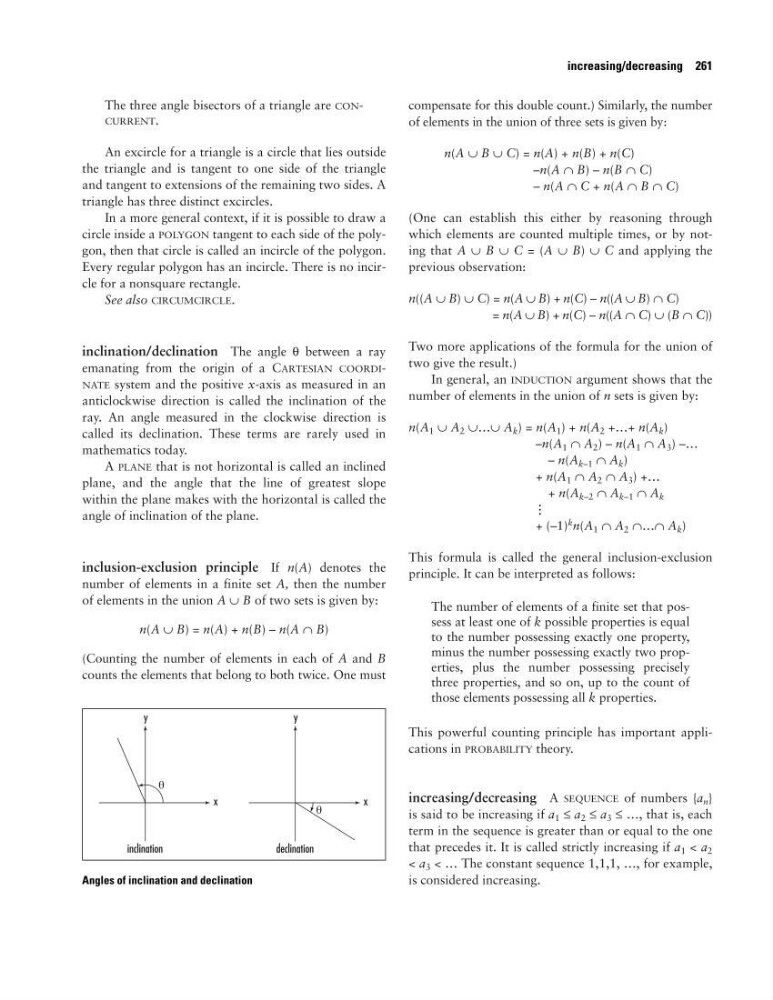
inclination/declination The angle θ between a ray
emanating from the origin of a CARTESIAN COORDINATE system and the positive x-axis as measured in an
anticlockwise direction is called the inclination of the
ray. An angle measured in the clockwise direction is
called its declination. These terms are rarely used in
mathematics today.
A PLANE that is not horizontal is called an inclined
plane, and the angle that the line of greatest slope
within the plane makes with the horizontal is called the
angle of inclination of the plane.
inclusion-exclusion principle If n(A) denotes the
number of elements in a finite set A, then the number
of elements in the union A ∪ B of two sets is given by:
n(A ∪ B) = n(A) + n(B) – n(A ∩ B)
(Counting the number of elements in each of A and B
counts the elements that belong to both twice. One must
compensate for this double count.) Similarly, the number
of elements in the union of three sets is given by:
n(A ∪ B ∪ C) = n(A) + n(B) + n(C)
–n(A ∩ B) – n(B ∩ C)
– n(A ∩ C + n(A ∩ B ∩ C)
(One can establish this either by reasoning through
which elements are counted multiple times, or by noting that A ∪ B ∪ C = (A ∪ B) ∪ C and applying the
previous observation:
n((A ∪ B) ∪ C) = n(A ∪ B) + n(C) – n((A ∪ B) ∩ C)
= n(A ∪ B) + n(C) – n((A ∩ C) ∪ (B ∩ C))
Two more applications of the formula for the union of
two give the result.)
In general, an INDUCTION argument shows that the
number of elements in the union of n sets is given by:
n(A 1 ∪ A 2 ∪…∪ A k ) = n(A 1 ) + n(A 2 +…+ n(A k )
–n(A 1 ∩ A 2 ) – n(A 1 ∩ A 3 ) –…
– n(A k–1 ∩ A k )
+ n(A 1 ∩ A 2 ∩ A 3 ) +…
+ n(A k–2 ∩ A k–1 ∩ A k
+ (–1)
k
n(A 1 ∩ A 2 ∩…∩ A k )
This formula is called the general inclusion-exclusion
principle. It can be interpreted as follows:
The number of elements of a finite set that possess at least one of k possible properties is equal
to the number possessing exactly one property,
minus the number possessing exactly two properties, plus the number possessing precisely
three properties, and so on, up to the count of
those elements possessing all k properties.
This powerful counting principle has important applications in PROBABILITY theory.
increasing/decreasing A SEQUENCE of numbers {a n }
is said to be increasing if a 1 ≤ a 2 ≤ a 3 ≤ …, that is, each
term in the sequence is greater than or equal to the one
that precedes it. It is called strictly increasing if a 1 < a 2
< a 3 < … The constant sequence 1,1,1, …, for example,
is considered increasing.
…
increasing/decreasing 261
Angles of inclination and declination
An excircle for a triangle is a circle that lies outside
the triangle and is tangent to one side of the triangle
and tangent to extensions of the remaining two sides. A
triangle has three distinct excircles.
In a more general context, if it is possible to draw a
circle inside a POLYGON tangent to each side of the polygon, then that circle is called an incircle of the polygon.
Every regular polygon has an incircle. There is no incircle for a nonsquare rectangle.
See also CIRCUMCIRCLE.
inclination/declination The angle θ between a ray
emanating from the origin of a CARTESIAN COORDINATE system and the positive x-axis as measured in an
anticlockwise direction is called the inclination of the
ray. An angle measured in the clockwise direction is
called its declination. These terms are rarely used in
mathematics today.
A PLANE that is not horizontal is called an inclined
plane, and the angle that the line of greatest slope
within the plane makes with the horizontal is called the
angle of inclination of the plane.
inclusion-exclusion principle If n(A) denotes the
number of elements in a finite set A, then the number
of elements in the union A ∪ B of two sets is given by:
n(A ∪ B) = n(A) + n(B) – n(A ∩ B)
(Counting the number of elements in each of A and B
counts the elements that belong to both twice. One must
compensate for this double count.) Similarly, the number
of elements in the union of three sets is given by:
n(A ∪ B ∪ C) = n(A) + n(B) + n(C)
–n(A ∩ B) – n(B ∩ C)
– n(A ∩ C + n(A ∩ B ∩ C)
(One can establish this either by reasoning through
which elements are counted multiple times, or by noting that A ∪ B ∪ C = (A ∪ B) ∪ C and applying the
previous observation:
n((A ∪ B) ∪ C) = n(A ∪ B) + n(C) – n((A ∪ B) ∩ C)
= n(A ∪ B) + n(C) – n((A ∩ C) ∪ (B ∩ C))
Two more applications of the formula for the union of
two give the result.)
In general, an INDUCTION argument shows that the
number of elements in the union of n sets is given by:
n(A 1 ∪ A 2 ∪…∪ A k ) = n(A 1 ) + n(A 2 +…+ n(A k )
–n(A 1 ∩ A 2 ) – n(A 1 ∩ A 3 ) –…
– n(A k–1 ∩ A k )
+ n(A 1 ∩ A 2 ∩ A 3 ) +…
+ n(A k–2 ∩ A k–1 ∩ A k
+ (–1)
k
n(A 1 ∩ A 2 ∩…∩ A k )
This formula is called the general inclusion-exclusion
principle. It can be interpreted as follows:
The number of elements of a finite set that possess at least one of k possible properties is equal
to the number possessing exactly one property,
minus the number possessing exactly two properties, plus the number possessing precisely
three properties, and so on, up to the count of
those elements possessing all k properties.
This powerful counting principle has important applications in PROBABILITY theory.
increasing/decreasing A SEQUENCE of numbers {a n }
is said to be increasing if a 1 ≤ a 2 ≤ a 3 ≤ …, that is, each
term in the sequence is greater than or equal to the one
that precedes it. It is called strictly increasing if a 1 < a 2
< a 3 < … The constant sequence 1,1,1, …, for example,
is considered increasing.
…
increasing/decreasing 261
Angles of inclination and declination