

If an infinite number of tourist buses, each containing an infinite number of tourists, arrive at the same
time, one can still find room to accommodate the multitude of new guests:
Move all the existing hotel guests to the evennumbered rooms.
Place the tourists from the first bus into
the rooms given by the powers of 3: 3, 9, 27,…
Place the tourists from the second bus into
the rooms given by the powers of 5: 5, 25,
125,…
Next use all rooms numbered the powers
of 7, of 11, of 13, and so on, down along the
list of all the PRIME numbers. As, according to
EUCLID’S PROOF OF THE INFINITUDE OF PRIMES,
there are infinitely many primes, and no two
powers of different primes are the same, this
allocation scheme does the trick.
See also CARDINALITY; FUNDAMENTAL THEOREM OF
ARITHMETIC; INFINITY; PARADOX; TRISTRAM SHANDY
PARADOX.
Hindu-Arabic numerals The numeral system we
use today is called the Hindu-Arabic numeral system.
Using a base-10 PLACE-VALUE SYSTEM, numbers are
expressed via combinations of the symbols 0, 1, 2, 3, 4,
5, 6, 7, 8, and 9, organized so as to represent groupings
of powers of 10. For instance, the number 574 represents the five groups of 100, seven groups of 10, and
four single units.
This numerical system originated from India
around 600 C.E., almost in the exact same form as we
use it today. The system was transmitted to the Arabs
two centuries later as they worked to translate the Sanskrit works on astronomy into Arabic. The Arab mathematician MUHAMMAD IBN M –
US
– A AL-KHW – ARIZM – ı
(ca. 800) wrote an influential treatise describing the
Hindu numeral system, and used it in his famous book
Hisab al-jabr w’al-muq¯ abala (Calculation by restoration and reduction), from whose title the modern word
algebra is derived. As Western scholars began translating the Arabic texts into Latin, word of the efficient
numeration system spread across Western Europe. Italian scholar FIBONACCI (ca. 1170–1250) avidly promoted their use. By the end of the 17th century, the
Hindu-Arabic numeral system completely replaced the
cumbersome system of ROMAN NUMERALS that were
the standard in Europe for over 1,500 years.
See also BASE OF A NUMBER SYSTEM; DECIMAL REPRESENTATION; NUMBER; ZERO.
Hippasus of Metapontum See PYTHAGORAS.
Hippocrates of Chios (ca. 470–410 B.C.E.) Greek
Geometry Born in Khíos (Chios), Greece, Hippocrates is remembered as the first mathematician to have
found the area of a curved figure, namely, that of a
LUNE. He also made first steps toward properly analyzing the problem of SQUARING THE CIRCLE.
Very little is known of Hippocrates’ life. It is
thought that Hippocrates may have first worked as a
merchant before developing an interest and talent for
geometry later in his life. Although he wrote only one
text on the topic (unfortunately lost to us today), many
scholars throughout history referred to his work in
their own studies.
Hippocrates was interested in the famous problem of
squaring the circle, that is, finding a method of constructing a square of the same area as a given circle. Although
he was unable to solve this problem, he did manage to
show that, in many instances, it is possible to “square a
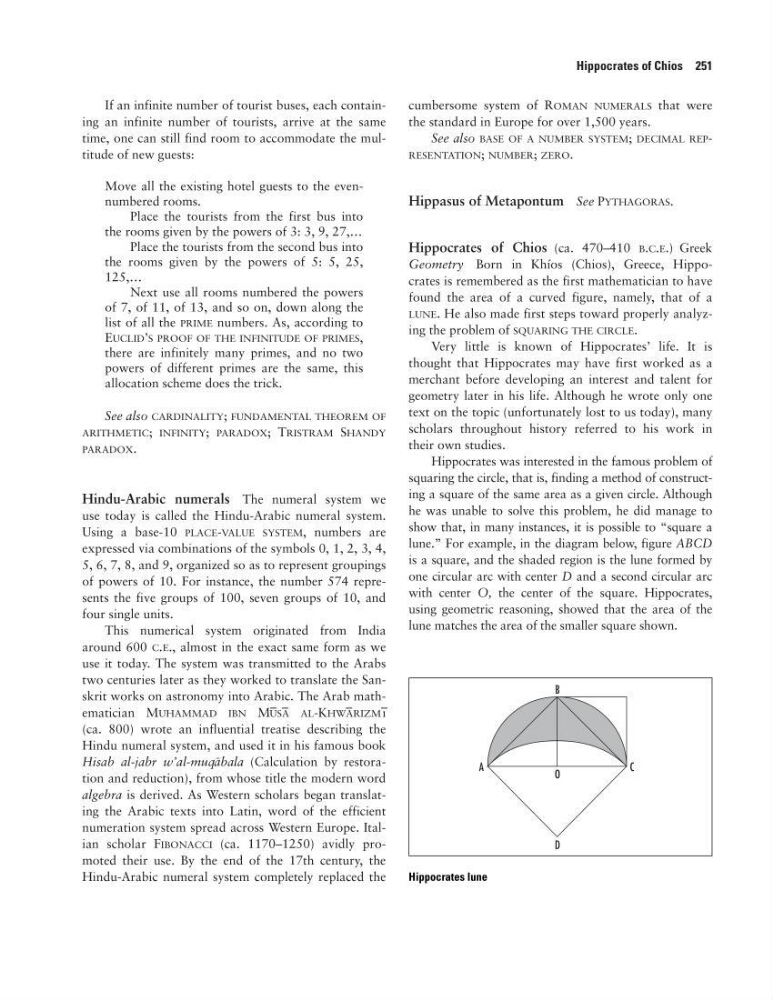
lune.” For example, in the diagram below, figure ABCD
is a square, and the shaded region is the lune formed by
one circular arc with center D and a second circular arc
with center O, the center of the square. Hippocrates,
using geometric reasoning, showed that the area of the
lune matches the area of the smaller square shown.
Hippocrates of Chios 251
Hippocrates lune
time, one can still find room to accommodate the multitude of new guests:
Move all the existing hotel guests to the evennumbered rooms.
Place the tourists from the first bus into
the rooms given by the powers of 3: 3, 9, 27,…
Place the tourists from the second bus into
the rooms given by the powers of 5: 5, 25,
125,…
Next use all rooms numbered the powers
of 7, of 11, of 13, and so on, down along the
list of all the PRIME numbers. As, according to
EUCLID’S PROOF OF THE INFINITUDE OF PRIMES,
there are infinitely many primes, and no two
powers of different primes are the same, this
allocation scheme does the trick.
See also CARDINALITY; FUNDAMENTAL THEOREM OF
ARITHMETIC; INFINITY; PARADOX; TRISTRAM SHANDY
PARADOX.
Hindu-Arabic numerals The numeral system we
use today is called the Hindu-Arabic numeral system.
Using a base-10 PLACE-VALUE SYSTEM, numbers are
expressed via combinations of the symbols 0, 1, 2, 3, 4,
5, 6, 7, 8, and 9, organized so as to represent groupings
of powers of 10. For instance, the number 574 represents the five groups of 100, seven groups of 10, and
four single units.
This numerical system originated from India
around 600 C.E., almost in the exact same form as we
use it today. The system was transmitted to the Arabs
two centuries later as they worked to translate the Sanskrit works on astronomy into Arabic. The Arab mathematician MUHAMMAD IBN M –
US
– A AL-KHW – ARIZM – ı
(ca. 800) wrote an influential treatise describing the
Hindu numeral system, and used it in his famous book
Hisab al-jabr w’al-muq¯ abala (Calculation by restoration and reduction), from whose title the modern word
algebra is derived. As Western scholars began translating the Arabic texts into Latin, word of the efficient
numeration system spread across Western Europe. Italian scholar FIBONACCI (ca. 1170–1250) avidly promoted their use. By the end of the 17th century, the
Hindu-Arabic numeral system completely replaced the
cumbersome system of ROMAN NUMERALS that were
the standard in Europe for over 1,500 years.
See also BASE OF A NUMBER SYSTEM; DECIMAL REPRESENTATION; NUMBER; ZERO.
Hippasus of Metapontum See PYTHAGORAS.
Hippocrates of Chios (ca. 470–410 B.C.E.) Greek
Geometry Born in Khíos (Chios), Greece, Hippocrates is remembered as the first mathematician to have
found the area of a curved figure, namely, that of a
LUNE. He also made first steps toward properly analyzing the problem of SQUARING THE CIRCLE.
Very little is known of Hippocrates’ life. It is
thought that Hippocrates may have first worked as a
merchant before developing an interest and talent for
geometry later in his life. Although he wrote only one
text on the topic (unfortunately lost to us today), many
scholars throughout history referred to his work in
their own studies.
Hippocrates was interested in the famous problem of
squaring the circle, that is, finding a method of constructing a square of the same area as a given circle. Although
he was unable to solve this problem, he did manage to
show that, in many instances, it is possible to “square a
lune.” For example, in the diagram below, figure ABCD
is a square, and the shaded region is the lune formed by
one circular arc with center D and a second circular arc
with center O, the center of the square. Hippocrates,
using geometric reasoning, showed that the area of the
lune matches the area of the smaller square shown.
Hippocrates of Chios 251
Hippocrates lune