

rate) study of pressure in fluids, along with a description of a collection of trick gadgets and toys illustrating
specific scientific principles. He also describes designs
for over 100 practical machines, including pneumatic
pulleys and lifts, wind organs, coin-operated machines,
fire engines, and steam-powered engines that operate in
a way similar to today’s jet engine.
Some of Heron’s texts have the appearance of draft
lecture notes, leading some historians to suspect that he
may have taught at the famous Museum of Alexandria.
Little is actually known of Heron’s life.
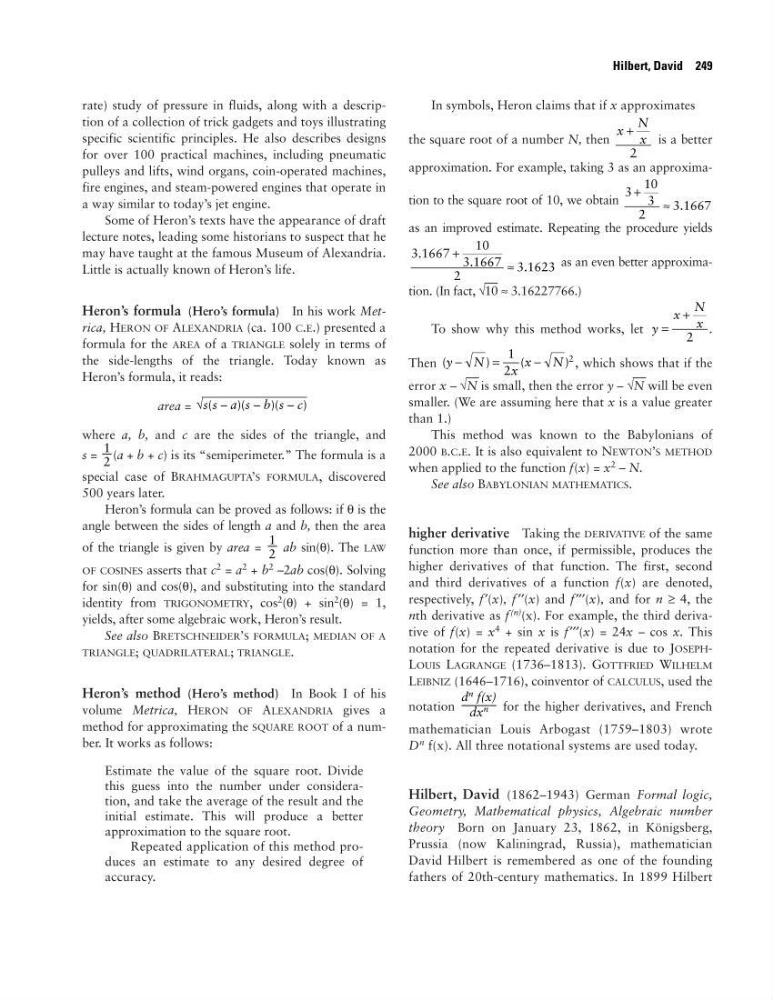
Heron’s formula (Hero’s formula) In his work Metrica, HERON OF ALEXANDRIA (ca. 100 C.E.) presented a
formula for the AREA of a TRIANGLE solely in terms of
the side-lengths of the triangle. Today known as
Heron’s formula, it reads:
area =
where a, b, and c are the sides of the triangle, and
s = (a + b + c) is its “semiperimeter.” The formula is a
special case of BRAHMAGUPTA’S FORMULA, discovered
500 years later.
Heron’s formula can be proved as follows: if θ is the
angle between the sides of length a and b, then the area
of the triangle is given by area =
ab sin(θ). The LAW
OF COSINES asserts that c
2 = a
2 + b
2 –2ab cos(θ). Solving
for sin(θ) and cos(θ), and substituting into the standard
identity from TRIGONOMETRY, cos
2
(θ) + sin
2
(θ) = 1,
yields, after some algebraic work, Heron’s result.
See also BRETSCHNEIDER’S FORMULA; MEDIAN OF A
TRIANGLE; QUADRILATERAL; TRIANGLE.
Heron’s method (Hero’s method) In Book I of his
volume Metrica, HERON OF ALEXANDRIA gives a
method for approximating the SQUARE ROOT of a number. It works as follows:
Estimate the value of the square root. Divide
this guess into the number under consideration, and take the average of the result and the
initial estimate. This will produce a better
approximation to the square root.
Repeated application of this method produces an estimate to any desired degree of
accuracy.
In symbols, Heron claims that if x approximates
the square root of a number N, then
is a better
approximation. For example, taking 3 as an approximation to the square root of 10, we obtain
as an improved estimate. Repeating the procedure yields
as an even better approximation. (In fact, √
–
10 ≈ 3.16227766.)
To show why this method works, let
.
Then
, which shows that if the
error x – √
–
N is small, then the error y – √
–
N will be even
smaller. (We are assuming here that x is a value greater
than 1.)
This method was known to the Babylonians of
2000 B.C.E. It is also equivalent to NEWTON’S METHOD
when applied to the function f(x) = x
2 – N.
See also BABYLONIAN MATHEMATICS.
higher derivative Taking the DERIVATIVE of the same
function more than once, if permissible, produces the
higher derivatives of that function. The first, second
and third derivatives of a function f(x) are denoted,
respectively, f ′(x), f ′′(x) and f′′′(x), and for n ≥ 4, the
nth derivative as f
(n) (x). For example, the third derivative of f(x) = x
4 + sin x is f′′′(x) = 24x – cos x. This
notation for the repeated derivative is due to JOSEPHLOUIS LAGRANGE (1736–1813). GOTTFRIED WILHELM
LEIBNIZ (1646–1716), coinventor of CALCULUS, used the
notation
for the higher derivatives, and French
mathematician Louis Arbogast (1759–1803) wrote
D
n f(x). All three notational systems are used today.
Hilbert, David (1862–1943) German Formal logic,
Geometry, Mathematical physics, Algebraic number
theory Born on January 23, 1862, in Königsberg,
Prussia (now Kaliningrad, Russia), mathematician
David Hilbert is remembered as one of the founding
fathers of 20th-century mathematics. In 1899 Hilbert
d
n f(x)
––––
dx
n
(
)
(
)
y
N
x
x
N
−
=
−
1
2
2
y
x
N
x
=
+
2
3 1667
10
3 1667
2
3 1623
.
.
.
+
≈
3
10
3
2
3 1667
+
≈ .
x
N
x
+
2
1
–
2
1
–
2
√s(s – a)(s – b)(s – c)
Hilbert, David 249
specific scientific principles. He also describes designs
for over 100 practical machines, including pneumatic
pulleys and lifts, wind organs, coin-operated machines,
fire engines, and steam-powered engines that operate in
a way similar to today’s jet engine.
Some of Heron’s texts have the appearance of draft
lecture notes, leading some historians to suspect that he
may have taught at the famous Museum of Alexandria.
Little is actually known of Heron’s life.
Heron’s formula (Hero’s formula) In his work Metrica, HERON OF ALEXANDRIA (ca. 100 C.E.) presented a
formula for the AREA of a TRIANGLE solely in terms of
the side-lengths of the triangle. Today known as
Heron’s formula, it reads:
area =
where a, b, and c are the sides of the triangle, and
s = (a + b + c) is its “semiperimeter.” The formula is a
special case of BRAHMAGUPTA’S FORMULA, discovered
500 years later.
Heron’s formula can be proved as follows: if θ is the
angle between the sides of length a and b, then the area
of the triangle is given by area =
ab sin(θ). The LAW
OF COSINES asserts that c
2 = a
2 + b
2 –2ab cos(θ). Solving
for sin(θ) and cos(θ), and substituting into the standard
identity from TRIGONOMETRY, cos
2
(θ) + sin
2
(θ) = 1,
yields, after some algebraic work, Heron’s result.
See also BRETSCHNEIDER’S FORMULA; MEDIAN OF A
TRIANGLE; QUADRILATERAL; TRIANGLE.
Heron’s method (Hero’s method) In Book I of his
volume Metrica, HERON OF ALEXANDRIA gives a
method for approximating the SQUARE ROOT of a number. It works as follows:
Estimate the value of the square root. Divide
this guess into the number under consideration, and take the average of the result and the
initial estimate. This will produce a better
approximation to the square root.
Repeated application of this method produces an estimate to any desired degree of
accuracy.
In symbols, Heron claims that if x approximates
the square root of a number N, then
is a better
approximation. For example, taking 3 as an approximation to the square root of 10, we obtain
as an improved estimate. Repeating the procedure yields
as an even better approximation. (In fact, √
–
10 ≈ 3.16227766.)
To show why this method works, let
.
Then
, which shows that if the
error x – √
–
N is small, then the error y – √
–
N will be even
smaller. (We are assuming here that x is a value greater
than 1.)
This method was known to the Babylonians of
2000 B.C.E. It is also equivalent to NEWTON’S METHOD
when applied to the function f(x) = x
2 – N.
See also BABYLONIAN MATHEMATICS.
higher derivative Taking the DERIVATIVE of the same
function more than once, if permissible, produces the
higher derivatives of that function. The first, second
and third derivatives of a function f(x) are denoted,
respectively, f ′(x), f ′′(x) and f′′′(x), and for n ≥ 4, the
nth derivative as f
(n) (x). For example, the third derivative of f(x) = x
4 + sin x is f′′′(x) = 24x – cos x. This
notation for the repeated derivative is due to JOSEPHLOUIS LAGRANGE (1736–1813). GOTTFRIED WILHELM
LEIBNIZ (1646–1716), coinventor of CALCULUS, used the
notation
for the higher derivatives, and French
mathematician Louis Arbogast (1759–1803) wrote
D
n f(x). All three notational systems are used today.
Hilbert, David (1862–1943) German Formal logic,
Geometry, Mathematical physics, Algebraic number
theory Born on January 23, 1862, in Königsberg,
Prussia (now Kaliningrad, Russia), mathematician
David Hilbert is remembered as one of the founding
fathers of 20th-century mathematics. In 1899 Hilbert
d
n f(x)
––––
dx
n
(
)
(
)
y
N
x
x
N
−
=
−
1
2
2
y
x
N
x
=
+
2
3 1667
10
3 1667
2
3 1623
.
.
.
+
≈
3
10
3
2
3 1667
+
≈ .
x
N
x
+
2
1
–
2
1
–
2
√s(s – a)(s – b)(s – c)
Hilbert, David 249