

used because the nth harmonic produced by a violin
string is the tone produced by the string that is 1/n
times as long.
The corresponding SERIES
for any harmonic
sequence necessarily diverges. In the study of CONVERGENT
SERIES, the comparison test shows that this must be the
case. (Compare a series of the form
with
, which we know diverges.)
See also HARMONIC SERIES.
harmonic series The particular infinite sum 1 +
+
+
+
+ … is called the harmonic SERIES. The
word harmonic is used because the nth harmonic produced by a violin string is the tone produced by the
string that is 1/n times as long.
Even though the terms of this series approach zero,
the series does not sum to a finite value. This can be
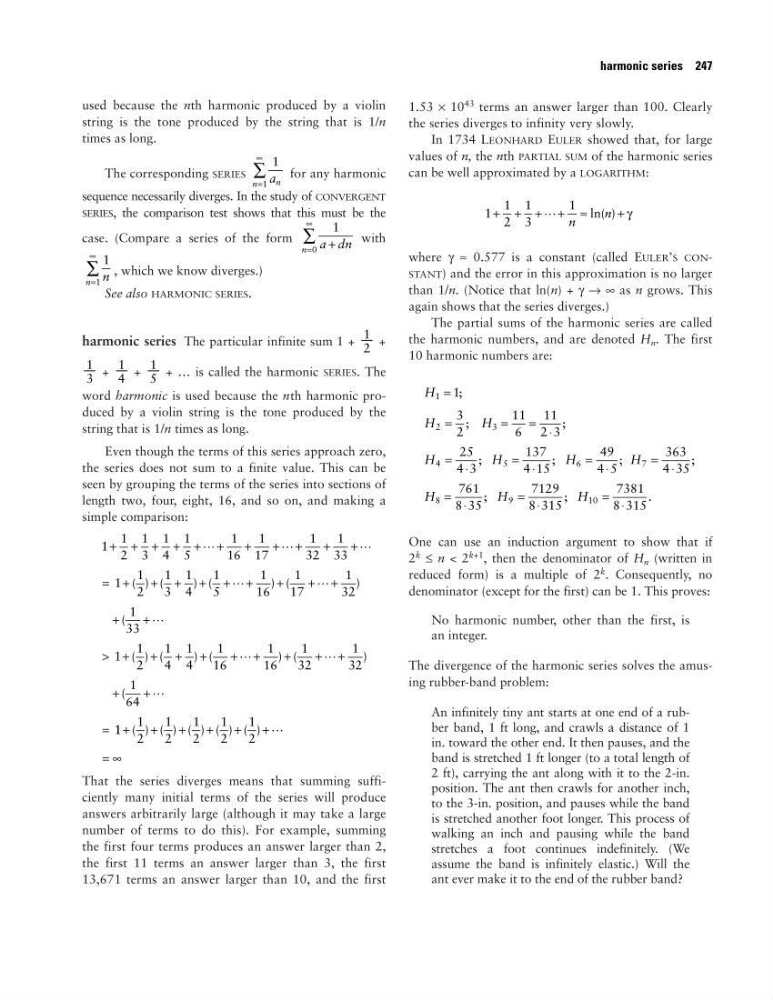
seen by grouping the terms of the series into sections of
length two, four, eight, 16, and so on, and making a
simple comparison:
That the series diverges means that summing sufficiently many initial terms of the series will produce
answers arbitrarily large (although it may take a large
number of terms to do this). For example, summing
the first four terms produces an answer larger than 2,
the first 11 terms an answer larger than 3, the first
13,671 terms an answer larger than 10, and the first
1.53 × 10
43 terms an answer larger than 100. Clearly
the series diverges to infinity very slowly.
In 1734 LEONHARD EULER showed that, for large
values of n, the nth PARTIAL SUM of the harmonic series
can be well approximated by a LOGARITHM:
where γ ≈ 0.577 is a constant (called EULER’S CONSTANT) and the error in this approximation is no larger
than 1/n. (Notice that ln(n) + γ → ∞ as n grows. This
again shows that the series diverges.)
The partial sums of the harmonic series are called
the harmonic numbers, and are denoted H n . The first
10 harmonic numbers are:
One can use an induction argument to show that if
2
k
≤ n < 2
k+1 , then the denominator of H n (written in
reduced form) is a multiple of 2
k . Consequently, no
denominator (except for the first) can be 1. This proves:
No harmonic number, other than the first, is
an integer.
The divergence of the harmonic series solves the amusing rubber-band problem:
An infinitely tiny ant starts at one end of a rubber band, 1 ft long, and crawls a distance of 1
in. toward the other end. It then pauses, and the
band is stretched 1 ft longer (to a total length of
2 ft), carrying the ant along with it to the 2-in.
position. The ant then crawls for another inch,
to the 3-in. position, and pauses while the band
is stretched another foot longer. This process of
walking an inch and pausing while the band
stretches a foot continues indefinitely. (We
assume the band is infinitely elastic.) Will the
ant ever make it to the end of the rubber band?
H
H
H
H
H
H
H
H
H
H
1
2
3
4
5
6
7
8
9
1 0
1
3
2
11
6
11
2 3
25
4 3
137
4 15
49
4 5
363
4 35
761
8 35
7129
8 315
7381
8 315
=
=
=
= ⋅
= ⋅
= ⋅
= ⋅
= ⋅
= ⋅
= ⋅
= ⋅
;
;
;
;
;
;
;
;
;
.
1
1
2
1
3
1
+ + + + ≈
+
L n
n
ln( ) γ
1
1
2
1
3
1
4
1
5
1
16
1
17
1
32
1
33
1
1
2
1
3
1
4
1
5
1
16
1
17
1
32
1
33
1
1
2
1
4
1
4
1
16
1
16
1
32
1
32
1
64
+ + + + + +
+
+ +
+
+
= +
+ + + + +
+
+ +
+
+
> +
+ + +
+ +
+
+ +
+
+
=
L
L
L
L
L
L
L
L
L
( ) (
) (
) (
)
(
( ) (
) (
) (
)
(
1 1
1
2
1
2
1
2
1
2
1
2
+
+
+
+
+
+
= ∞
( ) ( ) ( ) ( ) ( ) L
1
–
5
1
–
4
1
–
3
1
–
2
1
1 n
n=
∞
∑
1
0 a dn
n
+
=
∞
∑
1
1 a n
n=
∞
∑
harmonic series 247
string is the tone produced by the string that is 1/n
times as long.
The corresponding SERIES
for any harmonic
sequence necessarily diverges. In the study of CONVERGENT
SERIES, the comparison test shows that this must be the
case. (Compare a series of the form
with
, which we know diverges.)
See also HARMONIC SERIES.
harmonic series The particular infinite sum 1 +
+
+
+
+ … is called the harmonic SERIES. The
word harmonic is used because the nth harmonic produced by a violin string is the tone produced by the
string that is 1/n times as long.
Even though the terms of this series approach zero,
the series does not sum to a finite value. This can be
seen by grouping the terms of the series into sections of
length two, four, eight, 16, and so on, and making a
simple comparison:
That the series diverges means that summing sufficiently many initial terms of the series will produce
answers arbitrarily large (although it may take a large
number of terms to do this). For example, summing
the first four terms produces an answer larger than 2,
the first 11 terms an answer larger than 3, the first
13,671 terms an answer larger than 10, and the first
1.53 × 10
43 terms an answer larger than 100. Clearly
the series diverges to infinity very slowly.
In 1734 LEONHARD EULER showed that, for large
values of n, the nth PARTIAL SUM of the harmonic series
can be well approximated by a LOGARITHM:
where γ ≈ 0.577 is a constant (called EULER’S CONSTANT) and the error in this approximation is no larger
than 1/n. (Notice that ln(n) + γ → ∞ as n grows. This
again shows that the series diverges.)
The partial sums of the harmonic series are called
the harmonic numbers, and are denoted H n . The first
10 harmonic numbers are:
One can use an induction argument to show that if
2
k
≤ n < 2
k+1 , then the denominator of H n (written in
reduced form) is a multiple of 2
k . Consequently, no
denominator (except for the first) can be 1. This proves:
No harmonic number, other than the first, is
an integer.
The divergence of the harmonic series solves the amusing rubber-band problem:
An infinitely tiny ant starts at one end of a rubber band, 1 ft long, and crawls a distance of 1
in. toward the other end. It then pauses, and the
band is stretched 1 ft longer (to a total length of
2 ft), carrying the ant along with it to the 2-in.
position. The ant then crawls for another inch,
to the 3-in. position, and pauses while the band
is stretched another foot longer. This process of
walking an inch and pausing while the band
stretches a foot continues indefinitely. (We
assume the band is infinitely elastic.) Will the
ant ever make it to the end of the rubber band?
H
H
H
H
H
H
H
H
H
H
1
2
3
4
5
6
7
8
9
1 0
1
3
2
11
6
11
2 3
25
4 3
137
4 15
49
4 5
363
4 35
761
8 35
7129
8 315
7381
8 315
=
=
=
= ⋅
= ⋅
= ⋅
= ⋅
= ⋅
= ⋅
= ⋅
= ⋅
;
;
;
;
;
;
;
;
;
.
1
1
2
1
3
1
+ + + + ≈
+
L n
n
ln( ) γ
1
1
2
1
3
1
4
1
5
1
16
1
17
1
32
1
33
1
1
2
1
3
1
4
1
5
1
16
1
17
1
32
1
33
1
1
2
1
4
1
4
1
16
1
16
1
32
1
32
1
64
+ + + + + +
+
+ +
+
+
= +
+ + + + +
+
+ +
+
+
> +
+ + +
+ +
+
+ +
+
+
=
L
L
L
L
L
L
L
L
L
( ) (
) (
) (
)
(
( ) (
) (
) (
)
(
1 1
1
2
1
2
1
2
1
2
1
2
+
+
+
+
+
+
= ∞
( ) ( ) ( ) ( ) ( ) L
1
–
5
1
–
4
1
–
3
1
–
2
1
1 n
n=
∞
∑
1
0 a dn
n
+
=
∞
∑
1
1 a n
n=
∞
∑
harmonic series 247