

Gregory series (Leibniz’s series) Named after the
Scottish astronomer and algebraist JAMES GREGORY
(1638–75), the MACLAURIN SERIES for arctan(x) is
sometimes called the Gregory series:
This expression is valid for –1 ≤ x ≤ 1. Placing x = 1
into the formula yields the following remarkable formula for PI:
Often the name “Gregory series” is used to mean this
particular expression.
See also INVERSE TRIGONOMETRIC FUNCTIONS;
MADHAVA OF SANGAMAGRAMMA; TAYLOR SERIES.
group Research in pure mathematics is motivated
by one question: what makes mathematics work the
way it does? By identifying the key principles that
underpin one type of mathematical system—be it
geometry and symmetry, or numbers and arithmetic—
mathematicians establish connections between disparate fields: known facts about any one system
satisfying a set of basic principles translate immediately to analogous facts about a second system satisfying analogous principles. For example, a study of
arithmetic shows that the operation of addition satisfies the same four basic principles as multiplication.
Thus any known fact about addition is accompanied
by a known fact about multiplication (and this corresponding result about multiplication consequently
requires no new proof.)
Motivated by the workings of arithmetic, mathematicians define a group to be any set, often denoted
G, whose elements can be combined in some way that
mimics the addition or the multiplication of the integers. Specifically, if we denote the result of combining
the elements a and b of G by the symbol a*b, then G is
a group if the following four axioms hold:
1. Closure: For all a and b in G, the element a*b is
also a member of G.
2. Associativity: For all a,b,c in G we have: a*(b*c) =
(a*b)*c.
3. Existence of an identity: There is an element e in G
so that a*e = a = e*a for all a in G.
4. Existence of inverses: For any a in G there is an element b in G such that a*b = e and b*a = e.
To honor the work of Norwegian scholar NIELS
HENRIK ABEL (1802–29), mathematicians call G
“Abelian” if a fifth axiom also holds:
5. Commutativity: For all a and b in G we have: a*b
= b*a.
These axioms do indeed capture the working principles behind both addition and multiplication. For
example, interpreting “*” as addition with “e” as the
number zero, the set of all integers satisfies the axioms
of an Abelian group. (In this setting the inverse of an
integer a is usually denoted –a.) The set of all real numbers with zero removed forms an Abelian group under
multiplication. In this context, * is interpreted as the
product operation, “e” is the number 1, and the inverse
of an element a is the number 1/a.
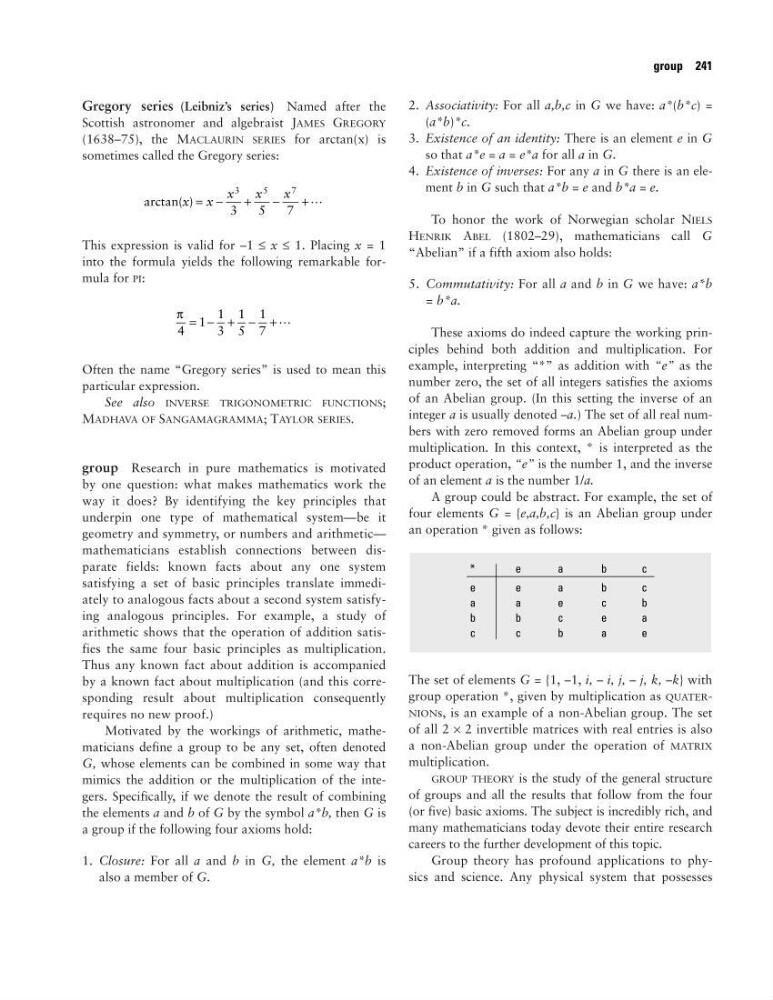
A group could be abstract. For example, the set of
four elements G = {e,a,b,c} is an Abelian group under
an operation * given as follows:
The set of elements G = {1, –1, i, – i, j, – j, k, –k} with
group operation *, given by multiplication as QUATERNIONs, is an example of a non-Abelian group. The set
of all 2 × 2 invertible matrices with real entries is also
a non-Abelian group under the operation of MATRIX
multiplication.
GROUP THEORY is the study of the general structure
of groups and all the results that follow from the four
(or five) basic axioms. The subject is incredibly rich, and
many mathematicians today devote their entire research
careers to the further development of this topic.
Group theory has profound applications to physics and science. Any physical system that possesses
*
e
a
b
c
e
e
a
b
c
a
a
e
c
b
b
b
c
e
a
c
c
b
a
e
π
4
1
1
3
1
5
1
7
= − + − +L
arctan( )
x x
x
x
x
= −
+
−
+
3
5
7
3
5
7
L
group 241
Scottish astronomer and algebraist JAMES GREGORY
(1638–75), the MACLAURIN SERIES for arctan(x) is
sometimes called the Gregory series:
This expression is valid for –1 ≤ x ≤ 1. Placing x = 1
into the formula yields the following remarkable formula for PI:
Often the name “Gregory series” is used to mean this
particular expression.
See also INVERSE TRIGONOMETRIC FUNCTIONS;
MADHAVA OF SANGAMAGRAMMA; TAYLOR SERIES.
group Research in pure mathematics is motivated
by one question: what makes mathematics work the
way it does? By identifying the key principles that
underpin one type of mathematical system—be it
geometry and symmetry, or numbers and arithmetic—
mathematicians establish connections between disparate fields: known facts about any one system
satisfying a set of basic principles translate immediately to analogous facts about a second system satisfying analogous principles. For example, a study of
arithmetic shows that the operation of addition satisfies the same four basic principles as multiplication.
Thus any known fact about addition is accompanied
by a known fact about multiplication (and this corresponding result about multiplication consequently
requires no new proof.)
Motivated by the workings of arithmetic, mathematicians define a group to be any set, often denoted
G, whose elements can be combined in some way that
mimics the addition or the multiplication of the integers. Specifically, if we denote the result of combining
the elements a and b of G by the symbol a*b, then G is
a group if the following four axioms hold:
1. Closure: For all a and b in G, the element a*b is
also a member of G.
2. Associativity: For all a,b,c in G we have: a*(b*c) =
(a*b)*c.
3. Existence of an identity: There is an element e in G
so that a*e = a = e*a for all a in G.
4. Existence of inverses: For any a in G there is an element b in G such that a*b = e and b*a = e.
To honor the work of Norwegian scholar NIELS
HENRIK ABEL (1802–29), mathematicians call G
“Abelian” if a fifth axiom also holds:
5. Commutativity: For all a and b in G we have: a*b
= b*a.
These axioms do indeed capture the working principles behind both addition and multiplication. For
example, interpreting “*” as addition with “e” as the
number zero, the set of all integers satisfies the axioms
of an Abelian group. (In this setting the inverse of an
integer a is usually denoted –a.) The set of all real numbers with zero removed forms an Abelian group under
multiplication. In this context, * is interpreted as the
product operation, “e” is the number 1, and the inverse
of an element a is the number 1/a.
A group could be abstract. For example, the set of
four elements G = {e,a,b,c} is an Abelian group under
an operation * given as follows:
The set of elements G = {1, –1, i, – i, j, – j, k, –k} with
group operation *, given by multiplication as QUATERNIONs, is an example of a non-Abelian group. The set
of all 2 × 2 invertible matrices with real entries is also
a non-Abelian group under the operation of MATRIX
multiplication.
GROUP THEORY is the study of the general structure
of groups and all the results that follow from the four
(or five) basic axioms. The subject is incredibly rich, and
many mathematicians today devote their entire research
careers to the further development of this topic.
Group theory has profound applications to physics and science. Any physical system that possesses
*
e
a
b
c
e
e
a
b
c
a
a
e
c
b
b
b
c
e
a
c
c
b
a
e
π
4
1
1
3
1
5
1
7
= − + − +L
arctan( )
x x
x
x
x
= −
+
−
+
3
5
7
3
5
7
L
group 241