

In 1705, GOTTFRIED WILHELM LEIBNIZ noticed that
many convergent alternating series, like the Gregory
series, have terms a i that decrease and approach zero:
i. a 1 ≥ a 2 ≥ a 3 ≥…
ii. a n → 0
He managed to prove that any alternating series satisfying these two conditions does indeed converge, and
today this result is called the “alternating series test.”
(One can see that the test is valid if one physically
paces smaller and smaller steps back and forth: a 1 feet
forward, a 2 feet backward, a 3 feet forward, and so on.
This motion begins to “hone in” on a single limiting
location.) We see, for example, that the series
converges. Unfortunately,
the alternating series test gives us no indication as to
what the value of the sum could be. Generally, finding
the limit value is a considerable amount of work, if at
all possible. The values of many “simple” alternating
series are not known today. (One can show, however,
that the above series above converges to π
2 /12. See
CONVERGENT SERIES.)
See also ZETA FUNCTION.
altitude A line segment indicating the height of a
two- or three-dimensional geometric figure such as a
POLYGON, POLYHEDRON, CYLINDER, or CONE is called
an altitude of the figure. An altitude meets the base of
the figure at a RIGHT ANGLE.
Any TRIANGLE has three distinct altitudes. Each is a
LINE segment emanating from a vertex of the triangle
meeting the opposite edge at a 90° angle. The LAW OF
SINES shows that the lengths h a , h b , and h c of the three
altitudes of a triangle ABC satisfy:
h a = c sin β = b sin γ
h b = a sin γ = c sin α
h c = b sin α = a sin β
where a, b, and c are the side-lengths of the triangle,
and α, β, and γ are the angles at vertices A, B, and C,
respectively. Here h a is the altitude meeting the side of
length a at 90°. Similarly, h b and h c are the altitudes
meeting sides of length b and c, respectively. It also follows from this law that the following relation holds:
where r is the radius of the circle that contains the
points A, B, and C.
The three altitudes of a triangle always meet at a
common point called the orthocenter of the triangle.
Surprisingly, this fundamental fact was not noticed by
the geometer EUCLID (ca. 300 B.C.E.). The claim can be
proved as follows:
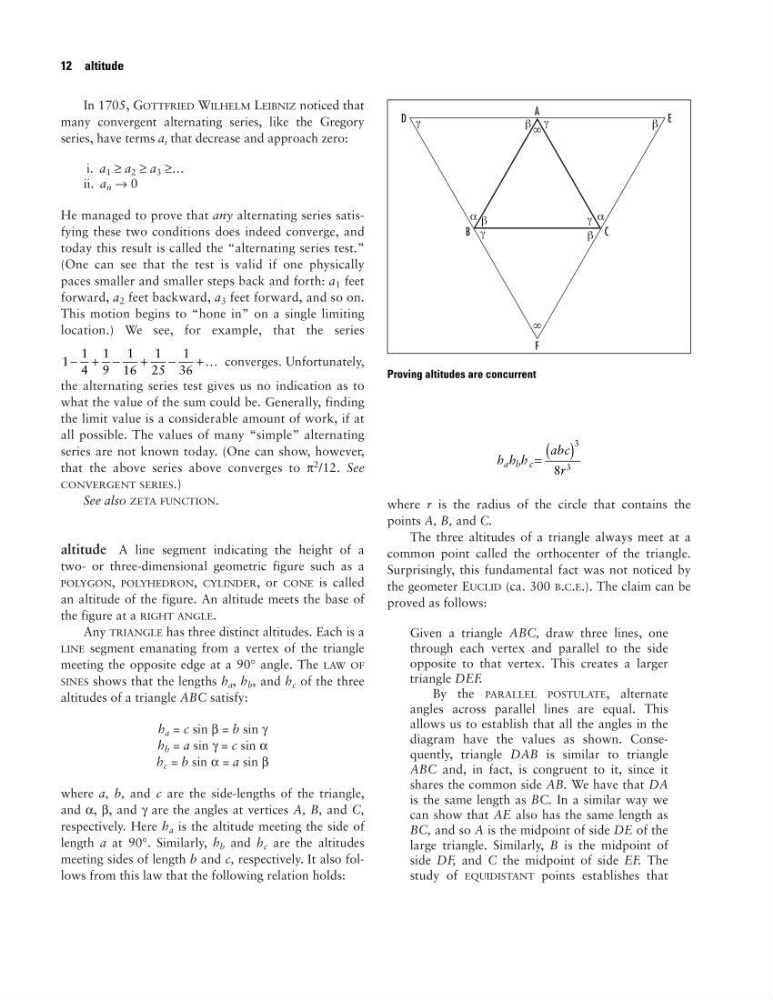
Given a triangle ABC, draw three lines, one
through each vertex and parallel to the side
opposite to that vertex. This creates a larger
triangle DEF.
By the PARALLEL POSTULATE, alternate
angles across parallel lines are equal. This
allows us to establish that all the angles in the
diagram have the values as shown. Consequently, triangle DAB is similar to triangle
ABC and, in fact, is congruent to it, since it
shares the common side AB. We have that DA
is the same length as BC. In a similar way we
can show that AE also has the same length as
BC, and so A is the midpoint of side DE of the
large triangle. Similarly, B is the midpoint of
side DF, and C the midpoint of side EF. The
study of EQUIDISTANT points establishes that
h h h
abc
r
a b c =
( )
3
3
8
1
1
4
1
9
1
16
1
25
1
36
− + −
+
−
+K
12 altitude
Proving altitudes are concurrent
many convergent alternating series, like the Gregory
series, have terms a i that decrease and approach zero:
i. a 1 ≥ a 2 ≥ a 3 ≥…
ii. a n → 0
He managed to prove that any alternating series satisfying these two conditions does indeed converge, and
today this result is called the “alternating series test.”
(One can see that the test is valid if one physically
paces smaller and smaller steps back and forth: a 1 feet
forward, a 2 feet backward, a 3 feet forward, and so on.
This motion begins to “hone in” on a single limiting
location.) We see, for example, that the series
converges. Unfortunately,
the alternating series test gives us no indication as to
what the value of the sum could be. Generally, finding
the limit value is a considerable amount of work, if at
all possible. The values of many “simple” alternating
series are not known today. (One can show, however,
that the above series above converges to π
2 /12. See
CONVERGENT SERIES.)
See also ZETA FUNCTION.
altitude A line segment indicating the height of a
two- or three-dimensional geometric figure such as a
POLYGON, POLYHEDRON, CYLINDER, or CONE is called
an altitude of the figure. An altitude meets the base of
the figure at a RIGHT ANGLE.
Any TRIANGLE has three distinct altitudes. Each is a
LINE segment emanating from a vertex of the triangle
meeting the opposite edge at a 90° angle. The LAW OF
SINES shows that the lengths h a , h b , and h c of the three
altitudes of a triangle ABC satisfy:
h a = c sin β = b sin γ
h b = a sin γ = c sin α
h c = b sin α = a sin β
where a, b, and c are the side-lengths of the triangle,
and α, β, and γ are the angles at vertices A, B, and C,
respectively. Here h a is the altitude meeting the side of
length a at 90°. Similarly, h b and h c are the altitudes
meeting sides of length b and c, respectively. It also follows from this law that the following relation holds:
where r is the radius of the circle that contains the
points A, B, and C.
The three altitudes of a triangle always meet at a
common point called the orthocenter of the triangle.
Surprisingly, this fundamental fact was not noticed by
the geometer EUCLID (ca. 300 B.C.E.). The claim can be
proved as follows:
Given a triangle ABC, draw three lines, one
through each vertex and parallel to the side
opposite to that vertex. This creates a larger
triangle DEF.
By the PARALLEL POSTULATE, alternate
angles across parallel lines are equal. This
allows us to establish that all the angles in the
diagram have the values as shown. Consequently, triangle DAB is similar to triangle
ABC and, in fact, is congruent to it, since it
shares the common side AB. We have that DA
is the same length as BC. In a similar way we
can show that AE also has the same length as
BC, and so A is the midpoint of side DE of the
large triangle. Similarly, B is the midpoint of
side DF, and C the midpoint of side EF. The
study of EQUIDISTANT points establishes that
h h h
abc
r
a b c =
( )
3
3
8
1
1
4
1
9
1
16
1
25
1
36
− + −
+
−
+K
12 altitude
Proving altitudes are concurrent