

where r represents the radius of the circle. The
QUADRATIC formula for the roots of a quadratic equation of the form ax
2 + bx + c = 0 is:
foundations of mathematics The branch of mathematics concerned with the justification of mathematical
rules, AXIOMs, and modes of inference is called foundations of mathematics. The paradigm for critical mathematical analysis came from the work of the great
geometer EUCLID (ca. 300–260 B.C.E.) who, in his work
THE ELEMENTS, demonstrated that all geometry known
at his time can be logically deduced from a small set of
self-evident truths (axioms). LEONHARD EULER
(1707–83) produced fundamental results in disparate
branches of mathematics and often saw connections
between those branches. He too searched for small collections of concepts that were fundamental and, hopefully, common to all fields. In the late 1800s and at the
turn of the century with the discovery of RUSSELL’S
PARADOX in SET THEORY, mathematicians were led to
apparent paradoxes and inconsistencies within the
seemingly very basic notions of “set” and “number.”
This led to the fervent study of the fundamental principles of elementary mathematics and even to the study of
the process of mathematical thinking itself (FORMAL
LOGIC). In the 1930s Austrian mathematician KURT
GÖDEL (1906–78) stunned the mathematical community by proving, essentially, that any formal system of
mathematics that incorporates the principles of arithmetic will contain statements that can neither be proved
nor disproved, and, in addition, such a system will necessarily be incapable of establishing that it is free from
CONTRADICTIONs. Despite these disturbing conclusions,
the study of the founding principles of mathematics is
still an active area of research today.
See also GEORG CANTOR; GÖDEL’S INCOMPLETENESS THEOREMS; BERTRAND ARTHUR WILLIAM RUSSELL;
ALFRED NORTH WHITEHEAD; ERNST FRIEDRICH FERDINAND ZERMELO.
four-color theorem For centuries, cartographers have
known that four colors suffice to color any geographical
map (that is, any division of the plane into regions). It is
required that regions sharing a common length of
boundary be painted different colors (but two regions
meeting at a point, such as the states Arizona and Colorado on a map of the United States, may be painted the
same tint). Cartographers had also observed that the
same is true for any map drawn on a SPHERE (the globe).
The question of whether this observation could be
proved true mathematically was first posed by English
scholar Francis Guthrie in 1852. Mathematicians
AUGUSTUS DE MORGAN (1806–71) and ARTHUR CAYLEY (1821–95) worked to solve the problem and, in
1872, Cayley’s student Alfred Bray Kempe (1849–1922)
produced the first attempt at a proof of the four-color
conjecture. Unfortunately, 11 years later English scholar
Percy Heawood (1861–1955) found that Kempe had
made an error in his work. In 1890 Headwood later
proved that five colors will always suffice to color a planar map, but the proof that just four will actually suffice eluded him. Heawood also looked beyond just
planar and spherical maps and made a general conjecture that if a surface contains g holes (such as TORUS
with g = 1 hole, or a sphere with g = 0 holes), then any
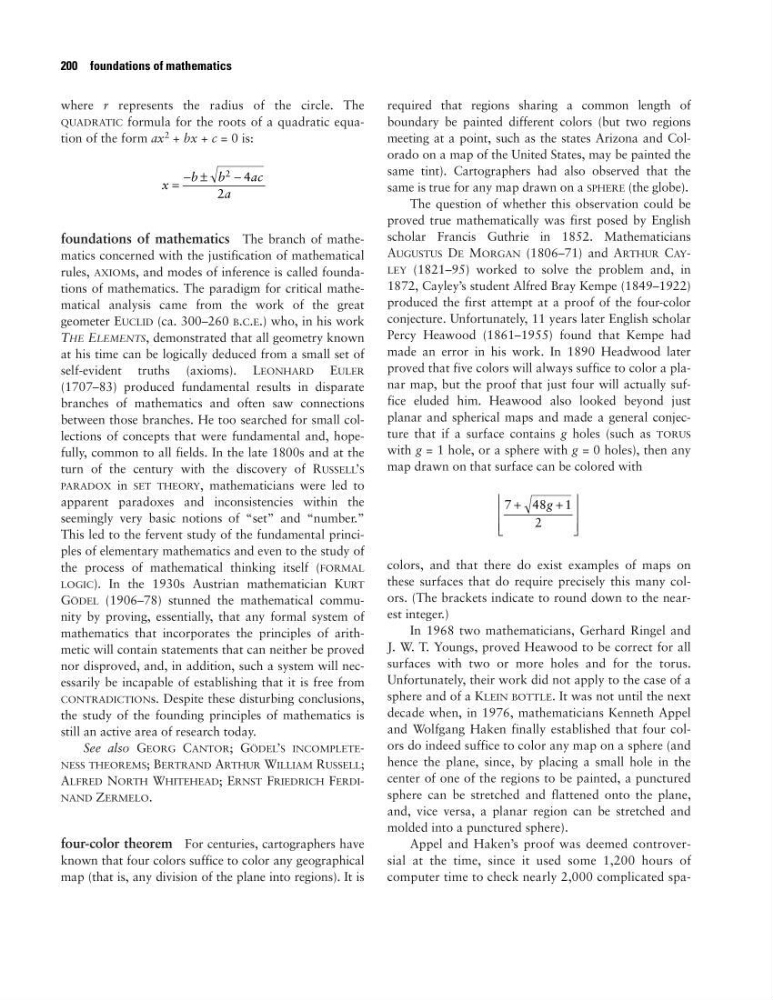
map drawn on that surface can be colored with
colors, and that there do exist examples of maps on
these surfaces that do require precisely this many colors. (The brackets indicate to round down to the nearest integer.)
In 1968 two mathematicians, Gerhard Ringel and
J. W. T. Youngs, proved Heawood to be correct for all
surfaces with two or more holes and for the torus.
Unfortunately, their work did not apply to the case of a
sphere and of a KLEIN BOTTLE. It was not until the next
decade when, in 1976, mathematicians Kenneth Appel
and Wolfgang Haken finally established that four colors do indeed suffice to color any map on a sphere (and
hence the plane, since, by placing a small hole in the
center of one of the regions to be painted, a punctured
sphere can be stretched and flattened onto the plane,
and, vice versa, a planar region can be stretched and
molded into a punctured sphere).
Appel and Haken’s proof was deemed controversial at the time, since it used some 1,200 hours of
computer time to check nearly 2,000 complicated spa7
48 1
2
+
+
g
x
b
b
ac
a
=
− ±
−
2
4
2
200 foundations of mathematics
QUADRATIC formula for the roots of a quadratic equation of the form ax
2 + bx + c = 0 is:
foundations of mathematics The branch of mathematics concerned with the justification of mathematical
rules, AXIOMs, and modes of inference is called foundations of mathematics. The paradigm for critical mathematical analysis came from the work of the great
geometer EUCLID (ca. 300–260 B.C.E.) who, in his work
THE ELEMENTS, demonstrated that all geometry known
at his time can be logically deduced from a small set of
self-evident truths (axioms). LEONHARD EULER
(1707–83) produced fundamental results in disparate
branches of mathematics and often saw connections
between those branches. He too searched for small collections of concepts that were fundamental and, hopefully, common to all fields. In the late 1800s and at the
turn of the century with the discovery of RUSSELL’S
PARADOX in SET THEORY, mathematicians were led to
apparent paradoxes and inconsistencies within the
seemingly very basic notions of “set” and “number.”
This led to the fervent study of the fundamental principles of elementary mathematics and even to the study of
the process of mathematical thinking itself (FORMAL
LOGIC). In the 1930s Austrian mathematician KURT
GÖDEL (1906–78) stunned the mathematical community by proving, essentially, that any formal system of
mathematics that incorporates the principles of arithmetic will contain statements that can neither be proved
nor disproved, and, in addition, such a system will necessarily be incapable of establishing that it is free from
CONTRADICTIONs. Despite these disturbing conclusions,
the study of the founding principles of mathematics is
still an active area of research today.
See also GEORG CANTOR; GÖDEL’S INCOMPLETENESS THEOREMS; BERTRAND ARTHUR WILLIAM RUSSELL;
ALFRED NORTH WHITEHEAD; ERNST FRIEDRICH FERDINAND ZERMELO.
four-color theorem For centuries, cartographers have
known that four colors suffice to color any geographical
map (that is, any division of the plane into regions). It is
required that regions sharing a common length of
boundary be painted different colors (but two regions
meeting at a point, such as the states Arizona and Colorado on a map of the United States, may be painted the
same tint). Cartographers had also observed that the
same is true for any map drawn on a SPHERE (the globe).
The question of whether this observation could be
proved true mathematically was first posed by English
scholar Francis Guthrie in 1852. Mathematicians
AUGUSTUS DE MORGAN (1806–71) and ARTHUR CAYLEY (1821–95) worked to solve the problem and, in
1872, Cayley’s student Alfred Bray Kempe (1849–1922)
produced the first attempt at a proof of the four-color
conjecture. Unfortunately, 11 years later English scholar
Percy Heawood (1861–1955) found that Kempe had
made an error in his work. In 1890 Headwood later
proved that five colors will always suffice to color a planar map, but the proof that just four will actually suffice eluded him. Heawood also looked beyond just
planar and spherical maps and made a general conjecture that if a surface contains g holes (such as TORUS
with g = 1 hole, or a sphere with g = 0 holes), then any
map drawn on that surface can be colored with
colors, and that there do exist examples of maps on
these surfaces that do require precisely this many colors. (The brackets indicate to round down to the nearest integer.)
In 1968 two mathematicians, Gerhard Ringel and
J. W. T. Youngs, proved Heawood to be correct for all
surfaces with two or more holes and for the torus.
Unfortunately, their work did not apply to the case of a
sphere and of a KLEIN BOTTLE. It was not until the next
decade when, in 1976, mathematicians Kenneth Appel
and Wolfgang Haken finally established that four colors do indeed suffice to color any map on a sphere (and
hence the plane, since, by placing a small hole in the
center of one of the regions to be painted, a punctured
sphere can be stretched and flattened onto the plane,
and, vice versa, a planar region can be stretched and
molded into a punctured sphere).
Appel and Haken’s proof was deemed controversial at the time, since it used some 1,200 hours of
computer time to check nearly 2,000 complicated spa7
48 1
2
+
+
g
x
b
b
ac
a
=
− ±
−
2
4
2
200 foundations of mathematics