

times 8” is computed as 60 + 2 × 2 = 64, “9 times 7” as
60 + 1 × 3 = 63, and “6 times 7” as 30 + 3 × 4 = 42.
Notice that one is never required to multiply two numbers greater than five. That the method works is
explained by the algebraic identity:
(5 + a)(5 + b) = 10(a + b) + (5 – a)(5 – b)
The identity (N + a)(N + b) = 2N(a + b) + (N – a)(N – b)
shows that we can extend this method to use of a different number of digits on each hand. For example, with
N = 10, using fingers and toes, one can readily compute
17 × 18 as “seven raised fingers” and “eight raised
toes.” Counting each raised digit as 20 (2N) we have:
17 × 18 = 20 × 15 + 3 × 2 = 306.
See also EGYPTIAN MULTIPLICATION; ELIZABETHAN
MULTIPLICATION; MULTIPLICATION; NAPIER’S BONES;
RUSSIAN MULTIPLICATION.
finite Intuitively, a set is said to be finite if one can
recite all the elements of the set in a bounded amount
of time. For instance, the set {knife, fork, spoon} is
finite, for it takes only a second or two to recite the elements of this set. On the other hand, the set of natural
numbers {1, 2, 3, …} is not finite, for one can never
recite each and every element of this set.
Despite our intuitive understanding of the concept,
it is difficult to give a precise and direct mathematical
definition of a finite set. The easiest approach is to
simply define a finite set to be one that is not INFINITE,
since the notion of an infinite set can be made clear.
Alternatively, since there is a well-defined procedure
for mechanically writing down the string of natural
numbers 1, 2, 3, …, one can define a finite set to be
any set S whose elements can be put in one-to-one correspondence with a bounded initial segment of the
string of natural numbers. For instance, matching
“knife” with 1, “fork” with 2, and “spoon” with 3,
the set {knife, fork, spoon} is finite because its elements can be matched precisely with the string of natural numbers {1, 2, 3}.
finite differences To analyze the terms of a
SEQUENCE, it can be useful to create a table of successive
differences (in the sense of “right minus left”) between
the terms of the sequence, and subsequent differences of
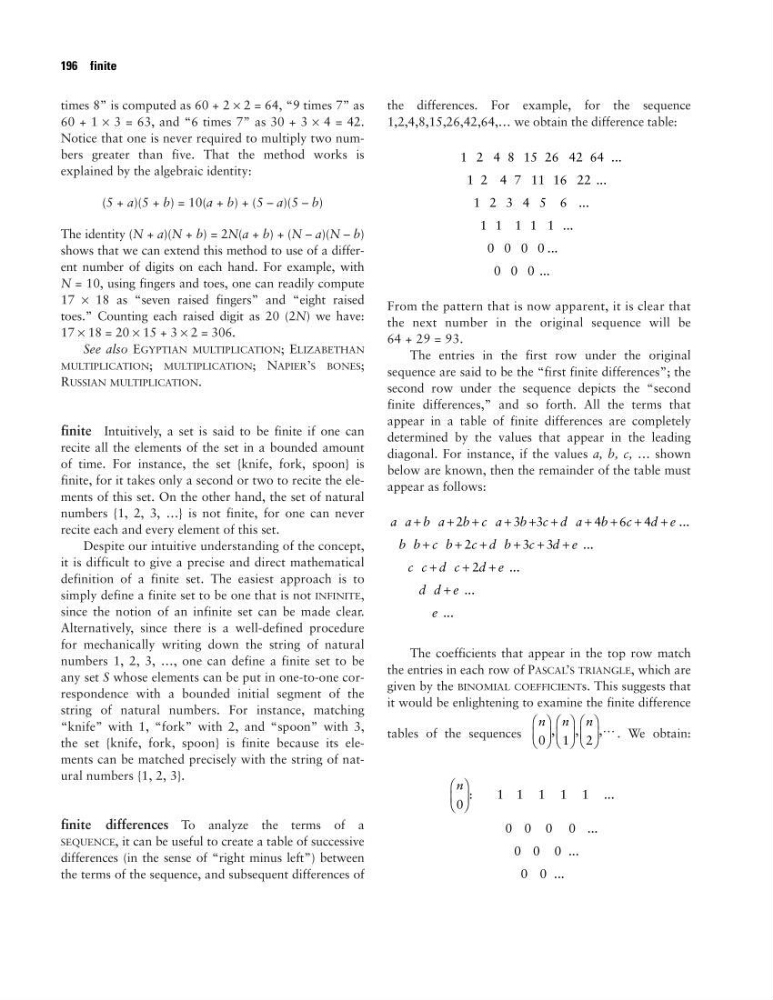
the differences. For example, for the sequence
1,2,4,8,15,26,42,64,… we obtain the difference table:
From the pattern that is now apparent, it is clear that
the next number in the original sequence will be
64 + 29 = 93.
The entries in the first row under the original
sequence are said to be the “first finite differences”; the
second row under the sequence depicts the “second
finite differences,” and so forth. All the terms that
appear in a table of finite differences are completely
determined by the values that appear in the leading
diagonal. For instance, if the values a, b, c, … shown
below are known, then the remainder of the table must
appear as follows:
The coefficients that appear in the top row match
the entries in each row of PASCAL’S TRIANGLE, which are
given by the BINOMIAL COEFFICIENTs. This suggests that
it would be enlightening to examine the finite difference
tables of the sequences
. We obtain:
n
0
1 1 1 1 1
0 0 0 0
0 0 0
0 0
:
...
...
...
...
n n n
0 1 2
,
,
,L
a a b a b c a b c d a b c
d e
b b c b c d b c d e
c c d c
d e
d d e
e
+
+ +
+ + +
+ + +
+
+
+ +
+ + +
+
+
+
+
2
3 3
4 6 4
2
3 3
2
...
...
...
...
...
1 2 4 8 15 26 42 64
1 2 4 7 11 16 22
1 2 3 4 5 6
1 1 1 1 1
0 0 0 0
0 0 0
...
...
...
...
...
...
196 finite
60 + 1 × 3 = 63, and “6 times 7” as 30 + 3 × 4 = 42.
Notice that one is never required to multiply two numbers greater than five. That the method works is
explained by the algebraic identity:
(5 + a)(5 + b) = 10(a + b) + (5 – a)(5 – b)
The identity (N + a)(N + b) = 2N(a + b) + (N – a)(N – b)
shows that we can extend this method to use of a different number of digits on each hand. For example, with
N = 10, using fingers and toes, one can readily compute
17 × 18 as “seven raised fingers” and “eight raised
toes.” Counting each raised digit as 20 (2N) we have:
17 × 18 = 20 × 15 + 3 × 2 = 306.
See also EGYPTIAN MULTIPLICATION; ELIZABETHAN
MULTIPLICATION; MULTIPLICATION; NAPIER’S BONES;
RUSSIAN MULTIPLICATION.
finite Intuitively, a set is said to be finite if one can
recite all the elements of the set in a bounded amount
of time. For instance, the set {knife, fork, spoon} is
finite, for it takes only a second or two to recite the elements of this set. On the other hand, the set of natural
numbers {1, 2, 3, …} is not finite, for one can never
recite each and every element of this set.
Despite our intuitive understanding of the concept,
it is difficult to give a precise and direct mathematical
definition of a finite set. The easiest approach is to
simply define a finite set to be one that is not INFINITE,
since the notion of an infinite set can be made clear.
Alternatively, since there is a well-defined procedure
for mechanically writing down the string of natural
numbers 1, 2, 3, …, one can define a finite set to be
any set S whose elements can be put in one-to-one correspondence with a bounded initial segment of the
string of natural numbers. For instance, matching
“knife” with 1, “fork” with 2, and “spoon” with 3,
the set {knife, fork, spoon} is finite because its elements can be matched precisely with the string of natural numbers {1, 2, 3}.
finite differences To analyze the terms of a
SEQUENCE, it can be useful to create a table of successive
differences (in the sense of “right minus left”) between
the terms of the sequence, and subsequent differences of
the differences. For example, for the sequence
1,2,4,8,15,26,42,64,… we obtain the difference table:
From the pattern that is now apparent, it is clear that
the next number in the original sequence will be
64 + 29 = 93.
The entries in the first row under the original
sequence are said to be the “first finite differences”; the
second row under the sequence depicts the “second
finite differences,” and so forth. All the terms that
appear in a table of finite differences are completely
determined by the values that appear in the leading
diagonal. For instance, if the values a, b, c, … shown
below are known, then the remainder of the table must
appear as follows:
The coefficients that appear in the top row match
the entries in each row of PASCAL’S TRIANGLE, which are
given by the BINOMIAL COEFFICIENTs. This suggests that
it would be enlightening to examine the finite difference
tables of the sequences
. We obtain:
n
0
1 1 1 1 1
0 0 0 0
0 0 0
0 0
:
...
...
...
...
n n n
0 1 2
,
,
,L
a a b a b c a b c d a b c
d e
b b c b c d b c d e
c c d c
d e
d d e
e
+
+ +
+ + +
+ + +
+
+
+ +
+ + +
+
+
+
+
2
3 3
4 6 4
2
3 3
2
...
...
...
...
...
1 2 4 8 15 26 42 64
1 2 4 7 11 16 22
1 2 3 4 5 6
1 1 1 1 1
0 0 0 0
0 0 0
...
...
...
...
...
...
196 finite