

sequence. For example, there are F n ways to climb n – 1
steps, one or two steps at a time (consider beginning the
climb with either a single step or a double step). There
are also F n ways to tile a 1 × (n – 1) row of squares with
1 × 1 tiles and 1 × 2 dominoes, and there are F n
sequences of 0s and 1s n-digits long beginning and ending with 1 and containing no two consecutive 0s.
Regarding a 1 as “tails” and 0 and “heads,” and
ignoring the initial and final 1s, this latter example can
be used to show that the PROBABILITY of not getting
two heads in a row when tossing a coin n times is
. One can also use it to show that there are F n+2
subsets of {1,2,…,n} lacking two consecutive numbers
as members.
Perhaps the most surprising appearances of
Fibonacci numbers occur in nature. The seeds in a sunflower’s head, for example, appear to form two systems
of spirals—often with 55 spirals arcing in a clockwise
tilt, and 34 spirals with a counterclockwise tilt. (Large
species of sunflowers have 89 and 144 spirals, again
consecutive Fibonacci numbers.) This appears to be
typical of all natural objects containing spiral floret,
petal, or seed patterns: pineapples, pinecones, and even
the spacing of branches around the trunk of a tree. The
botanical name for leaf arrangement is phyllotaxis.
It is useful to ask whether it is possible to find a
value x so that the sequence 1,x,x
2 ,x
3 ,… satisfies the
same recursive relationship as the Fibonacci numbers,
namely that every term after the second equals the
sum of the two preceding terms. This condition therefore requires x to be a number satisfying the equation
1 + x = x
2 . By the QUADRATIC formula there are two
solutions:
It follows that any combination of the form aϕ
n + bτ
n
satisfies the same recursive relation as the Fibonacci
sequence. Choosing the constants a and b appropriately, so that the first two terms of the sequence produced are both 1, yields the following formula, called
Binet’s formula, for the nth Fibonacci number:
(It is surprising that this formula yields an integer for
every value of n). One can use this result to show that
the ratio
of Fibonacci numbers approaches the
value ϕ as n becomes large. This happens to be the
GOLDEN RATIO.
The properties of the Fibonacci numbers are so
numerous that there is a mathematical periodical, The
Fibonacci Quarterly, devoted entirely to their continued study.
See also PASCAL’S TRIANGLE; POLYOMINO.
field See RING.
Fields medals These are prizes awarded to young
researchers for outstanding achievement in mathematics. The awards are regarded as equivalent in stature to
Nobel Prizes (which do not exist for mathematics).
“International medals for outstanding discoveries in
mathematics” were first proposed at the 1924 International Congress of Mathematicians meeting in Toronto.
F n
––
F n –1
F n
n
n
n
n
=
−
=
+
⎛
⎝
⎜
⎞
⎠
⎟ −
−
⎛
⎝
⎜
⎞
⎠
⎟
φ
τ
5
1
5
2
1
5
2
5
φ
τ
=
+
=
−
1
5
2
1
5
2
F n + 2
––
2
n
Fields medals 193
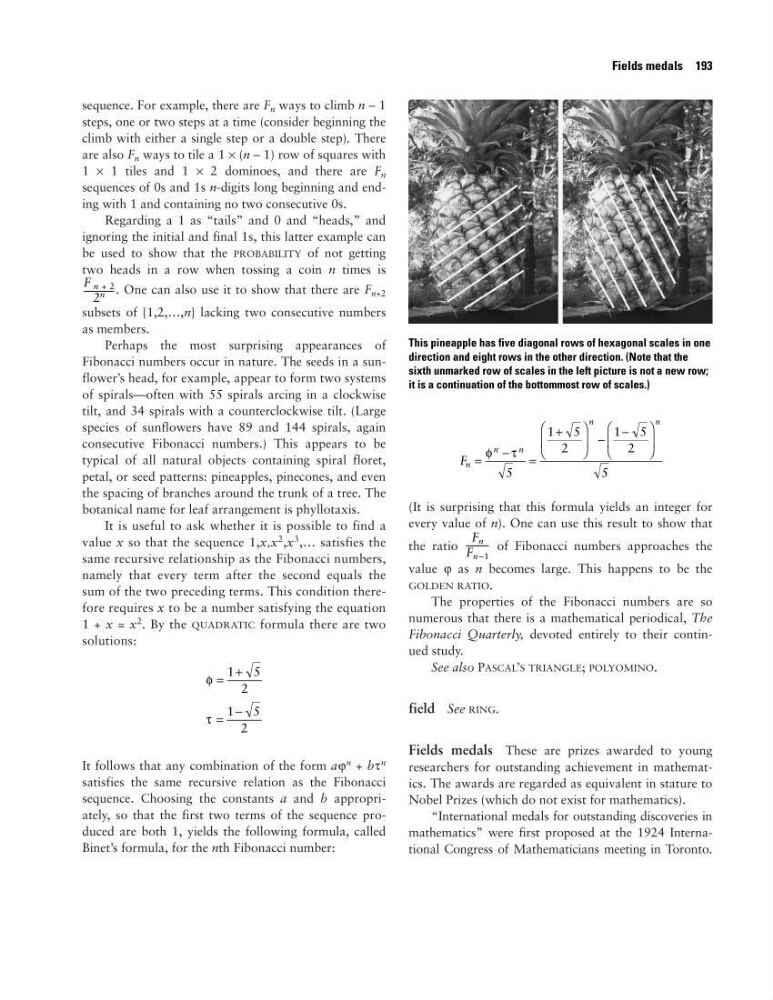
This pineapple has five diagonal rows of hexagonal scales in one
direction and eight rows in the other direction. (Note that the
sixth unmarked row of scales in the left picture is not a new row;
it is a continuation of the bottommost row of scales.)
steps, one or two steps at a time (consider beginning the
climb with either a single step or a double step). There
are also F n ways to tile a 1 × (n – 1) row of squares with
1 × 1 tiles and 1 × 2 dominoes, and there are F n
sequences of 0s and 1s n-digits long beginning and ending with 1 and containing no two consecutive 0s.
Regarding a 1 as “tails” and 0 and “heads,” and
ignoring the initial and final 1s, this latter example can
be used to show that the PROBABILITY of not getting
two heads in a row when tossing a coin n times is
. One can also use it to show that there are F n+2
subsets of {1,2,…,n} lacking two consecutive numbers
as members.
Perhaps the most surprising appearances of
Fibonacci numbers occur in nature. The seeds in a sunflower’s head, for example, appear to form two systems
of spirals—often with 55 spirals arcing in a clockwise
tilt, and 34 spirals with a counterclockwise tilt. (Large
species of sunflowers have 89 and 144 spirals, again
consecutive Fibonacci numbers.) This appears to be
typical of all natural objects containing spiral floret,
petal, or seed patterns: pineapples, pinecones, and even
the spacing of branches around the trunk of a tree. The
botanical name for leaf arrangement is phyllotaxis.
It is useful to ask whether it is possible to find a
value x so that the sequence 1,x,x
2 ,x
3 ,… satisfies the
same recursive relationship as the Fibonacci numbers,
namely that every term after the second equals the
sum of the two preceding terms. This condition therefore requires x to be a number satisfying the equation
1 + x = x
2 . By the QUADRATIC formula there are two
solutions:
It follows that any combination of the form aϕ
n + bτ
n
satisfies the same recursive relation as the Fibonacci
sequence. Choosing the constants a and b appropriately, so that the first two terms of the sequence produced are both 1, yields the following formula, called
Binet’s formula, for the nth Fibonacci number:
(It is surprising that this formula yields an integer for
every value of n). One can use this result to show that
the ratio
of Fibonacci numbers approaches the
value ϕ as n becomes large. This happens to be the
GOLDEN RATIO.
The properties of the Fibonacci numbers are so
numerous that there is a mathematical periodical, The
Fibonacci Quarterly, devoted entirely to their continued study.
See also PASCAL’S TRIANGLE; POLYOMINO.
field See RING.
Fields medals These are prizes awarded to young
researchers for outstanding achievement in mathematics. The awards are regarded as equivalent in stature to
Nobel Prizes (which do not exist for mathematics).
“International medals for outstanding discoveries in
mathematics” were first proposed at the 1924 International Congress of Mathematicians meeting in Toronto.
F n
––
F n –1
F n
n
n
n
n
=
−
=
+
⎛
⎝
⎜
⎞
⎠
⎟ −
−
⎛
⎝
⎜
⎞
⎠
⎟
φ
τ
5
1
5
2
1
5
2
5
φ
τ
=
+
=
−
1
5
2
1
5
2
F n + 2
––
2
n
Fields medals 193
This pineapple has five diagonal rows of hexagonal scales in one
direction and eight rows in the other direction. (Note that the
sixth unmarked row of scales in the left picture is not a new row;
it is a continuation of the bottommost row of scales.)