

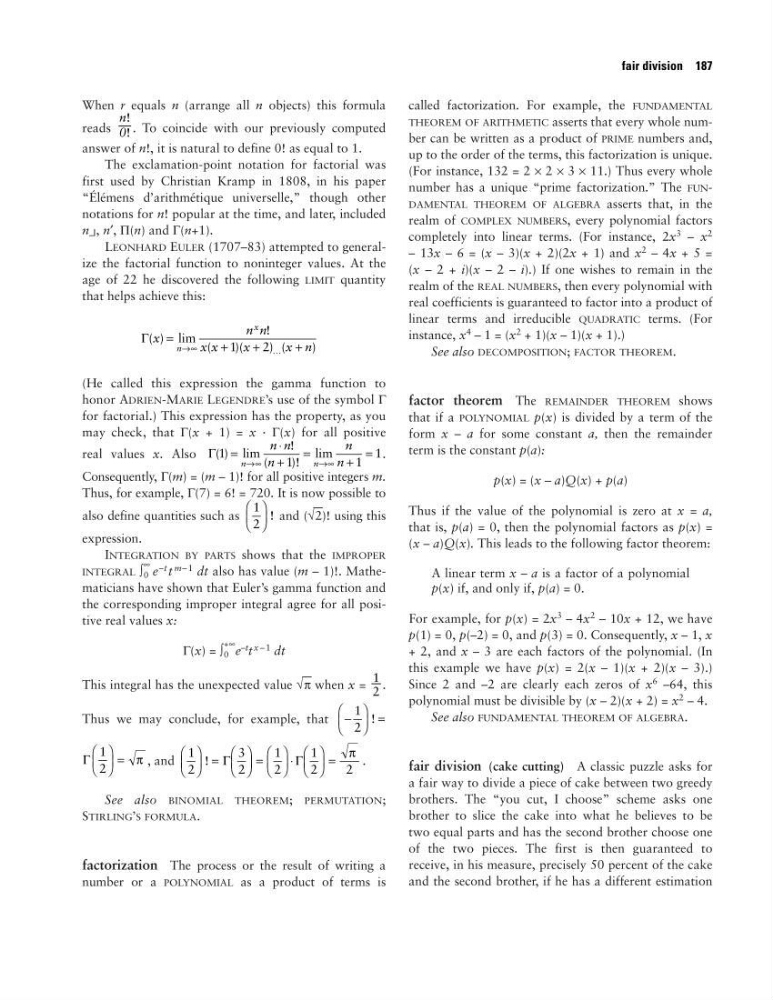
When r equals n (arrange all n objects) this formula
reads
. To coincide with our previously computed
answer of n!, it is natural to define 0! as equal to 1.
The exclamation-point notation for factorial was
first used by Christian Kramp in 1808, in his paper
“Élémens d’arithmétique universelle,” though other
notations for n! popular at the time, and later, included
n_ | , n′, Π(n) and Γ(n+1).
LEONHARD EULER (1707–83) attempted to generalize the factorial function to noninteger values. At the
age of 22 he discovered the following LIMIT quantity
that helps achieve this:
(He called this expression the gamma function to
honor ADRIEN-MARIE LEGENDRE’s use of the symbol Γ
for factorial.) This expression has the property, as you
may check, that Γ(x + 1) = x · Γ(x) for all positive
real values x. Also
.
Consequently, Γ(m) = (m – 1)! for all positive integers m.
Thus, for example, Γ(7) = 6! = 720. It is now possible to
also define quantities such as
and (√
–
2)! using this
expression.
INTEGRATION BY PARTS shows that the IMPROPER
INTEGRAL ∫
∞
0 e
–t t
m– 1 dt also has value (m – 1)!. Mathematicians have shown that Euler’s gamma function and
the corresponding improper integral agree for all positive real values x:
Γ(x) = ∫
+∞
0 e
–t
t
x – 1 dt
This integral has the unexpected value √
–
π when x = .
Thus we may conclude, for example, that
, and
.
See also BINOMIAL THEOREM; PERMUTATION;
STIRLING’S FORMULA.
factorization The process or the result of writing a
number or a POLYNOMIAL as a product of terms is
called factorization. For example, the FUNDAMENTAL
THEOREM OF ARITHMETIC asserts that every whole number can be written as a product of PRIME numbers and,
up to the order of the terms, this factorization is unique.
(For instance, 132 = 2 × 2 × 3 × 11.) Thus every whole
number has a unique “prime factorization.” The FUNDAMENTAL THEOREM OF ALGEBRA asserts that, in the
realm of COMPLEX NUMBERS, every polynomial factors
completely into linear terms. (For instance, 2x
3 – x
2
– 13x – 6 = (x – 3)(x + 2)(2x + 1) and x
2 – 4x + 5 =
(x – 2 + i)(x – 2 – i).) If one wishes to remain in the
realm of the REAL NUMBERS, then every polynomial with
real coefficients is guaranteed to factor into a product of
linear terms and irreducible QUADRATIC terms. (For
instance, x
4 – 1 = (x
2 + 1)(x – 1)(x + 1).)
See also DECOMPOSITION; FACTOR THEOREM.
factor theorem The REMAINDER THEOREM shows
that if a POLYNOMIAL p(x) is divided by a term of the
form x – a for some constant a, then the remainder
term is the constant p(a):
p(x) = (x – a)Q(x) + p(a)
Thus if the value of the polynomial is zero at x = a,
that is, p(a) = 0, then the polynomial factors as p(x) =
(x – a)Q(x). This leads to the following factor theorem:
A linear term x – a is a factor of a polynomial
p(x) if, and only if, p(a) = 0.
For example, for p(x) = 2x
3 – 4x
2 – 10x + 12, we have
p(1) = 0, p(–2) = 0, and p(3) = 0. Consequently, x – 1, x
+ 2, and x – 3 are each factors of the polynomial. (In
this example we have p(x) = 2(x – 1)(x + 2)(x – 3).)
Since 2 and –2 are clearly each zeros of x
6 –64, this
polynomial must be divisible by (x – 2)(x + 2) = x
2 – 4.
See also FUNDAMENTAL THEOREM OF ALGEBRA.
fair division (cake cutting) A classic puzzle asks for
a fair way to divide a piece of cake between two greedy
brothers. The “you cut, I choose” scheme asks one
brother to slice the cake into what he believes to be
two equal parts and has the second brother choose one
of the two pieces. The first is then guaranteed to
receive, in his measure, precisely 50 percent of the cake
and the second brother, if he has a different estimation
1
2
3
2
1
2
1
2
2
=
=
⋅
=
! Γ
Γ
π
=
1
2
Γ
π
−
=
1
2
!
1
–
2
1
2
!
Γ( ) lim
!
(
)!
lim
1
1
1
1
=
⋅
+
=
+
=
→∞
→∞
n
n
n n
n
n
n
Γ( ) lim
!
(
)(
) (
)
x
n n
x x
x
x n
n
x
=
+
+
+
→∞
1
2 K
n!
–
0!
fair division 187
reads
. To coincide with our previously computed
answer of n!, it is natural to define 0! as equal to 1.
The exclamation-point notation for factorial was
first used by Christian Kramp in 1808, in his paper
“Élémens d’arithmétique universelle,” though other
notations for n! popular at the time, and later, included
n_ | , n′, Π(n) and Γ(n+1).
LEONHARD EULER (1707–83) attempted to generalize the factorial function to noninteger values. At the
age of 22 he discovered the following LIMIT quantity
that helps achieve this:
(He called this expression the gamma function to
honor ADRIEN-MARIE LEGENDRE’s use of the symbol Γ
for factorial.) This expression has the property, as you
may check, that Γ(x + 1) = x · Γ(x) for all positive
real values x. Also
.
Consequently, Γ(m) = (m – 1)! for all positive integers m.
Thus, for example, Γ(7) = 6! = 720. It is now possible to
also define quantities such as
and (√
–
2)! using this
expression.
INTEGRATION BY PARTS shows that the IMPROPER
INTEGRAL ∫
∞
0 e
–t t
m– 1 dt also has value (m – 1)!. Mathematicians have shown that Euler’s gamma function and
the corresponding improper integral agree for all positive real values x:
Γ(x) = ∫
+∞
0 e
–t
t
x – 1 dt
This integral has the unexpected value √
–
π when x = .
Thus we may conclude, for example, that
, and
.
See also BINOMIAL THEOREM; PERMUTATION;
STIRLING’S FORMULA.
factorization The process or the result of writing a
number or a POLYNOMIAL as a product of terms is
called factorization. For example, the FUNDAMENTAL
THEOREM OF ARITHMETIC asserts that every whole number can be written as a product of PRIME numbers and,
up to the order of the terms, this factorization is unique.
(For instance, 132 = 2 × 2 × 3 × 11.) Thus every whole
number has a unique “prime factorization.” The FUNDAMENTAL THEOREM OF ALGEBRA asserts that, in the
realm of COMPLEX NUMBERS, every polynomial factors
completely into linear terms. (For instance, 2x
3 – x
2
– 13x – 6 = (x – 3)(x + 2)(2x + 1) and x
2 – 4x + 5 =
(x – 2 + i)(x – 2 – i).) If one wishes to remain in the
realm of the REAL NUMBERS, then every polynomial with
real coefficients is guaranteed to factor into a product of
linear terms and irreducible QUADRATIC terms. (For
instance, x
4 – 1 = (x
2 + 1)(x – 1)(x + 1).)
See also DECOMPOSITION; FACTOR THEOREM.
factor theorem The REMAINDER THEOREM shows
that if a POLYNOMIAL p(x) is divided by a term of the
form x – a for some constant a, then the remainder
term is the constant p(a):
p(x) = (x – a)Q(x) + p(a)
Thus if the value of the polynomial is zero at x = a,
that is, p(a) = 0, then the polynomial factors as p(x) =
(x – a)Q(x). This leads to the following factor theorem:
A linear term x – a is a factor of a polynomial
p(x) if, and only if, p(a) = 0.
For example, for p(x) = 2x
3 – 4x
2 – 10x + 12, we have
p(1) = 0, p(–2) = 0, and p(3) = 0. Consequently, x – 1, x
+ 2, and x – 3 are each factors of the polynomial. (In
this example we have p(x) = 2(x – 1)(x + 2)(x – 3).)
Since 2 and –2 are clearly each zeros of x
6 –64, this
polynomial must be divisible by (x – 2)(x + 2) = x
2 – 4.
See also FUNDAMENTAL THEOREM OF ALGEBRA.
fair division (cake cutting) A classic puzzle asks for
a fair way to divide a piece of cake between two greedy
brothers. The “you cut, I choose” scheme asks one
brother to slice the cake into what he believes to be
two equal parts and has the second brother choose one
of the two pieces. The first is then guaranteed to
receive, in his measure, precisely 50 percent of the cake
and the second brother, if he has a different estimation
1
2
3
2
1
2
1
2
2
=
=
⋅
=
! Γ
Γ
π
=
1
2
Γ
π
−
=
1
2
!
1
–
2
1
2
!
Γ( ) lim
!
(
)!
lim
1
1
1
1
=
⋅
+
=
+
=
→∞
→∞
n
n
n n
n
n
n
Γ( ) lim
!
(
)(
) (
)
x
n n
x x
x
x n
n
x
=
+
+
+
→∞
1
2 K
n!
–
0!
fair division 187