

vertices lie at lattice points. Mathematicians have
proved that it is impossible to draw an equiangular lattice polygon with n sides if n is a number different
from 4 or 8. (Any four-sided equiangular lattice polygon is a rectangle, and any eight-sided equiangular lattice polygon has eight interior angles, each equal to
135°.) The square and the octagon are the only two
regular lattice polygons.
See also CARTESIAN COORDINATES.
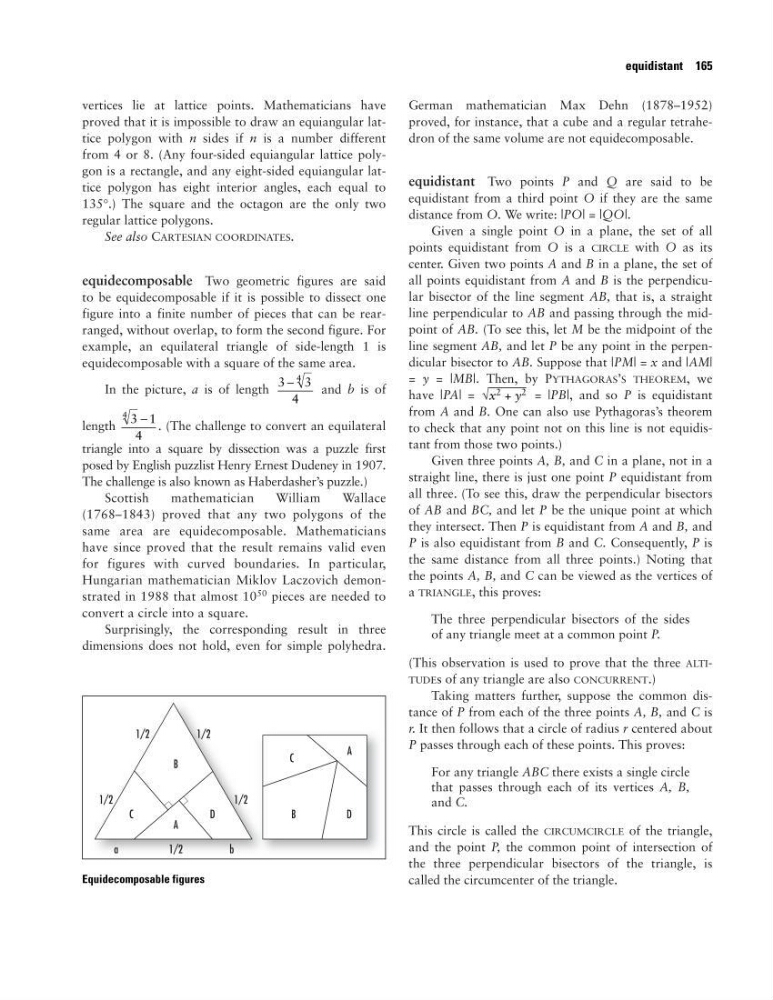
equidecomposable Two geometric figures are said
to be equidecomposable if it is possible to dissect one
figure into a finite number of pieces that can be rearranged, without overlap, to form the second figure. For
example, an equilateral triangle of side-length 1 is
equidecomposable with a square of the same area.
In the picture, a is of length
and b is of
length
. (The challenge to convert an equilateral
triangle into a square by dissection was a puzzle first
posed by English puzzlist Henry Ernest Dudeney in 1907.
The challenge is also known as Haberdasher’s puzzle.)
Scottish
mathematician
William
Wallace
(1768–1843) proved that any two polygons of the
same area are equidecomposable. Mathematicians
have since proved that the result remains valid even
for figures with curved boundaries. In particular,
Hungarian mathematician Miklov Laczovich demonstrated in 1988 that almost 10
50 pieces are needed to
convert a circle into a square.
Surprisingly, the corresponding result in three
dimensions does not hold, even for simple polyhedra.
German mathematician Max Dehn (1878–1952)
proved, for instance, that a cube and a regular tetrahedron of the same volume are not equidecomposable.
equidistant Two points P and Q are said to be
equidistant from a third point O if they are the same
distance from O. We write: |PO| = |QO|.
Given a single point O in a plane, the set of all
points equidistant from O is a CIRCLE with O as its
center. Given two points A and B in a plane, the set of
all points equidistant from A and B is the perpendicular bisector of the line segment AB, that is, a straight
line perpendicular to AB and passing through the midpoint of AB. (To see this, let M be the midpoint of the
line segment AB, and let P be any point in the perpendicular bisector to AB. Suppose that |PM| = x and |AM|
= y = |MB|. Then, by PYTHAGORAS’S THEOREM, we
have |PA| =
= |PB|, and so P is equidistant
from A and B. One can also use Pythagoras’s theorem
to check that any point not on this line is not equidistant from those two points.)
Given three points A, B, and C in a plane, not in a
straight line, there is just one point P equidistant from
all three. (To see this, draw the perpendicular bisectors
of AB and BC, and let P be the unique point at which
they intersect. Then P is equidistant from A and B, and
P is also equidistant from B and C. Consequently, P is
the same distance from all three points.) Noting that
the points A, B, and C can be viewed as the vertices of
a TRIANGLE, this proves:
The three perpendicular bisectors of the sides
of any triangle meet at a common point P.
(This observation is used to prove that the three ALTITUDEs of any triangle are also CONCURRENT.)
Taking matters further, suppose the common distance of P from each of the three points A, B, and C is
r. It then follows that a circle of radius r centered about
P passes through each of these points. This proves:
For any triangle ABC there exists a single circle
that passes through each of its vertices A, B,
and C.
This circle is called the CIRCUMCIRCLE of the triangle,
and the point P, the common point of intersection of
the three perpendicular bisectors of the triangle, is
called the circumcenter of the triangle.
√x
2 + y
2
3 1
4
4
−
3
3
4
4
−
equidistant 165
Equidecomposable figures
proved that it is impossible to draw an equiangular lattice polygon with n sides if n is a number different
from 4 or 8. (Any four-sided equiangular lattice polygon is a rectangle, and any eight-sided equiangular lattice polygon has eight interior angles, each equal to
135°.) The square and the octagon are the only two
regular lattice polygons.
See also CARTESIAN COORDINATES.
equidecomposable Two geometric figures are said
to be equidecomposable if it is possible to dissect one
figure into a finite number of pieces that can be rearranged, without overlap, to form the second figure. For
example, an equilateral triangle of side-length 1 is
equidecomposable with a square of the same area.
In the picture, a is of length
and b is of
length
. (The challenge to convert an equilateral
triangle into a square by dissection was a puzzle first
posed by English puzzlist Henry Ernest Dudeney in 1907.
The challenge is also known as Haberdasher’s puzzle.)
Scottish
mathematician
William
Wallace
(1768–1843) proved that any two polygons of the
same area are equidecomposable. Mathematicians
have since proved that the result remains valid even
for figures with curved boundaries. In particular,
Hungarian mathematician Miklov Laczovich demonstrated in 1988 that almost 10
50 pieces are needed to
convert a circle into a square.
Surprisingly, the corresponding result in three
dimensions does not hold, even for simple polyhedra.
German mathematician Max Dehn (1878–1952)
proved, for instance, that a cube and a regular tetrahedron of the same volume are not equidecomposable.
equidistant Two points P and Q are said to be
equidistant from a third point O if they are the same
distance from O. We write: |PO| = |QO|.
Given a single point O in a plane, the set of all
points equidistant from O is a CIRCLE with O as its
center. Given two points A and B in a plane, the set of
all points equidistant from A and B is the perpendicular bisector of the line segment AB, that is, a straight
line perpendicular to AB and passing through the midpoint of AB. (To see this, let M be the midpoint of the
line segment AB, and let P be any point in the perpendicular bisector to AB. Suppose that |PM| = x and |AM|
= y = |MB|. Then, by PYTHAGORAS’S THEOREM, we
have |PA| =
= |PB|, and so P is equidistant
from A and B. One can also use Pythagoras’s theorem
to check that any point not on this line is not equidistant from those two points.)
Given three points A, B, and C in a plane, not in a
straight line, there is just one point P equidistant from
all three. (To see this, draw the perpendicular bisectors
of AB and BC, and let P be the unique point at which
they intersect. Then P is equidistant from A and B, and
P is also equidistant from B and C. Consequently, P is
the same distance from all three points.) Noting that
the points A, B, and C can be viewed as the vertices of
a TRIANGLE, this proves:
The three perpendicular bisectors of the sides
of any triangle meet at a common point P.
(This observation is used to prove that the three ALTITUDEs of any triangle are also CONCURRENT.)
Taking matters further, suppose the common distance of P from each of the three points A, B, and C is
r. It then follows that a circle of radius r centered about
P passes through each of these points. This proves:
For any triangle ABC there exists a single circle
that passes through each of its vertices A, B,
and C.
This circle is called the CIRCUMCIRCLE of the triangle,
and the point P, the common point of intersection of
the three perpendicular bisectors of the triangle, is
called the circumcenter of the triangle.
√x
2 + y
2
3 1
4
4
−
3
3
4
4
−
equidistant 165
Equidecomposable figures