

By the FUNDAMENTAL THEOREM OF CALCULUS, the
derivative of an area function is the original function
and so we have:
ln(x) =
Now consider the corresponding exponential function y = e
x
. By taking logarithms, we obtain ln(y) = x.
Differentiating yields
= 1, and so
= y = e
x
. This
establishes definition 3 stating that f(x) = e
x is the function that equals its own derivative.
Now that we know the derivative of y = e
x
, we can
compute its Taylor series. We obtain:
Setting x = 1 establishes definition 4.
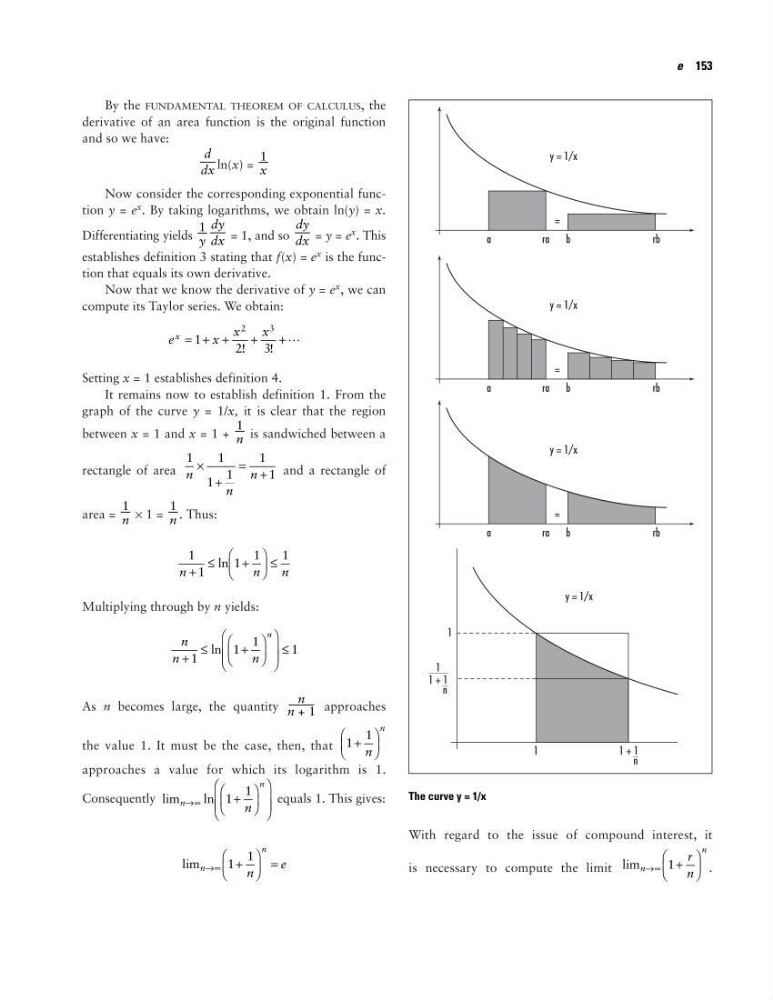
It remains now to establish definition 1. From the
graph of the curve y = 1/x, it is clear that the region
between x = 1 and x = 1 +
is sandwiched between a
rectangle of area
and a rectangle of
area =
× 1 = . Thus:
Multiplying through by n yields:
As n becomes large, the quantity
approaches
the value 1. It must be the case, then, that
approaches a value for which its logarithm is 1.
Consequently
equals 1. This gives:
With regard to the issue of compound interest, it
is necessary to compute the limit
.
lim n
n
r
n
→∞
+
1
lim n
n
n
e
→∞
+
=
1
1
lim
ln
n
n
n
→∞
+
1
1
1
1
+
n
n
n
––
n + 1
n
n
n
n
+
≤
+
≤
1
1
1
1
ln
1
1
1
1
1
n
n
n
+
≤
+
≤
ln
1
–
n
1
–
n
1
1
1
1
1
1
n
n
n
×
+
= +
1
–
n
e
x
x
x
x
= + +
+
+
1
2
3
2
3
!
!
L
dy
––
dx
dy
––
dx
1
–
y
1
–
x
d
––
dx
e 153
The curve y = 1/x
derivative of an area function is the original function
and so we have:
ln(x) =
Now consider the corresponding exponential function y = e
x
. By taking logarithms, we obtain ln(y) = x.
Differentiating yields
= 1, and so
= y = e
x
. This
establishes definition 3 stating that f(x) = e
x is the function that equals its own derivative.
Now that we know the derivative of y = e
x
, we can
compute its Taylor series. We obtain:
Setting x = 1 establishes definition 4.
It remains now to establish definition 1. From the
graph of the curve y = 1/x, it is clear that the region
between x = 1 and x = 1 +
is sandwiched between a
rectangle of area
and a rectangle of
area =
× 1 = . Thus:
Multiplying through by n yields:
As n becomes large, the quantity
approaches
the value 1. It must be the case, then, that
approaches a value for which its logarithm is 1.
Consequently
equals 1. This gives:
With regard to the issue of compound interest, it
is necessary to compute the limit
.
lim n
n
r
n
→∞
+
1
lim n
n
n
e
→∞
+
=
1
1
lim
ln
n
n
n
→∞
+
1
1
1
1
+
n
n
n
––
n + 1
n
n
n
n
+
≤
+
≤
1
1
1
1
ln
1
1
1
1
1
n
n
n
+
≤
+
≤
ln
1
–
n
1
–
n
1
1
1
1
1
1
n
n
n
×
+
= +
1
–
n
e
x
x
x
x
= + +
+
+
1
2
3
2
3
!
!
L
dy
––
dx
dy
––
dx
1
–
y
1
–
x
d
––
dx
e 153
The curve y = 1/x