

a
2 + b
2 > c
2
b
2 + c
2 > a
2
c
2 + a
2 > b
2
See also OBTUSE ANGLE; PERIGON; PYTHAGORAS’S
THEOREM; TRIANGLE.
addition The process of finding the sum of two
numbers is called addition. In the elementary ARITHMETIC of whole numbers, addition can be regarded as
the process of accumulating sets of objects. For example, if a set of three apples is combined with a set of
five apples, then the result is a set of eight apples. We
write: 3 + 5 = 8.
Two numbers that are added together are called
addends. For instance, in the equation 17 + 33 = 50,
the numbers 17 and 33 are the addends, and the number 50 is their sum. Addition can also be regarded as
the process of increasing one number (an addend) by
another (called, in this context, an augend). Thus when
17 is augmented by 33 units, the result is 50.
The PLACE-VALUE SYSTEM we use today for writing
numbers simplifies the process of adding large integers.
For instance, adding together 253 and 589 yields 2 + 5
= 7 units of 100, 5 + 8 = 13 units of 10, and 3 + 9 = 12
units of 1. So, in some sense, it is reasonable to write
the answer to this addition problem simply as 7 | 13 |
12 using a vertical bar to separate units of powers of
10. Since 13 units of 10 is equivalent to one unit of 100
and three units of 10, this is equivalent to 8 | 3 | 12.
Noting, also, that 12 units of one 12 is equivalent to
one unit of 10 and two single units, this can be rewritten as 8 | 4 | 2. Thus we have: 253 + 589 = 842.
The latter process of modifying the figures into single-digit powers of 10 (that is, in our example, the process of rewriting 7 | 13 | 12 as 8 | 4 | 2) is called
“carrying digits.” Students in schools are usually
taught an algorithm that has one carry digits early in
the process of completing an addition problem rather
than leaving this work as the final step. Either method
is valid. (The term “carry a digit” dates back to the
time of the ABACUS, where beads on rods represented
counts of powers of 10 and the person had to move—
“carry”—counters from one rod to another if any
count was greater than a single digit.)
The process of addition can be extended to NEGATIVE NUMBERS (yielding an operation called SUBTRACTION), the addition of FRACTIONs (completed with the
aid of computing COMMON DENOMINATORs), REAL
NUMBERS, COMPLEX NUMBERS, VECTORs, and MATRIX
addition. The number ZERO is an additive IDENTITY
ELEMENT in the theory of arithmetic. We have that a + 0
= a = 0 + a for any number a.
The sum of two real-valued functions f and g is the
function f + g whose value at any input x is the sum of
the outputs of f and g at that input value: (f + g)(x) =
f(x) + g(x). For example, if f(x) = x
2 + 2x and g(x) =
5x + 7, then (f + g)(x) = x
2 + 2x + 5x + 7 = x
2 + 7x + 7.
A function with the property that f(x + y) = f(x) +
f(y) for all inputs x and y is called “additive.” For
example, f(x) = 2x is additive.
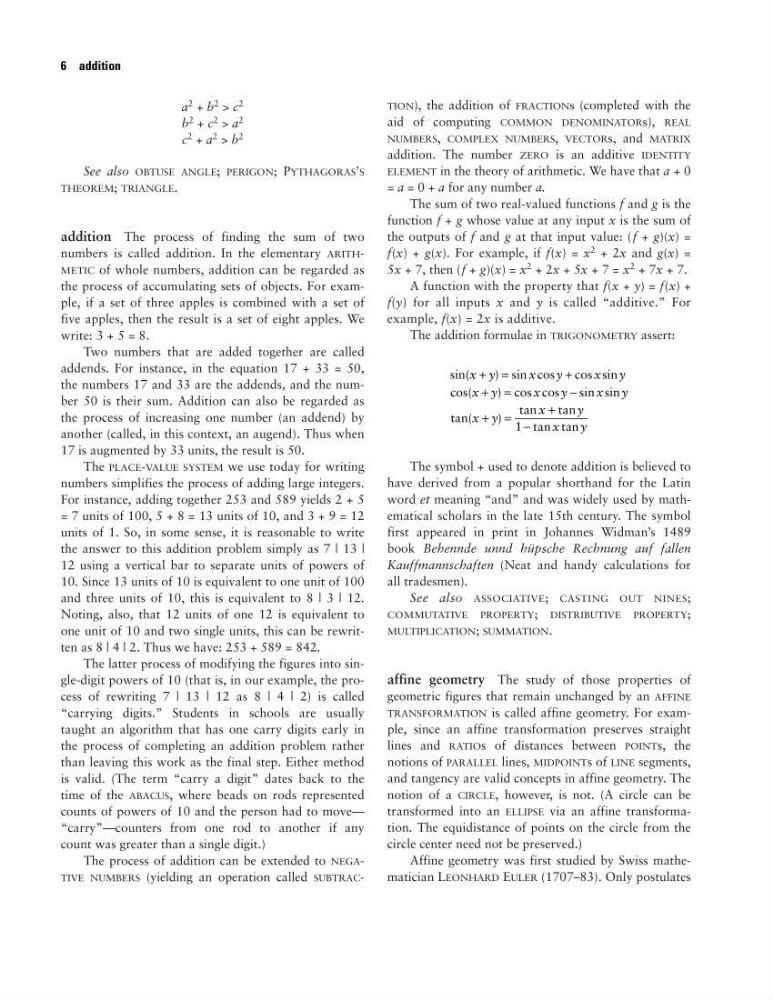
The addition formulae in TRIGONOMETRY assert:
The symbol + used to denote addition is believed to
have derived from a popular shorthand for the Latin
word et meaning “and” and was widely used by mathematical scholars in the late 15th century. The symbol
first appeared in print in Johannes Widman’s 1489
book Behennde unnd hüpsche Rechnung auf fallen
Kauffmannschaften (Neat and handy calculations for
all tradesmen).
See also ASSOCIATIVE; CASTING OUT NINES;
COMMUTATIVE PROPERTY; DISTRIBUTIVE PROPERTY;
MULTIPLICATION; SUMMATION.
affine geometry The study of those properties of
geometric figures that remain unchanged by an AFFINE
TRANSFORMATION is called affine geometry. For example, since an affine transformation preserves straight
lines and RATIOs of distances between POINTs, the
notions of PARALLEL lines, MIDPOINTs of LINE segments,
and tangency are valid concepts in affine geometry. The
notion of a CIRCLE, however, is not. (A circle can be
transformed into an ELLIPSE via an affine transformation. The equidistance of points on the circle from the
circle center need not be preserved.)
Affine geometry was first studied by Swiss mathematician LEONHARD EULER (1707–83). Only postulates
sin(
) sin cos
cos sin
cos(
) cos cos
sin sin
tan(
)
tan
tan
tan tan
x y
x
y
x y
x y
x
y
x y
x y
x
y
x
y
+ =
+
+ =
−
+ =
+
−
1
6 addition
2 + b
2 > c
2
b
2 + c
2 > a
2
c
2 + a
2 > b
2
See also OBTUSE ANGLE; PERIGON; PYTHAGORAS’S
THEOREM; TRIANGLE.
addition The process of finding the sum of two
numbers is called addition. In the elementary ARITHMETIC of whole numbers, addition can be regarded as
the process of accumulating sets of objects. For example, if a set of three apples is combined with a set of
five apples, then the result is a set of eight apples. We
write: 3 + 5 = 8.
Two numbers that are added together are called
addends. For instance, in the equation 17 + 33 = 50,
the numbers 17 and 33 are the addends, and the number 50 is their sum. Addition can also be regarded as
the process of increasing one number (an addend) by
another (called, in this context, an augend). Thus when
17 is augmented by 33 units, the result is 50.
The PLACE-VALUE SYSTEM we use today for writing
numbers simplifies the process of adding large integers.
For instance, adding together 253 and 589 yields 2 + 5
= 7 units of 100, 5 + 8 = 13 units of 10, and 3 + 9 = 12
units of 1. So, in some sense, it is reasonable to write
the answer to this addition problem simply as 7 | 13 |
12 using a vertical bar to separate units of powers of
10. Since 13 units of 10 is equivalent to one unit of 100
and three units of 10, this is equivalent to 8 | 3 | 12.
Noting, also, that 12 units of one 12 is equivalent to
one unit of 10 and two single units, this can be rewritten as 8 | 4 | 2. Thus we have: 253 + 589 = 842.
The latter process of modifying the figures into single-digit powers of 10 (that is, in our example, the process of rewriting 7 | 13 | 12 as 8 | 4 | 2) is called
“carrying digits.” Students in schools are usually
taught an algorithm that has one carry digits early in
the process of completing an addition problem rather
than leaving this work as the final step. Either method
is valid. (The term “carry a digit” dates back to the
time of the ABACUS, where beads on rods represented
counts of powers of 10 and the person had to move—
“carry”—counters from one rod to another if any
count was greater than a single digit.)
The process of addition can be extended to NEGATIVE NUMBERS (yielding an operation called SUBTRACTION), the addition of FRACTIONs (completed with the
aid of computing COMMON DENOMINATORs), REAL
NUMBERS, COMPLEX NUMBERS, VECTORs, and MATRIX
addition. The number ZERO is an additive IDENTITY
ELEMENT in the theory of arithmetic. We have that a + 0
= a = 0 + a for any number a.
The sum of two real-valued functions f and g is the
function f + g whose value at any input x is the sum of
the outputs of f and g at that input value: (f + g)(x) =
f(x) + g(x). For example, if f(x) = x
2 + 2x and g(x) =
5x + 7, then (f + g)(x) = x
2 + 2x + 5x + 7 = x
2 + 7x + 7.
A function with the property that f(x + y) = f(x) +
f(y) for all inputs x and y is called “additive.” For
example, f(x) = 2x is additive.
The addition formulae in TRIGONOMETRY assert:
The symbol + used to denote addition is believed to
have derived from a popular shorthand for the Latin
word et meaning “and” and was widely used by mathematical scholars in the late 15th century. The symbol
first appeared in print in Johannes Widman’s 1489
book Behennde unnd hüpsche Rechnung auf fallen
Kauffmannschaften (Neat and handy calculations for
all tradesmen).
See also ASSOCIATIVE; CASTING OUT NINES;
COMMUTATIVE PROPERTY; DISTRIBUTIVE PROPERTY;
MULTIPLICATION; SUMMATION.
affine geometry The study of those properties of
geometric figures that remain unchanged by an AFFINE
TRANSFORMATION is called affine geometry. For example, since an affine transformation preserves straight
lines and RATIOs of distances between POINTs, the
notions of PARALLEL lines, MIDPOINTs of LINE segments,
and tangency are valid concepts in affine geometry. The
notion of a CIRCLE, however, is not. (A circle can be
transformed into an ELLIPSE via an affine transformation. The equidistance of points on the circle from the
circle center need not be preserved.)
Affine geometry was first studied by Swiss mathematician LEONHARD EULER (1707–83). Only postulates
sin(
) sin cos
cos sin
cos(
) cos cos
sin sin
tan(
)
tan
tan
tan tan
x y
x
y
x y
x y
x
y
x y
x y
x
y
x
y
+ =
+
+ =
−
+ =
+
−
1
6 addition