

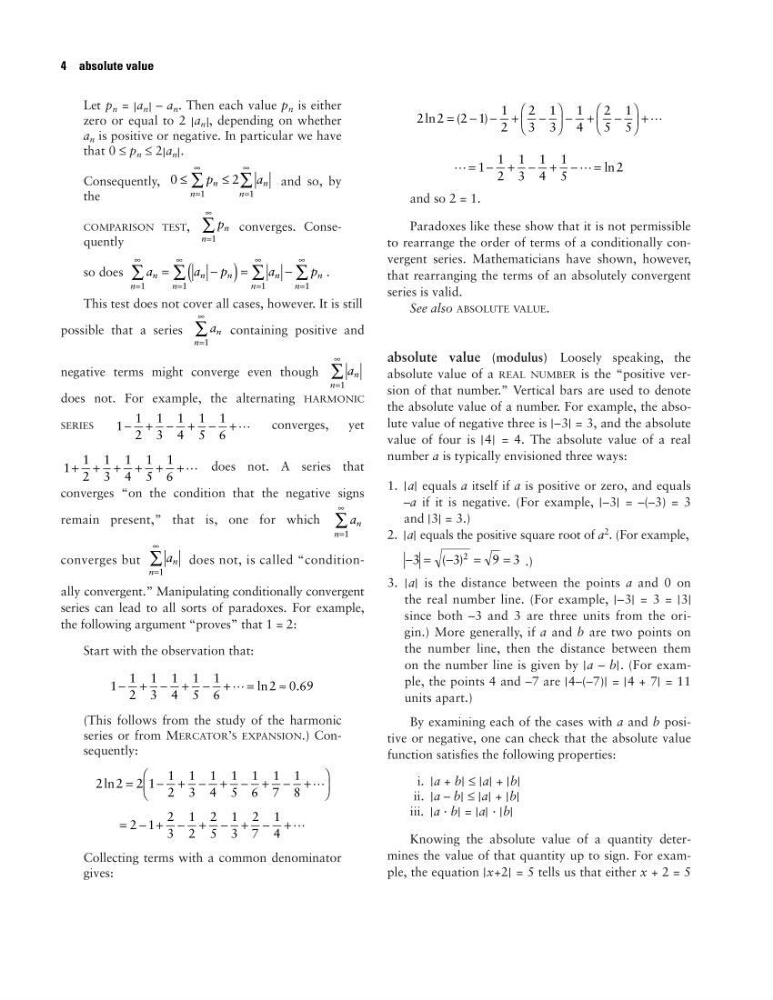
Let p n = | a n| – a n . Then each value p n is either
zero or equal to 2 | a n| , depending on whether
a n is positive or negative. In particular we have
that 0 ≤ p n ≤ 2 | a n| .
Consequently,
and so, by
the
COMPARISON TEST,
converges. Consequently
so does
.
This test does not cover all cases, however. It is still
possible that a series
containing positive and
negative terms might converge even though
does not. For example, the alternating HARMONIC
SERIES
converges,
yet
does not. A series that
converges “on the condition that the negative signs
remain present,” that is, one for which
converges but
does not, is called “conditionally convergent.” Manipulating conditionally convergent
series can lead to all sorts of paradoxes. For example,
the following argument “proves” that 1 = 2:
Start with the observation that:
(This follows from the study of the harmonic
series or from MERCATOR’S EXPANSION.) Consequently:
Collecting terms with a common denominator
gives:
and so 2 = 1.
Paradoxes like these show that it is not permissible
to rearrange the order of terms of a conditionally convergent series. Mathematicians have shown, however,
that rearranging the terms of an absolutely convergent
series is valid.
See also ABSOLUTE VALUE.
absolute value (modulus) Loosely speaking, the
absolute value of a REAL NUMBER is the “positive version of that number.” Vertical bars are used to denote
the absolute value of a number. For example, the absolute value of negative three is |–3| = 3, and the absolute
value of four is |4| = 4. The absolute value of a real
number a is typically envisioned three ways:
1. |a| equals a itself if a is positive or zero, and equals
–a if it is negative. (For example, |–3| = –(–3) = 3
and |3| = 3.)
2. |a| equals the positive square root of a
2
. (For example,
.)
3. | a| is the distance between the points a and 0 on
the real number line. (For example, |–3| = 3 = |3|
since both –3 and 3 are three units from the origin.) More generally, if a and b are two points on
the number line, then the distance between them
on the number line is given by |a – b|. (For example, the points 4 and –7 are |4–(–7)| = |4 + 7| = 11
units apart.)
By examining each of the cases with a and b positive or negative, one can check that the absolute value
function satisfies the following properties:
i. |a + b| ≤ |a| + |b|
ii. | a – b | ≤ | a | + | b |
iii. |a · b| = |a| · |b|
Knowing the absolute value of a quantity determines the value of that quantity up to sign. For example, the equation | x+2 | = 5 tells us that either x + 2 = 5
− = −
=
=
3
3
9 3
2
( )
1
1
2
1
3
1
4
1
5
2
ln
= − + − + − =
L
L
2 2 2 1
1
2
2
3
1
3
1
4
2
5
1
5
ln
(
)
= − − +
−
⎛
⎝
⎜
⎞
⎠
⎟ − +
−
⎛
⎝
⎜
⎞
⎠
⎟ + L
2 1
2
3
1
2
2
5
1
3
2
7
1
4
= − + − + − + − +L
2 2 2 1
1
2
1
3
1
4
1
5
1
6
1
7
1
8
ln =
− + − + − + − +
⎛
⎝
⎜
⎞
⎠
⎟
L
1
1
2
1
3
1
4
1
5
1
6
2 0 69
− + − + − + =
≈
L ln
.
a n
n=
∞
∑
1
a n
n=
∞
∑
1
1
1
2
1
3
1
4
1
5
1
6
+ + + + + +L
1
1
2
1
3
1
4
1
5
1
6
− + − + − +L
a n
n=
∞
∑
1
a n
n=
∞
∑
1
a
a
p
a
p
n
n
n
n
n
n
n
n
n
=
∞
=
∞
=
∞
=
∞
∑
∑
∑
∑
=
−
(
) =
−
1
1
1
1
p n
n=
∞
∑
1
0
2
1
1
≤
≤
=
∞
=
∞
∑
∑
p
a
n
n
n
n
4 absolute value
zero or equal to 2 | a n| , depending on whether
a n is positive or negative. In particular we have
that 0 ≤ p n ≤ 2 | a n| .
Consequently,
and so, by
the
COMPARISON TEST,
converges. Consequently
so does
.
This test does not cover all cases, however. It is still
possible that a series
containing positive and
negative terms might converge even though
does not. For example, the alternating HARMONIC
SERIES
converges,
yet
does not. A series that
converges “on the condition that the negative signs
remain present,” that is, one for which
converges but
does not, is called “conditionally convergent.” Manipulating conditionally convergent
series can lead to all sorts of paradoxes. For example,
the following argument “proves” that 1 = 2:
Start with the observation that:
(This follows from the study of the harmonic
series or from MERCATOR’S EXPANSION.) Consequently:
Collecting terms with a common denominator
gives:
and so 2 = 1.
Paradoxes like these show that it is not permissible
to rearrange the order of terms of a conditionally convergent series. Mathematicians have shown, however,
that rearranging the terms of an absolutely convergent
series is valid.
See also ABSOLUTE VALUE.
absolute value (modulus) Loosely speaking, the
absolute value of a REAL NUMBER is the “positive version of that number.” Vertical bars are used to denote
the absolute value of a number. For example, the absolute value of negative three is |–3| = 3, and the absolute
value of four is |4| = 4. The absolute value of a real
number a is typically envisioned three ways:
1. |a| equals a itself if a is positive or zero, and equals
–a if it is negative. (For example, |–3| = –(–3) = 3
and |3| = 3.)
2. |a| equals the positive square root of a
2
. (For example,
.)
3. | a| is the distance between the points a and 0 on
the real number line. (For example, |–3| = 3 = |3|
since both –3 and 3 are three units from the origin.) More generally, if a and b are two points on
the number line, then the distance between them
on the number line is given by |a – b|. (For example, the points 4 and –7 are |4–(–7)| = |4 + 7| = 11
units apart.)
By examining each of the cases with a and b positive or negative, one can check that the absolute value
function satisfies the following properties:
i. |a + b| ≤ |a| + |b|
ii. | a – b | ≤ | a | + | b |
iii. |a · b| = |a| · |b|
Knowing the absolute value of a quantity determines the value of that quantity up to sign. For example, the equation | x+2 | = 5 tells us that either x + 2 = 5
− = −
=
=
3
3
9 3
2
( )
1
1
2
1
3
1
4
1
5
2
ln
= − + − + − =
L
L
2 2 2 1
1
2
2
3
1
3
1
4
2
5
1
5
ln
(
)
= − − +
−
⎛
⎝
⎜
⎞
⎠
⎟ − +
−
⎛
⎝
⎜
⎞
⎠
⎟ + L
2 1
2
3
1
2
2
5
1
3
2
7
1
4
= − + − + − + − +L
2 2 2 1
1
2
1
3
1
4
1
5
1
6
1
7
1
8
ln =
− + − + − + − +
⎛
⎝
⎜
⎞
⎠
⎟
L
1
1
2
1
3
1
4
1
5
1
6
2 0 69
− + − + − + =
≈
L ln
.
a n
n=
∞
∑
1
a n
n=
∞
∑
1
1
1
2
1
3
1
4
1
5
1
6
+ + + + + +L
1
1
2
1
3
1
4
1
5
1
6
− + − + − +L
a n
n=
∞
∑
1
a n
n=
∞
∑
1
a
a
p
a
p
n
n
n
n
n
n
n
n
n
=
∞
=
∞
=
∞
=
∞
∑
∑
∑
∑
=
−
(
) =
−
1
1
1
1
p n
n=
∞
∑
1
0
2
1
1
≤
≤
=
∞
=
∞
∑
∑
p
a
n
n
n
n
4 absolute value