

data (singular, datum) Information of a numerical
nature is called data. For example, records of the daily
numbers of visitors to a tourist attraction, or the measurement of growth rates of a yeast culture under different temperature conditions, would be examples of data.
Direct counts from observational studies or measurements from experiments like these are called primary or
raw data. Numerical information describing the raw data
(such as the average value, largest value, range of values,
and so on) is sometimes called secondary data. The science of developing methods for collecting, organizing,
and summarizing data is called descriptive statistics.
See also STATISTICS; STATISTICS: DESCRIPTIVE.
days-of-the-week formula It is a challenging exercise
to derive a mathematical formula that determines the day
of the week on which a particular calendar date falls.
As a first step, knowing the day on which January
1 of a year falls, it is reasonably straightforward to
determine on which day any other date of that year
falls. For example, New Year’s Day in the year 2000
was a Saturday. As the days of the week cycle in periods of seven, it follows that January 8, January 15, and
January 22 of that year were also Saturdays. Since
there are 31 days in January, and because 31 is three
more than a multiple of 7, it follows that February 1,
2000, fell on the weekday three days later than Saturday, namely, Tuesday. As there were 29 days in February that year, and 29 is one more than a multiple of 7,
March 1 fell on the weekday that directly follows Tuesday, namely Wednesday; and April 1, 30 days later, fell
on a weekday two days after Wednesday, namely Friday. In this way we can determine the weekday of any
first day of the month, and from there, the weekday of
any particular day of that month.
It is convenient to label Sunday as “day 0,” Monday
as “day 1,” up to Saturday as “day 6.” As the weekdays
cycle in units of 7, it is also appropriate to ignore all multiples of 7 and work only with the remainders of numbers upon division by 7. (That is, we shall work in a
base-7 system of MODULAR ARITHMETIC.) For example,
dates 16 and 30 days into a year fall on the same weekday as the day 2 days into the year: all numbers involved
here are 2 more than a multiple of 7. We shall call the
numbers 16, 30, and 2 “equivalent” and write 16 ≡ 2
and 30 ≡ 2, for instance.
January 1, 2000, fell on day 6. As we have noted,
February 1 falls 31 ≡ 3 days later and so lands on day
6 + 3 ≡ 2, Tuesday. March 1 falls another 29 ≡ 1 days
later, and so lands on day 6 + 3 + 1 ≡ 3, Wednesday. In
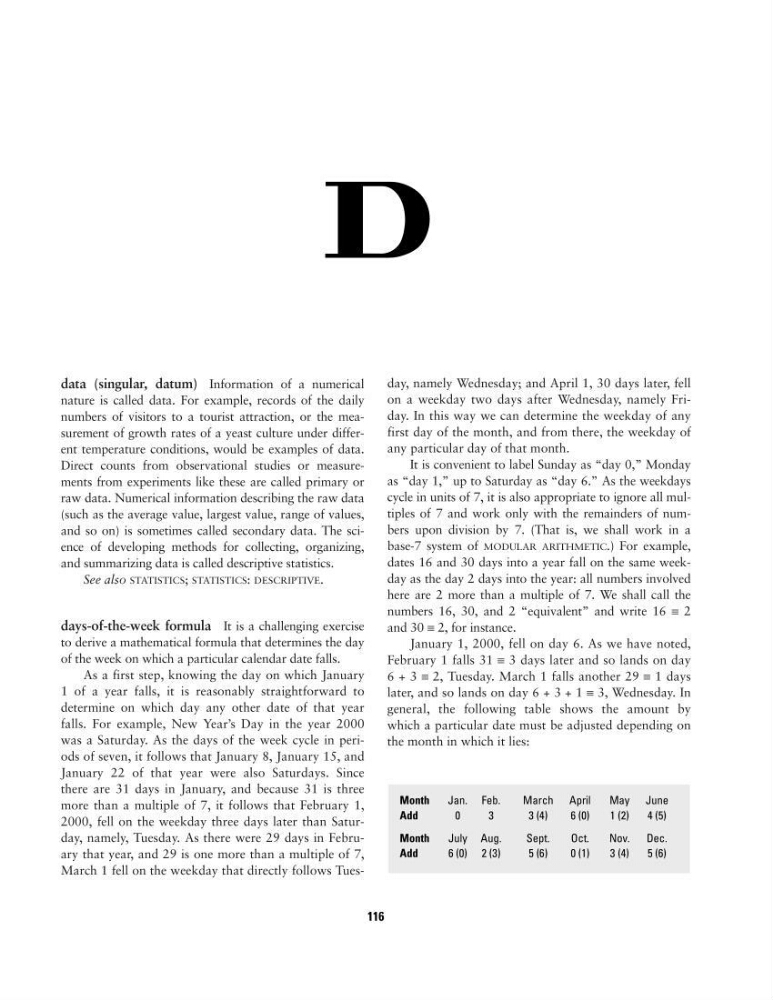
general, the following table shows the amount by
which a particular date must be adjusted depending on
the month in which it lies:
Month
Jan. Feb.
March April
May June
Add
0
3
3 (4)
6 (0)
1 (2)
4 (5)
Month
July Aug.
Sept.
Oct.
Nov. Dec.
Add
6 (0) 2 (3)
5 (6)
0 (1)
3 (4)
5 (6)
116
D
nature is called data. For example, records of the daily
numbers of visitors to a tourist attraction, or the measurement of growth rates of a yeast culture under different temperature conditions, would be examples of data.
Direct counts from observational studies or measurements from experiments like these are called primary or
raw data. Numerical information describing the raw data
(such as the average value, largest value, range of values,
and so on) is sometimes called secondary data. The science of developing methods for collecting, organizing,
and summarizing data is called descriptive statistics.
See also STATISTICS; STATISTICS: DESCRIPTIVE.
days-of-the-week formula It is a challenging exercise
to derive a mathematical formula that determines the day
of the week on which a particular calendar date falls.
As a first step, knowing the day on which January
1 of a year falls, it is reasonably straightforward to
determine on which day any other date of that year
falls. For example, New Year’s Day in the year 2000
was a Saturday. As the days of the week cycle in periods of seven, it follows that January 8, January 15, and
January 22 of that year were also Saturdays. Since
there are 31 days in January, and because 31 is three
more than a multiple of 7, it follows that February 1,
2000, fell on the weekday three days later than Saturday, namely, Tuesday. As there were 29 days in February that year, and 29 is one more than a multiple of 7,
March 1 fell on the weekday that directly follows Tuesday, namely Wednesday; and April 1, 30 days later, fell
on a weekday two days after Wednesday, namely Friday. In this way we can determine the weekday of any
first day of the month, and from there, the weekday of
any particular day of that month.
It is convenient to label Sunday as “day 0,” Monday
as “day 1,” up to Saturday as “day 6.” As the weekdays
cycle in units of 7, it is also appropriate to ignore all multiples of 7 and work only with the remainders of numbers upon division by 7. (That is, we shall work in a
base-7 system of MODULAR ARITHMETIC.) For example,
dates 16 and 30 days into a year fall on the same weekday as the day 2 days into the year: all numbers involved
here are 2 more than a multiple of 7. We shall call the
numbers 16, 30, and 2 “equivalent” and write 16 ≡ 2
and 30 ≡ 2, for instance.
January 1, 2000, fell on day 6. As we have noted,
February 1 falls 31 ≡ 3 days later and so lands on day
6 + 3 ≡ 2, Tuesday. March 1 falls another 29 ≡ 1 days
later, and so lands on day 6 + 3 + 1 ≡ 3, Wednesday. In
general, the following table shows the amount by
which a particular date must be adjusted depending on
the month in which it lies:
Month
Jan. Feb.
March April
May June
Add
0
3
3 (4)
6 (0)
1 (2)
4 (5)
Month
July Aug.
Sept.
Oct.
Nov. Dec.
Add
6 (0) 2 (3)
5 (6)
0 (1)
3 (4)
5 (6)
116
D