

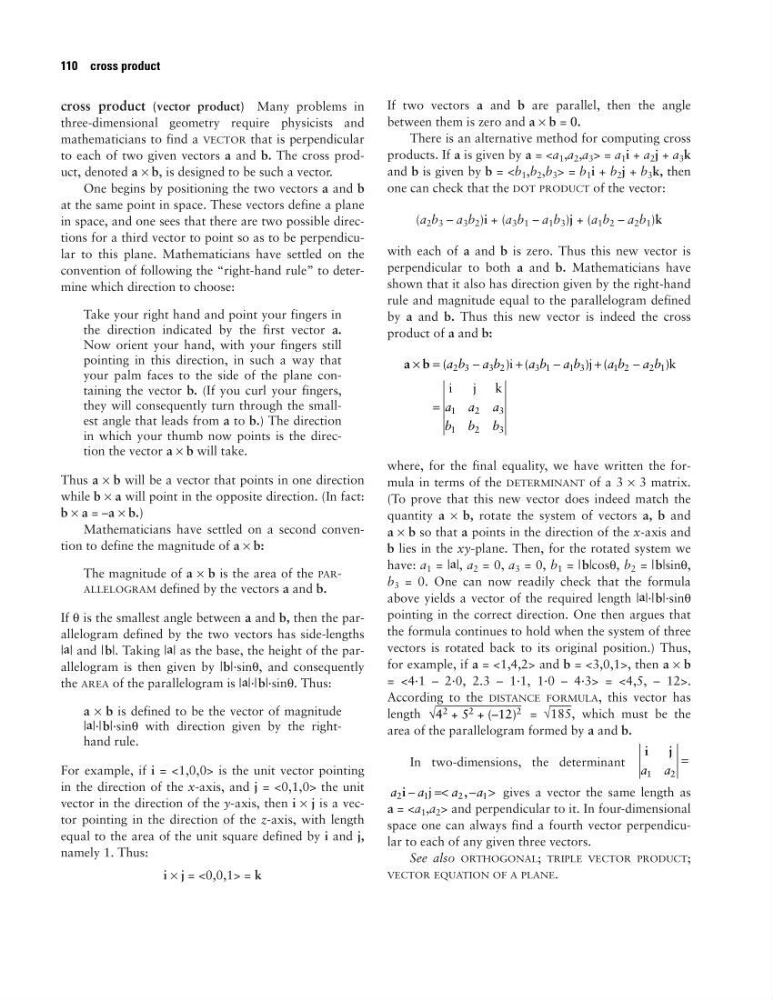
cross product (vector product) Many problems in
three-dimensional geometry require physicists and
mathematicians to find a VECTOR that is perpendicular
to each of two given vectors a and b. The cross product, denoted a × b, is designed to be such a vector.
One begins by positioning the two vectors a and b
at the same point in space. These vectors define a plane
in space, and one sees that there are two possible directions for a third vector to point so as to be perpendicular to this plane. Mathematicians have settled on the
convention of following the “right-hand rule” to determine which direction to choose:
Take your right hand and point your fingers in
the direction indicated by the first vector a.
Now orient your hand, with your fingers still
pointing in this direction, in such a way that
your palm faces to the side of the plane containing the vector b. (If you curl your fingers,
they will consequently turn through the smallest angle that leads from a to b.) The direction
in which your thumb now points is the direction the vector a × b will take.
Thus a × b will be a vector that points in one direction
while b × a will point in the opposite direction. (In fact:
b × a = –a × b.)
Mathematicians have settled on a second convention to define the magnitude of a × b:
The magnitude of a × b is the area of the PARALLELOGRAM defined by the vectors a and b.
If θ is the smallest angle between a and b, then the parallelogram defined by the two vectors has side-lengths
|a| and | b|. Taking |a| as the base, the height of the parallelogram is then given by |b|·sinθ, and consequently
the AREA of the parallelogram is |a|·| b|·sinθ. Thus:
a × b is defined to be the vector of magnitude
|a|·| b|·sinθ with direction given by the righthand rule.
For example, if i = <1,0,0> is the unit vector pointing
in the direction of the x-axis, and j = <0,1,0> the unit
vector in the direction of the y-axis, then i × j is a vector pointing in the direction of the z-axis, with length
equal to the area of the unit square defined by i and j,
namely 1. Thus:
i × j = <0,0,1> = k
If two vectors a and b are parallel, then the angle
between them is zero and a × b = 0.
There is an alternative method for computing cross
products. If a is given by a = = a 1 i + a 2 j + a 3 k
and b is given by b = = b 1 i + b 2 j + b 3 k, then
one can check that the DOT PRODUCT of the vector:
(a 2 b 3 – a 3 b 2 )i + (a 3 b 1 – a 1 b 3 )j + (a 1 b 2 – a 2 b 1 )k
with each of a and b is zero. Thus this new vector is
perpendicular to both a and b. Mathematicians have
shown that it also has direction given by the right-hand
rule and magnitude equal to the parallelogram defined
by a and b. Thus this new vector is indeed the cross
product of a and b:
where, for the final equality, we have written the formula in terms of the DETERMINANT of a 3 × 3 matrix.
(To prove that this new vector does indeed match the
quantity a × b, rotate the system of vectors a, b and
a × b so that a points in the direction of the x-axis and
b lies in the xy-plane. Then, for the rotated system we
have: a 1 = |a|, a 2 = 0, a 3 = 0, b 1 = |b|cosθ, b 2 = |b|sinθ,
b 3 = 0. One can now readily check that the formula
above yields a vector of the required length |a|·| b|·sinθ
pointing in the correct direction. One then argues that
the formula continues to hold when the system of three
vectors is rotated back to its original position.) Thus,
for example, if a = <1,4,2> and b = <3,0,1>, then a × b
= <4·1 – 2·0, 2.3 – 1·1, 1·0 – 4·3> = <4,5, – 12>.
According to the DISTANCE FORMULA, this vector has
length
= √
–
185, which must be the
area of the parallelogram formed by a and b.
In two-dimensions, the determinant
gives a vector the same length as
a = and perpendicular to it. In four-dimensional
space one can always find a fourth vector perpendicular to each of any given three vectors.
See also ORTHOGONAL; TRIPLE VECTOR PRODUCT;
VECTOR EQUATION OF A PLANE.
i
a
a
a a
2
1
2
1
−
=<
− >
j
,
i
j
a a
1
2
=
√4
2 + 5
2 + (–12)
2
a b
× =
−
+
−
+
−
=
(
) (
) (
)
a b a b
a b a b
a b a b
a a a
b b b
2 3
3 2
3 1
1 3
1 2
2 1
1
2
3
1
2
3
i
j
k
i
j k
110 cross product
three-dimensional geometry require physicists and
mathematicians to find a VECTOR that is perpendicular
to each of two given vectors a and b. The cross product, denoted a × b, is designed to be such a vector.
One begins by positioning the two vectors a and b
at the same point in space. These vectors define a plane
in space, and one sees that there are two possible directions for a third vector to point so as to be perpendicular to this plane. Mathematicians have settled on the
convention of following the “right-hand rule” to determine which direction to choose:
Take your right hand and point your fingers in
the direction indicated by the first vector a.
Now orient your hand, with your fingers still
pointing in this direction, in such a way that
your palm faces to the side of the plane containing the vector b. (If you curl your fingers,
they will consequently turn through the smallest angle that leads from a to b.) The direction
in which your thumb now points is the direction the vector a × b will take.
Thus a × b will be a vector that points in one direction
while b × a will point in the opposite direction. (In fact:
b × a = –a × b.)
Mathematicians have settled on a second convention to define the magnitude of a × b:
The magnitude of a × b is the area of the PARALLELOGRAM defined by the vectors a and b.
If θ is the smallest angle between a and b, then the parallelogram defined by the two vectors has side-lengths
|a| and | b|. Taking |a| as the base, the height of the parallelogram is then given by |b|·sinθ, and consequently
the AREA of the parallelogram is |a|·| b|·sinθ. Thus:
a × b is defined to be the vector of magnitude
|a|·| b|·sinθ with direction given by the righthand rule.
For example, if i = <1,0,0> is the unit vector pointing
in the direction of the x-axis, and j = <0,1,0> the unit
vector in the direction of the y-axis, then i × j is a vector pointing in the direction of the z-axis, with length
equal to the area of the unit square defined by i and j,
namely 1. Thus:
i × j = <0,0,1> = k
If two vectors a and b are parallel, then the angle
between them is zero and a × b = 0.
There is an alternative method for computing cross
products. If a is given by a = = a 1 i + a 2 j + a 3 k
and b is given by b = = b 1 i + b 2 j + b 3 k, then
one can check that the DOT PRODUCT of the vector:
(a 2 b 3 – a 3 b 2 )i + (a 3 b 1 – a 1 b 3 )j + (a 1 b 2 – a 2 b 1 )k
with each of a and b is zero. Thus this new vector is
perpendicular to both a and b. Mathematicians have
shown that it also has direction given by the right-hand
rule and magnitude equal to the parallelogram defined
by a and b. Thus this new vector is indeed the cross
product of a and b:
where, for the final equality, we have written the formula in terms of the DETERMINANT of a 3 × 3 matrix.
(To prove that this new vector does indeed match the
quantity a × b, rotate the system of vectors a, b and
a × b so that a points in the direction of the x-axis and
b lies in the xy-plane. Then, for the rotated system we
have: a 1 = |a|, a 2 = 0, a 3 = 0, b 1 = |b|cosθ, b 2 = |b|sinθ,
b 3 = 0. One can now readily check that the formula
above yields a vector of the required length |a|·| b|·sinθ
pointing in the correct direction. One then argues that
the formula continues to hold when the system of three
vectors is rotated back to its original position.) Thus,
for example, if a = <1,4,2> and b = <3,0,1>, then a × b
= <4·1 – 2·0, 2.3 – 1·1, 1·0 – 4·3> = <4,5, – 12>.
According to the DISTANCE FORMULA, this vector has
length
= √
–
185, which must be the
area of the parallelogram formed by a and b.
In two-dimensions, the determinant
gives a vector the same length as
a = and perpendicular to it. In four-dimensional
space one can always find a fourth vector perpendicular to each of any given three vectors.
See also ORTHOGONAL; TRIPLE VECTOR PRODUCT;
VECTOR EQUATION OF A PLANE.
i
a
a
a a
2
1
2
1
−
=<
− >
j
,
i
j
a a
1
2
=
√4
2 + 5
2 + (–12)
2
a b
× =
−
+
−
+
−
=
(
) (
) (
)
a b a b
a b a b
a b a b
a a a
b b b
2 3
3 2
3 1
1 3
1 2
2 1
1
2
3
1
2
3
i
j
k
i
j k
110 cross product