

Shahabuddin, Rahaman, Rehman, Ahmad, and Khan
22
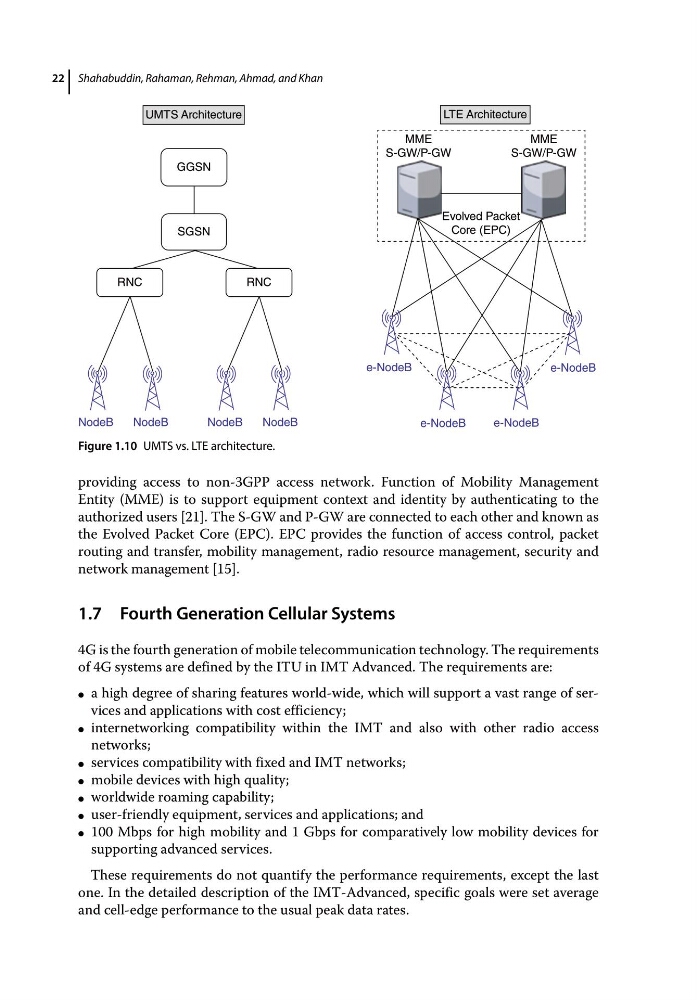
providing access to non‐3GPP access network. Function of Mobility Management
Entity (MME) is to support equipment context and identity by authenticating to the
authorized users [21]. The S‐GW and P‐GW are connected to each other and known as
the Evolved Packet Core (EPC). EPC provides the function of access control, packet
routing and transfer, mobility management, radio resource management, security and
network management [15].
1.7 Fourth Generation Cellular Systems
4G is the fourth generation of mobile telecommunication technology. The requirements
of 4G systems are defined by the ITU in IMT Advanced. The requirements are:
● a high degree of sharing features world‐wide, which will support a vast range of services and applications with cost efficiency;
● internetworking compatibility within the IMT and also with other radio access
networks;
● services compatibility with fixed and IMT networks;
● mobile devices with high quality;
● worldwide roaming capability;
● user‐friendly equipment, services and applications; and
● 100 Mbps for high mobility and 1 Gbps for comparatively low mobility devices for
supporting advanced services.
These requirements do not quantify the performance requirements, except the last
one. In the detailed description of the IMT‐Advanced, specific goals were set average
and cell‐edge performance to the usual peak data rates.
UMTS Architecture
LTE Architecture
Evolved Packet
Core (EPC)
MME
S-GW/P-GW
MME
S-GW/P-GW
GGSN
SGSN
RNC
NodeB
NodeB
NodeB
NodeB
e-NodeB
e-NodeB
e-NodeB
e-NodeB
RNC
Figure 1.10 UMTS vs. LTE architecture.
22
providing access to non‐3GPP access network. Function of Mobility Management
Entity (MME) is to support equipment context and identity by authenticating to the
authorized users [21]. The S‐GW and P‐GW are connected to each other and known as
the Evolved Packet Core (EPC). EPC provides the function of access control, packet
routing and transfer, mobility management, radio resource management, security and
network management [15].
1.7 Fourth Generation Cellular Systems
4G is the fourth generation of mobile telecommunication technology. The requirements
of 4G systems are defined by the ITU in IMT Advanced. The requirements are:
● a high degree of sharing features world‐wide, which will support a vast range of services and applications with cost efficiency;
● internetworking compatibility within the IMT and also with other radio access
networks;
● services compatibility with fixed and IMT networks;
● mobile devices with high quality;
● worldwide roaming capability;
● user‐friendly equipment, services and applications; and
● 100 Mbps for high mobility and 1 Gbps for comparatively low mobility devices for
supporting advanced services.
These requirements do not quantify the performance requirements, except the last
one. In the detailed description of the IMT‐Advanced, specific goals were set average
and cell‐edge performance to the usual peak data rates.
UMTS Architecture
LTE Architecture
Evolved Packet
Core (EPC)
MME
S-GW/P-GW
MME
S-GW/P-GW
GGSN
SGSN
RNC
NodeB
NodeB
NodeB
NodeB
e-NodeB
e-NodeB
e-NodeB
e-NodeB
RNC
Figure 1.10 UMTS vs. LTE architecture.