

Shahabuddin, Rahaman, Rehman, Ahmad, and Khan
12
digits, out of which the first 5 or 6 specify the network and the country. In order to
prevent the eavesdropping, the IMSI is rarely sent, as instead the randomly‐generated
TMSI is used [14].
1.4.5.2 Ki
Ki is a root encryption key used in GSM. It is basically a randomly‐generated 128‐bit
number assigned to a particular subscriber, and plays a large part in the generation of all
the keys in GSM. The Ki is only known to the SIM and the Authentication center (AuC)
for protection reasons. The mobile set also has no information about the Ki, other than
just feeding the information to the SIM that it needs to know in order to perform the
authentication or to generate the ciphering keys. The authentication and key generation
is performed in the SIM.
1.4.5.3 A3 Algorithm
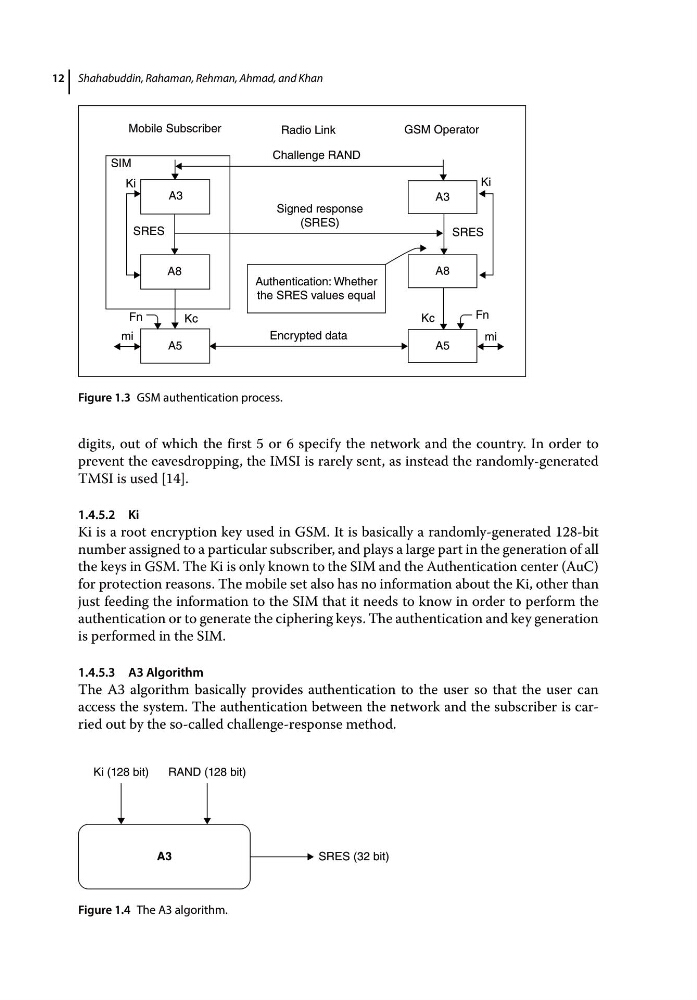
The A3 algorithm basically provides authentication to the user so that the user can
access the system. The authentication between the network and the subscriber is carried out by the so‐called challenge‐response method.
Mobile Subscriber
SIM
Ki
Ki
A3
A8
Encrypted data
Authentication: Whether
the SRES values equal
Signed response
(SRES)
Challenge RAND
Radio Link
GSM Operator
SRES
SRES
Kc
Kc
Fn
Fn
mi
mi
A5
A3
A8
A5
Figure 1.3 GSM authentication process.
A3
SRES (32 bit)
RAND (128 bit)
Ki (128 bit)
Figure 1.4 The A3 algorithm.
12
digits, out of which the first 5 or 6 specify the network and the country. In order to
prevent the eavesdropping, the IMSI is rarely sent, as instead the randomly‐generated
TMSI is used [14].
1.4.5.2 Ki
Ki is a root encryption key used in GSM. It is basically a randomly‐generated 128‐bit
number assigned to a particular subscriber, and plays a large part in the generation of all
the keys in GSM. The Ki is only known to the SIM and the Authentication center (AuC)
for protection reasons. The mobile set also has no information about the Ki, other than
just feeding the information to the SIM that it needs to know in order to perform the
authentication or to generate the ciphering keys. The authentication and key generation
is performed in the SIM.
1.4.5.3 A3 Algorithm
The A3 algorithm basically provides authentication to the user so that the user can
access the system. The authentication between the network and the subscriber is carried out by the so‐called challenge‐response method.
Mobile Subscriber
SIM
Ki
Ki
A3
A8
Encrypted data
Authentication: Whether
the SRES values equal
Signed response
(SRES)
Challenge RAND
Radio Link
GSM Operator
SRES
SRES
Kc
Kc
Fn
Fn
mi
mi
A5
A3
A8
A5
Figure 1.3 GSM authentication process.
A3
SRES (32 bit)
RAND (128 bit)
Ki (128 bit)
Figure 1.4 The A3 algorithm.