

Cloud and MEC Security 379
16.2.5 5G Cloud Computing Architecture
Cloud computing is one of the key technologies that will drive the evolution towards
5G mobile networks. According to the 5G Infrastructure Public‐Private Partnership
(5G PPP) Architecture Working Group, the overall 5G network architecture will be
driven by an extreme demand for flexibility and programmability across all non‐radio
network segments, ranging from the fronthaul to the backhaul networks. Flexibility and
programmability will also extend to mobile networks, access networks, core networks,
and aggregation networks, as well as other evolving network segments such as the
mobile edge networks, IoT networks, satellite networks, and the software defined cloud
networks [15,16].
The 5G evolution will advance the convergence of multiple heterogeneous network
environments, hence integrating a wide variety of network technologies for radio access
and also introducing some novel access technologies to support specific deployment
scenarios and use cases. Cloud computing capabilities will be leveraged to provision
services at different network segments of the 5G network, from the Core Network (CN)
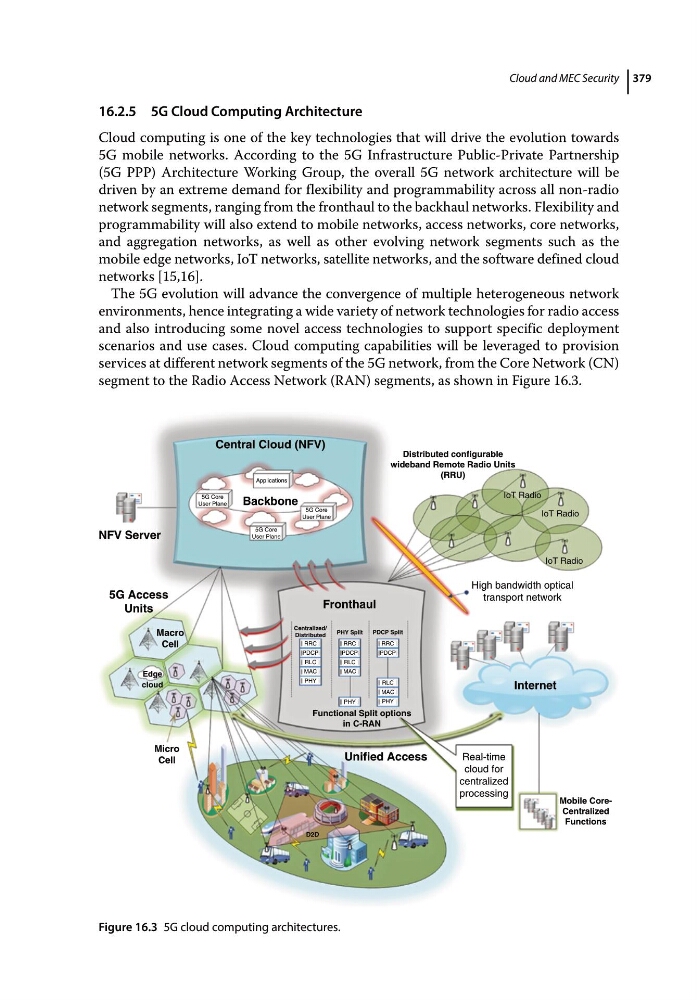
segment to the Radio Access Network (RAN) segments, as shown in Figure 16.3.
Central Cloud (NFV)
Distributed configurable
wideband Remote Radio Units
(RRU)
High bandwidth optical
transport network
Backbone
NFV Server
Fronthaul
Internet
Functional Split options
in C-RAN
Applications
5G Core
User Plane
5G Core
User Plane
Macro
Cell
Micro
Cell
Edge
cloud
RRC
PDCP
RLC
MAC
RRC
PDCP
RRC
PDCP
RLC
MAC
PHY
D2D
RLC
MAC
PHY
PHY
Real-time
cloud for
centralized
processing
Centralized/
Distributed
PHY Split
PDCP Split
5G Core
User Plane
Mobile CoreCentralized
Functions
IoT Radio
IoT Radio
IoT Radio
Unified Access
5G Access
Units
Figure 16.3 5G cloud computing architectures.
16.2.5 5G Cloud Computing Architecture
Cloud computing is one of the key technologies that will drive the evolution towards
5G mobile networks. According to the 5G Infrastructure Public‐Private Partnership
(5G PPP) Architecture Working Group, the overall 5G network architecture will be
driven by an extreme demand for flexibility and programmability across all non‐radio
network segments, ranging from the fronthaul to the backhaul networks. Flexibility and
programmability will also extend to mobile networks, access networks, core networks,
and aggregation networks, as well as other evolving network segments such as the
mobile edge networks, IoT networks, satellite networks, and the software defined cloud
networks [15,16].
The 5G evolution will advance the convergence of multiple heterogeneous network
environments, hence integrating a wide variety of network technologies for radio access
and also introducing some novel access technologies to support specific deployment
scenarios and use cases. Cloud computing capabilities will be leveraged to provision
services at different network segments of the 5G network, from the Core Network (CN)
segment to the Radio Access Network (RAN) segments, as shown in Figure 16.3.
Central Cloud (NFV)
Distributed configurable
wideband Remote Radio Units
(RRU)
High bandwidth optical
transport network
Backbone
NFV Server
Fronthaul
Internet
Functional Split options
in C-RAN
Applications
5G Core
User Plane
5G Core
User Plane
Macro
Cell
Micro
Cell
Edge
cloud
RRC
PDCP
RLC
MAC
RRC
PDCP
RRC
PDCP
RLC
MAC
PHY
D2D
RLC
MAC
PHY
PHY
Real-time
cloud for
centralized
processing
Centralized/
Distributed
PHY Split
PDCP Split
5G Core
User Plane
Mobile CoreCentralized
Functions
IoT Radio
IoT Radio
IoT Radio
Unified Access
5G Access
Units
Figure 16.3 5G cloud computing architectures.