

Chu
352
OpenFlow style SDN, or even ONF’s interpretation of SDN. The phrase “software
defined” has also been applied to other components in the data center or other complex
systems, such as “Software Defined Storage”, or “Software Defined Data Center”, or
“Software Defined Infrastructure”. We will not attempt to distinguish between these.
We will use the term SDN to mean a concept different from the OpenFlow protocol,
and similarly to apply it to any network device other than just an Ethernet switch. We
think the essential benefits of SDN are the central control of decision‐making at a high
level, not centralizing the entire control plane in OpenFlow. For the purpose of this
chapter, the data plane device can be any Network Function (NF) – whether it is PNF or
VNF, or a software entity in NFVI virtualization layer, such as a virtual switch or a virtual router. For instance, software‐defined radio is a good example of SDN. The common entity is a logically centralized controller designed with modern interfaces and
distributed, loosely‐coupled architecture.
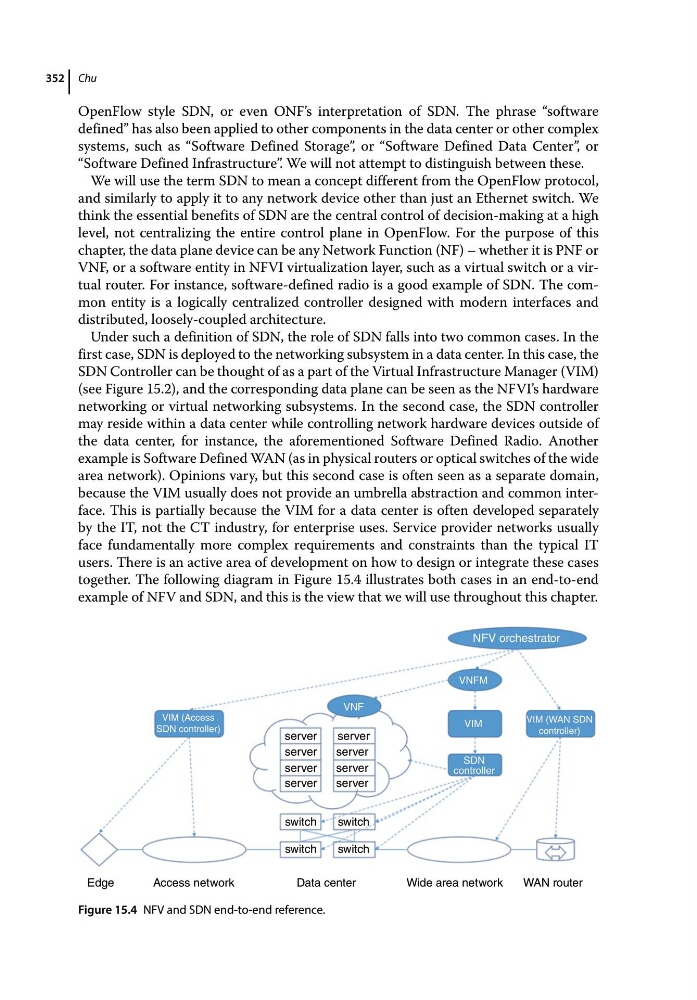
Under such a definition of SDN, the role of SDN falls into two common cases. In the
first case, SDN is deployed to the networking subsystem in a data center. In this case, the
SDN Controller can be thought of as a part of the Virtual Infrastructure Manager (VIM)
(see Figure 15.2), and the corresponding data plane can be seen as the NFVI’s hardware
networking or virtual networking subsystems. In the second case, the SDN controller
may reside within a data center while controlling network hardware devices outside of
the data center, for instance, the aforementioned Software Defined Radio. Another
example is Software Defined WAN (as in physical routers or optical switches of the wide
area network). Opinions vary, but this second case is often seen as a separate domain,
because the VIM usually does not provide an umbrella abstraction and common interface. This is partially because the VIM for a data center is often developed separately
by the IT, not the CT industry, for enterprise uses. Service provider networks usually
face fundamentally more complex requirements and constraints than the typical IT
users. There is an active area of development on how to design or integrate these cases
together. The following diagram in Figure 15.4 illustrates both cases in an end‐to‐end
example of NFV and SDN, and this is the view that we will use throughout this chapter.
VIM (Access
SDN controller)
Edge
Access network
Data center
server
server
server
server
switch
switch
switch
switch
server
server
server
server
Wide area network
WAN router
VNF
VNFM
NFV orchestrator
VIM (WAN SDN
controller)
VIM
SDN
controller
Figure 15.4 NFV and SDN end‐to‐end reference.
352
OpenFlow style SDN, or even ONF’s interpretation of SDN. The phrase “software
defined” has also been applied to other components in the data center or other complex
systems, such as “Software Defined Storage”, or “Software Defined Data Center”, or
“Software Defined Infrastructure”. We will not attempt to distinguish between these.
We will use the term SDN to mean a concept different from the OpenFlow protocol,
and similarly to apply it to any network device other than just an Ethernet switch. We
think the essential benefits of SDN are the central control of decision‐making at a high
level, not centralizing the entire control plane in OpenFlow. For the purpose of this
chapter, the data plane device can be any Network Function (NF) – whether it is PNF or
VNF, or a software entity in NFVI virtualization layer, such as a virtual switch or a virtual router. For instance, software‐defined radio is a good example of SDN. The common entity is a logically centralized controller designed with modern interfaces and
distributed, loosely‐coupled architecture.
Under such a definition of SDN, the role of SDN falls into two common cases. In the
first case, SDN is deployed to the networking subsystem in a data center. In this case, the
SDN Controller can be thought of as a part of the Virtual Infrastructure Manager (VIM)
(see Figure 15.2), and the corresponding data plane can be seen as the NFVI’s hardware
networking or virtual networking subsystems. In the second case, the SDN controller
may reside within a data center while controlling network hardware devices outside of
the data center, for instance, the aforementioned Software Defined Radio. Another
example is Software Defined WAN (as in physical routers or optical switches of the wide
area network). Opinions vary, but this second case is often seen as a separate domain,
because the VIM usually does not provide an umbrella abstraction and common interface. This is partially because the VIM for a data center is often developed separately
by the IT, not the CT industry, for enterprise uses. Service provider networks usually
face fundamentally more complex requirements and constraints than the typical IT
users. There is an active area of development on how to design or integrate these cases
together. The following diagram in Figure 15.4 illustrates both cases in an end‐to‐end
example of NFV and SDN, and this is the view that we will use throughout this chapter.
VIM (Access
SDN controller)
Edge
Access network
Data center
server
server
server
server
switch
switch
switch
switch
server
server
server
server
Wide area network
WAN router
VNF
VNFM
NFV orchestrator
VIM (WAN SDN
controller)
VIM
SDN
controller
Figure 15.4 NFV and SDN end‐to‐end reference.