

IoT Security 255
11.4.2 Robot Attack Classification
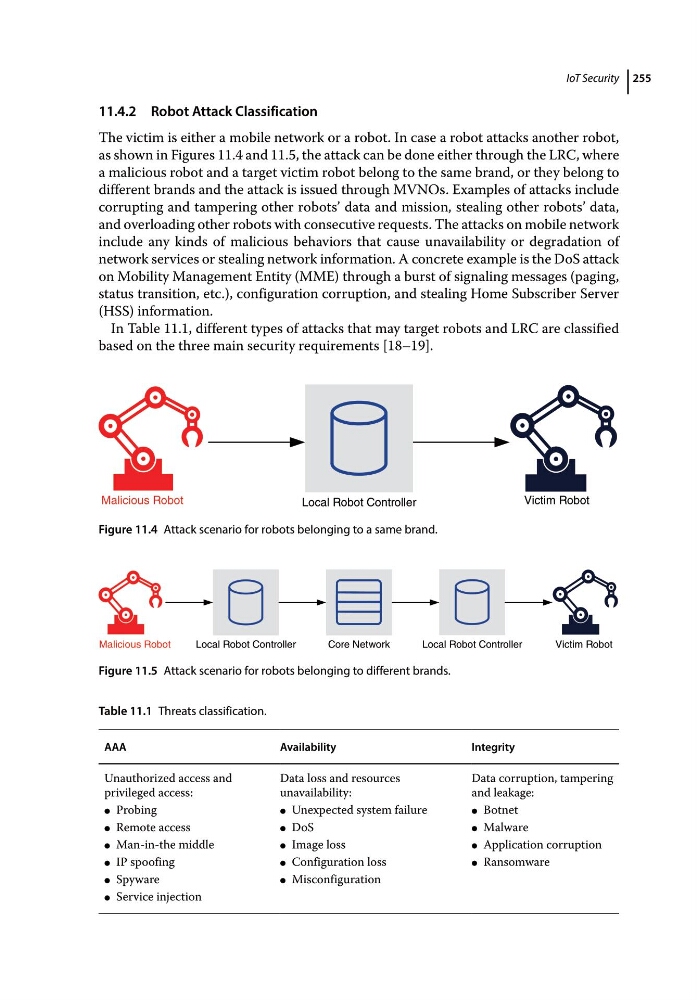
The victim is either a mobile network or a robot. In case a robot attacks another robot,
as shown in Figures 11.4 and 11.5, the attack can be done either through the LRC, where
a malicious robot and a target victim robot belong to the same brand, or they belong to
different brands and the attack is issued through MVNOs. Examples of attacks include
corrupting and tampering other robots’ data and mission, stealing other robots’ data,
and overloading other robots with consecutive requests. The attacks on mobile network
include any kinds of malicious behaviors that cause unavailability or degradation of
network services or stealing network information. A concrete example is the DoS attack
on Mobility Management Entity (MME) through a burst of signaling messages (paging,
status transition, etc.), configuration corruption, and stealing Home Subscriber Server
(HSS) information.
In Table 11.1, different types of attacks that may target robots and LRC are classified
based on the three main security requirements [18–19].
Malicious Robot
Local Robot Controller
Victim Robot
Figure 11.4 Attack scenario for robots belonging to a same brand.
Malicious Robot
Local Robot Controller
Core Network
Local Robot Controller
Victim Robot
Figure 11.5 Attack scenario for robots belonging to different brands.
Table 11.1 Threats classification.
AAA
Availability
Integrity
Unauthorized access and
privileged access:
● Probing
● Remote access
● Man‐in‐the middle
● IP spoofing
● Spyware
● Service injection
Data loss and resources
unavailability:
● Unexpected system failure
● DoS
● Image loss
● Configuration loss
● Misconfiguration
Data corruption, tampering
and leakage:
● Botnet
● Malware
● Application corruption
● Ransomware
11.4.2 Robot Attack Classification
The victim is either a mobile network or a robot. In case a robot attacks another robot,
as shown in Figures 11.4 and 11.5, the attack can be done either through the LRC, where
a malicious robot and a target victim robot belong to the same brand, or they belong to
different brands and the attack is issued through MVNOs. Examples of attacks include
corrupting and tampering other robots’ data and mission, stealing other robots’ data,
and overloading other robots with consecutive requests. The attacks on mobile network
include any kinds of malicious behaviors that cause unavailability or degradation of
network services or stealing network information. A concrete example is the DoS attack
on Mobility Management Entity (MME) through a burst of signaling messages (paging,
status transition, etc.), configuration corruption, and stealing Home Subscriber Server
(HSS) information.
In Table 11.1, different types of attacks that may target robots and LRC are classified
based on the three main security requirements [18–19].
Malicious Robot
Local Robot Controller
Victim Robot
Figure 11.4 Attack scenario for robots belonging to a same brand.
Malicious Robot
Local Robot Controller
Core Network
Local Robot Controller
Victim Robot
Figure 11.5 Attack scenario for robots belonging to different brands.
Table 11.1 Threats classification.
AAA
Availability
Integrity
Unauthorized access and
privileged access:
● Probing
● Remote access
● Man‐in‐the middle
● IP spoofing
● Spyware
● Service injection
Data loss and resources
unavailability:
● Unexpected system failure
● DoS
● Image loss
● Configuration loss
● Misconfiguration
Data corruption, tampering
and leakage:
● Botnet
● Malware
● Application corruption
● Ransomware