

Travanca and André
174
8.3.2 Actions
Actions are classified by their variation in time as [31,32,34]:
1) Permanent action (G): an action that is likely to act continuously during a given reference period and for which the variation in space and in magnitude with time is
insignificant;
2) Variable action (Q): an action that is likely to act during a given reference period but
for which the variation in space or in magnitude with time is not insignificant;
3) Accidental action (A): an action, usually of short duration but of abnormal magnitude, that is unlikely to occur on a given structure during a given reference period.
In general, the most important actions applied to communication structures are
wind action and the combined effect of icing and wind actions. Human errors during
design, assembly, maintenance and operation activities are also a common occurrence, enabling cause of collapses. In this chapter, attention will be given only to
wind action.
The wind velocity, V, can be decomposed into a mean wind velocity, V m , with direction,
u, and into fluctuating terms, V’ , along three orthogonal directions u, v, and w [35]. The
design wind velocity can be determined from BS EN 1991‐1‐4 [36,37], with additional
rules specified in Annex B of BS EN 1993‐3‐1. In BS EN 1991‐1‐4, the reference wind
velocities correspond to characteristic values of the wind velocity equal to the 50‐year
return period values. The reference wind velocity is considered equal to the maximum
mean wind velocity averaged over 10 min, referenced to a height of 10 m over flat open
country terrain.
Based on some prior information, namely location, altitude and orography of the
site, the basic wind velocity is determined by the reference wind velocity. In BS EN
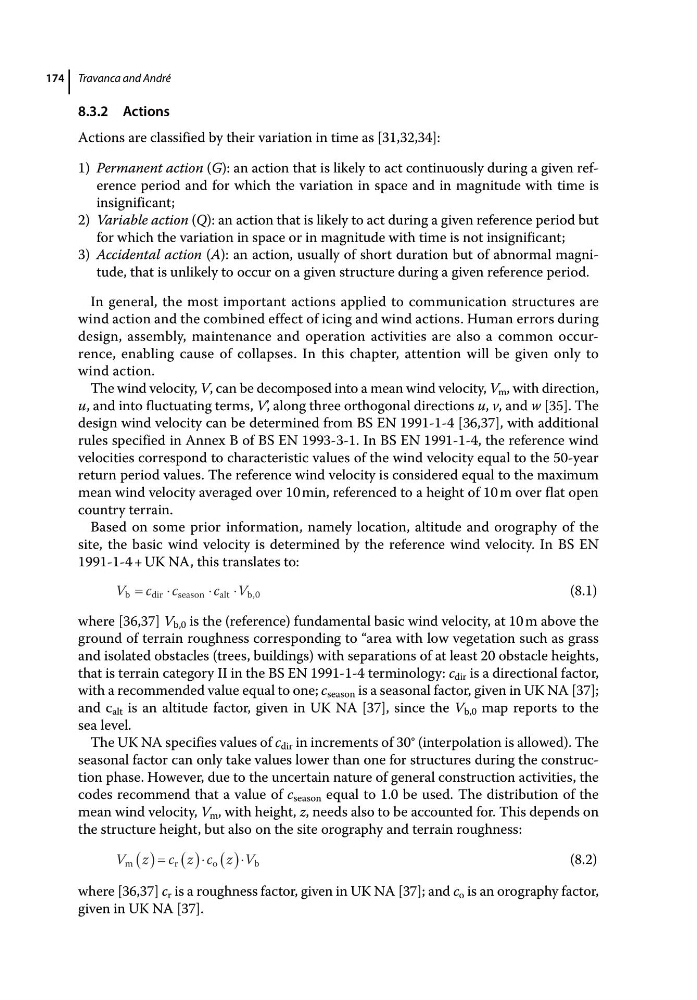
1991‐1‐4 + UK NA, this translates to:
V c c
c V
b
d ir
season
alt
b,0
(8.1)
where [36,37] V b,0 is the (reference) fundamental basic wind velocity, at 10 m above the
ground of terrain roughness corresponding to “area with low vegetation such as grass
and isolated obstacles (trees, buildings) with separations of at least 20 obstacle heights,
that is terrain category II in the BS EN 1991‐1‐4 terminology: c dir is a directional factor,
with a recommended value equal to one; c season is a seasonal factor, given in UK NA [37];
and c alt is an altitude factor, given in UK NA [37], since the V b,0 map reports to the
sea level.
The UK NA specifies values of c dir in increments of 30° (interpolation is allowed). The
seasonal factor can only take values lower than one for structures during the construction phase. However, due to the uncertain nature of general construction activities, the
codes recommend that a value of c season equal to 1.0 be used. The distribution of the
mean wind velocity, V m , with height, z, needs also to be accounted for. This depends on
the structure height, but also on the site orography and terrain roughness:
V z c z c z V
m
r
o
b
(8.2)
where [36,37] c r is a roughness factor, given in UK NA [37]; and c o is an orography factor,
given in UK NA [37].
174
8.3.2 Actions
Actions are classified by their variation in time as [31,32,34]:
1) Permanent action (G): an action that is likely to act continuously during a given reference period and for which the variation in space and in magnitude with time is
insignificant;
2) Variable action (Q): an action that is likely to act during a given reference period but
for which the variation in space or in magnitude with time is not insignificant;
3) Accidental action (A): an action, usually of short duration but of abnormal magnitude, that is unlikely to occur on a given structure during a given reference period.
In general, the most important actions applied to communication structures are
wind action and the combined effect of icing and wind actions. Human errors during
design, assembly, maintenance and operation activities are also a common occurrence, enabling cause of collapses. In this chapter, attention will be given only to
wind action.
The wind velocity, V, can be decomposed into a mean wind velocity, V m , with direction,
u, and into fluctuating terms, V’ , along three orthogonal directions u, v, and w [35]. The
design wind velocity can be determined from BS EN 1991‐1‐4 [36,37], with additional
rules specified in Annex B of BS EN 1993‐3‐1. In BS EN 1991‐1‐4, the reference wind
velocities correspond to characteristic values of the wind velocity equal to the 50‐year
return period values. The reference wind velocity is considered equal to the maximum
mean wind velocity averaged over 10 min, referenced to a height of 10 m over flat open
country terrain.
Based on some prior information, namely location, altitude and orography of the
site, the basic wind velocity is determined by the reference wind velocity. In BS EN
1991‐1‐4 + UK NA, this translates to:
V c c
c V
b
d ir
season
alt
b,0
(8.1)
where [36,37] V b,0 is the (reference) fundamental basic wind velocity, at 10 m above the
ground of terrain roughness corresponding to “area with low vegetation such as grass
and isolated obstacles (trees, buildings) with separations of at least 20 obstacle heights,
that is terrain category II in the BS EN 1991‐1‐4 terminology: c dir is a directional factor,
with a recommended value equal to one; c season is a seasonal factor, given in UK NA [37];
and c alt is an altitude factor, given in UK NA [37], since the V b,0 map reports to the
sea level.
The UK NA specifies values of c dir in increments of 30° (interpolation is allowed). The
seasonal factor can only take values lower than one for structures during the construction phase. However, due to the uncertain nature of general construction activities, the
codes recommend that a value of c season equal to 1.0 be used. The distribution of the
mean wind velocity, V m , with height, z, needs also to be accounted for. This depends on
the structure height, but also on the site orography and terrain roughness:
V z c z c z V
m
r
o
b
(8.2)
where [36,37] c r is a roughness factor, given in UK NA [37]; and c o is an orography factor,
given in UK NA [37].