

Soderi, Mucchi, Hämäläinen, Piva, and Iinatti
136
effect of increasing the jammed samples leads to a lower P out close to Alice. Figure 6.12
also shows the near‐field regions around Alice and Bob.
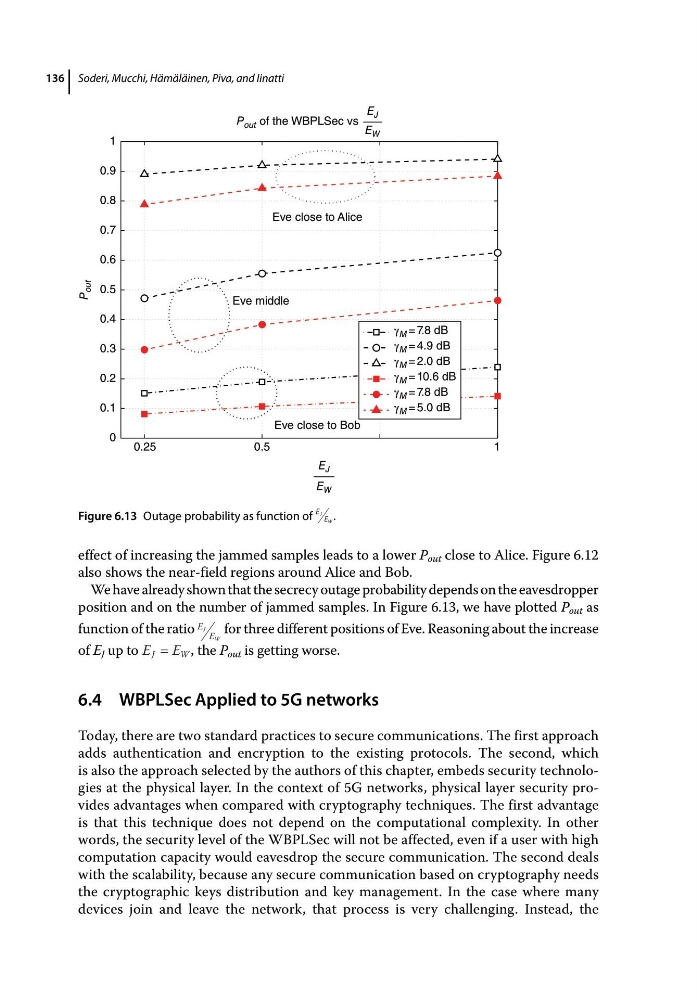
We have already shown that the secrecy outage probability depends on the eavesdropper
position and on the number of jammed samples. In Figure 6.13, we have plotted P out as
function of the ratio E
E
J
W
for three different positions of Eve. Reasoning about the increase
of E J up to E
E
J
W , the P out is getting worse.
6.4 WBPLSec Applied to 5G networks
Today, there are two standard practices to secure communications. The first approach
adds authentication and encryption to the existing protocols. The second, which
is also the approach selected by the authors of this chapter, embeds security technologies at the physical layer. In the context of 5G networks, physical layer security provides advantages when compared with cryptography techniques. The first advantage
is that this technique does not depend on the computational complexity. In other
words, the security level of the WBPLSec will not be affected, even if a user with high
computation capacity would eavesdrop the secure communication. The second deals
with the scalability, because any secure communication based on cryptography needs
the cryptographic keys distribution and key management. In the case where many
devices join and leave the network, that process is very challenging. Instead, the
0.25
0.5
1
0
0.1
0.2
0.3
0.4
0.5
0.6
0.7
0.8
0.9
1
E J
E W
P
out
P out of the WBPLSec vs
E J
E W
γ M = 5.0 dB
γ M = 7.8 dB
γ M = 10.6 dB
γ M = 2.0 dB
γ M = 4.9 dB
γ M = 7.8 dB
Eve close to Bob
Eve close to Alice
Eve middle
Figure 6.13 Outage probability as function of
E E
J
W
.
136
effect of increasing the jammed samples leads to a lower P out close to Alice. Figure 6.12
also shows the near‐field regions around Alice and Bob.
We have already shown that the secrecy outage probability depends on the eavesdropper
position and on the number of jammed samples. In Figure 6.13, we have plotted P out as
function of the ratio E
E
J
W
for three different positions of Eve. Reasoning about the increase
of E J up to E
E
J
W , the P out is getting worse.
6.4 WBPLSec Applied to 5G networks
Today, there are two standard practices to secure communications. The first approach
adds authentication and encryption to the existing protocols. The second, which
is also the approach selected by the authors of this chapter, embeds security technologies at the physical layer. In the context of 5G networks, physical layer security provides advantages when compared with cryptography techniques. The first advantage
is that this technique does not depend on the computational complexity. In other
words, the security level of the WBPLSec will not be affected, even if a user with high
computation capacity would eavesdrop the secure communication. The second deals
with the scalability, because any secure communication based on cryptography needs
the cryptographic keys distribution and key management. In the case where many
devices join and leave the network, that process is very challenging. Instead, the
0.25
0.5
1
0
0.1
0.2
0.3
0.4
0.5
0.6
0.7
0.8
0.9
1
E J
E W
P
out
P out of the WBPLSec vs
E J
E W
γ M = 5.0 dB
γ M = 7.8 dB
γ M = 10.6 dB
γ M = 2.0 dB
γ M = 4.9 dB
γ M = 7.8 dB
Eve close to Bob
Eve close to Alice
Eve middle
Figure 6.13 Outage probability as function of
E E
J
W
.