

Soderi, Mucchi, Hämäläinen, Piva, and Iinatti
134
6.3.1 Simulation Scenario for Secrecy Capacity
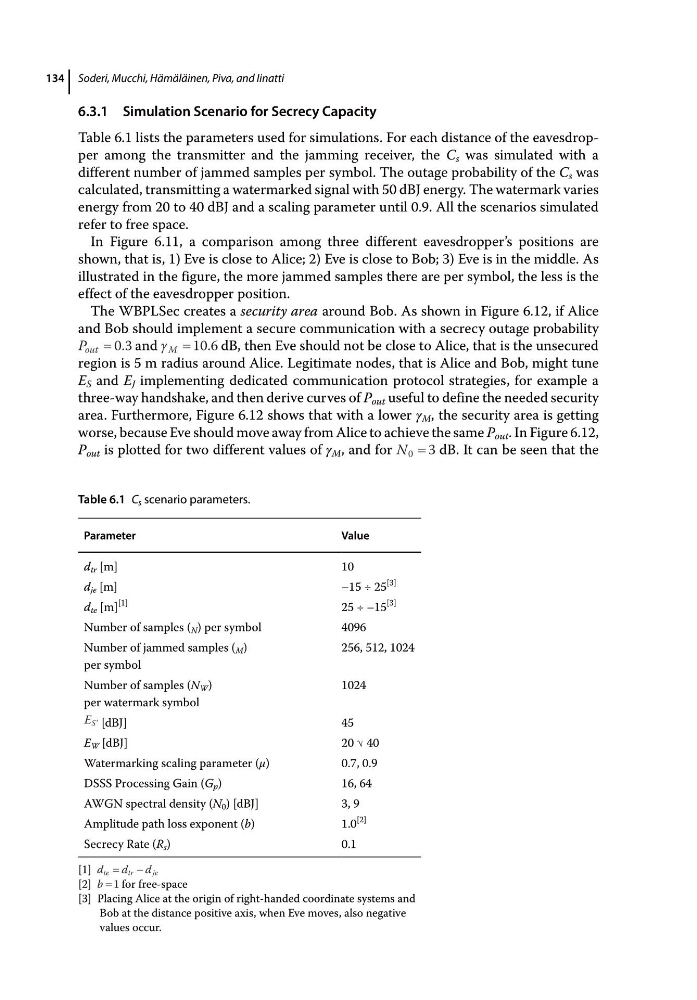
Table 6.1 lists the parameters used for simulations. For each distance of the eavesdropper among the transmitter and the jamming receiver, the C s was simulated with a
different number of jammed samples per symbol. The outage probability of the C s was
calculated, transmitting a watermarked signal with 50 dBJ energy. The watermark varies
energy from 20 to 40 dBJ and a scaling parameter until 0.9. All the scenarios simulated
refer to free space.
In Figure 6.11, a comparison among three different eavesdropper’s positions are
shown, that is, 1) Eve is close to Alice; 2) Eve is close to Bob; 3) Eve is in the middle. As
illustrated in the figure, the more jammed samples there are per symbol, the less is the
effect of the eavesdropper position.
The WBPLSec creates a security area around Bob. As shown in Figure 6.12, if Alice
and Bob should implement a secure communication with a secrecy outage probability
P out 0 3
. and M 10 6
. dB, then Eve should not be close to Alice, that is the unsecured
region is 5 m radius around Alice. Legitimate nodes, that is Alice and Bob, might tune
E S and E J implementing dedicated communication protocol strategies, for example a
three‐way handshake, and then derive curves of P out useful to define the needed security
area. Furthermore, Figure 6.12 shows that with a lower γ M , the security area is getting
worse, because Eve should move away from Alice to achieve the same P out . In Figure 6.12,
P out is plotted for two different values of γ M , and for N 0 3 dB. It can be seen that the
Table 6.1 C s scenario parameters.
Parameter
Value
d tr [m]
10
d je [m]
–15 ÷ 25
[3]
d te [m]
[1]
25 ÷ –15
[3]
Number of samples ( N ) per symbol
4096
Number of jammed samples ( M )
per symbol
256, 512, 1024
Number of samples (N W )
per watermark symbol
1024
E S [dBJ]
45
E W [dBJ]
20 40
Watermarking scaling parameter (μ)
0.7, 0.9
DSSS Processing Gain (G p )
16, 64
AWGN spectral density (N 0 ) [dBJ]
3, 9
Amplitude path loss exponent (b)
1.0
[2]
Secrecy Rate (R s )
0.1
[1] d
d d
te
tr
je
[2] b 1 for free‐space
[3] Placing Alice at the origin of right‐handed coordinate systems and
Bob at the distance positive axis, when Eve moves, also negative
values occur.
134
6.3.1 Simulation Scenario for Secrecy Capacity
Table 6.1 lists the parameters used for simulations. For each distance of the eavesdropper among the transmitter and the jamming receiver, the C s was simulated with a
different number of jammed samples per symbol. The outage probability of the C s was
calculated, transmitting a watermarked signal with 50 dBJ energy. The watermark varies
energy from 20 to 40 dBJ and a scaling parameter until 0.9. All the scenarios simulated
refer to free space.
In Figure 6.11, a comparison among three different eavesdropper’s positions are
shown, that is, 1) Eve is close to Alice; 2) Eve is close to Bob; 3) Eve is in the middle. As
illustrated in the figure, the more jammed samples there are per symbol, the less is the
effect of the eavesdropper position.
The WBPLSec creates a security area around Bob. As shown in Figure 6.12, if Alice
and Bob should implement a secure communication with a secrecy outage probability
P out 0 3
. and M 10 6
. dB, then Eve should not be close to Alice, that is the unsecured
region is 5 m radius around Alice. Legitimate nodes, that is Alice and Bob, might tune
E S and E J implementing dedicated communication protocol strategies, for example a
three‐way handshake, and then derive curves of P out useful to define the needed security
area. Furthermore, Figure 6.12 shows that with a lower γ M , the security area is getting
worse, because Eve should move away from Alice to achieve the same P out . In Figure 6.12,
P out is plotted for two different values of γ M , and for N 0 3 dB. It can be seen that the
Table 6.1 C s scenario parameters.
Parameter
Value
d tr [m]
10
d je [m]
–15 ÷ 25
[3]
d te [m]
[1]
25 ÷ –15
[3]
Number of samples ( N ) per symbol
4096
Number of jammed samples ( M )
per symbol
256, 512, 1024
Number of samples (N W )
per watermark symbol
1024
E S [dBJ]
45
E W [dBJ]
20 40
Watermarking scaling parameter (μ)
0.7, 0.9
DSSS Processing Gain (G p )
16, 64
AWGN spectral density (N 0 ) [dBJ]
3, 9
Amplitude path loss exponent (b)
1.0
[2]
Secrecy Rate (R s )
0.1
[1] d
d d
te
tr
je
[2] b 1 for free‐space
[3] Placing Alice at the origin of right‐handed coordinate systems and
Bob at the distance positive axis, when Eve moves, also negative
values occur.