

Cyber Security Business Models in 5G 105
content or whether it is freely accessible to end users, as in the case of advertisement
content.
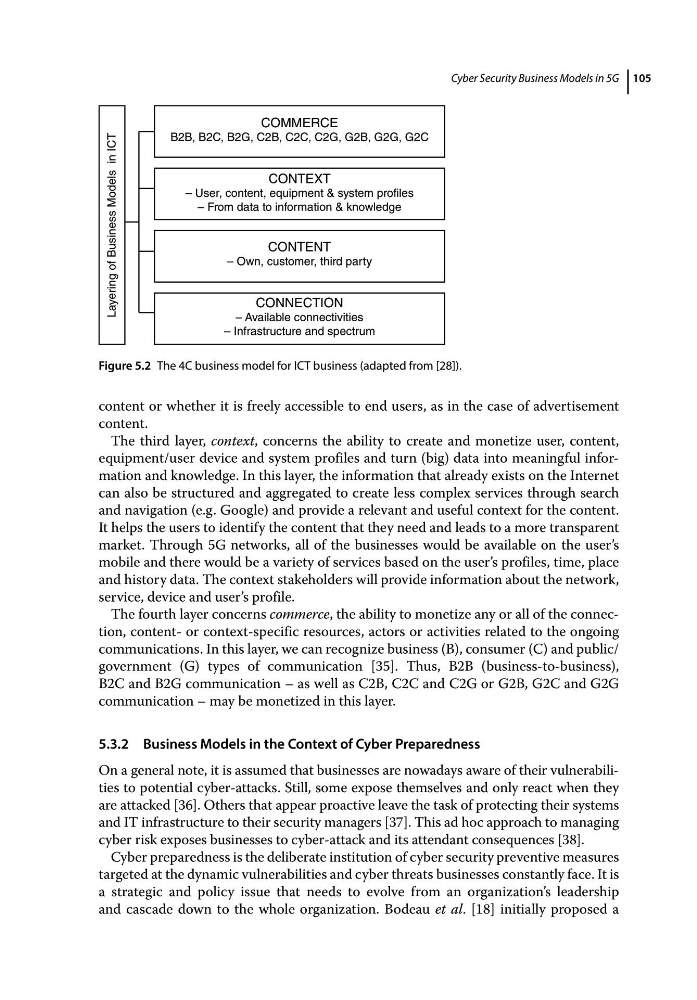
The third layer, context, concerns the ability to create and monetize user, content,
equipment/user device and system profiles and turn (big) data into meaningful information and knowledge. In this layer, the information that already exists on the Internet
can also be structured and aggregated to create less complex services through search
and navigation (e.g. Google) and provide a relevant and useful context for the content.
It helps the users to identify the content that they need and leads to a more transparent
market. Through 5G networks, all of the businesses would be available on the user’s
mobile and there would be a variety of services based on the user’s profiles, time, place
and history data. The context stakeholders will provide information about the network,
service, device and user’s profile.
The fourth layer concerns commerce, the ability to monetize any or all of the connection, content‐ or context‐specific resources, actors or activities related to the ongoing
communications. In this layer, we can recognize business (B), consumer (C) and public/
government (G) types of communication [35]. Thus, B2B (business‐to‐business),
B2C and B2G communication – as well as C2B, C2C and C2G or G2B, G2C and G2G
communication – may be monetized in this layer.
5.3.2 Business Models in the Context of Cyber Preparedness
On a general note, it is assumed that businesses are nowadays aware of their vulnerabilities to potential cyber‐attacks. Still, some expose themselves and only react when they
are attacked [36]. Others that appear proactive leave the task of protecting their systems
and IT infrastructure to their security managers [37]. This ad hoc approach to managing
cyber risk exposes businesses to cyber‐attack and its attendant consequences [38].
Cyber preparedness is the deliberate institution of cyber security preventive measures
targeted at the dynamic vulnerabilities and cyber threats businesses constantly face. It is
a strategic and policy issue that needs to evolve from an organization’s leadership
and cascade down to the whole organization. Bodeau et al. [18] initially proposed a
Layering of Business Models in ICT
COMMERCE
B2B, B2C, B2G, C2B, C2C, C2G, G2B, G2G, G2C
CONTEXT
– User, content, equipment & system profiles
– From data to information & knowledge
CONTENT
– Own, customer, third party
CONNECTION
– Available connectivities
– Infrastructure and spectrum
Figure 5.2 The 4C business model for ICT business (adapted from [28]).
content or whether it is freely accessible to end users, as in the case of advertisement
content.
The third layer, context, concerns the ability to create and monetize user, content,
equipment/user device and system profiles and turn (big) data into meaningful information and knowledge. In this layer, the information that already exists on the Internet
can also be structured and aggregated to create less complex services through search
and navigation (e.g. Google) and provide a relevant and useful context for the content.
It helps the users to identify the content that they need and leads to a more transparent
market. Through 5G networks, all of the businesses would be available on the user’s
mobile and there would be a variety of services based on the user’s profiles, time, place
and history data. The context stakeholders will provide information about the network,
service, device and user’s profile.
The fourth layer concerns commerce, the ability to monetize any or all of the connection, content‐ or context‐specific resources, actors or activities related to the ongoing
communications. In this layer, we can recognize business (B), consumer (C) and public/
government (G) types of communication [35]. Thus, B2B (business‐to‐business),
B2C and B2G communication – as well as C2B, C2C and C2G or G2B, G2C and G2G
communication – may be monetized in this layer.
5.3.2 Business Models in the Context of Cyber Preparedness
On a general note, it is assumed that businesses are nowadays aware of their vulnerabilities to potential cyber‐attacks. Still, some expose themselves and only react when they
are attacked [36]. Others that appear proactive leave the task of protecting their systems
and IT infrastructure to their security managers [37]. This ad hoc approach to managing
cyber risk exposes businesses to cyber‐attack and its attendant consequences [38].
Cyber preparedness is the deliberate institution of cyber security preventive measures
targeted at the dynamic vulnerabilities and cyber threats businesses constantly face. It is
a strategic and policy issue that needs to evolve from an organization’s leadership
and cascade down to the whole organization. Bodeau et al. [18] initially proposed a
Layering of Business Models in ICT
COMMERCE
B2B, B2C, B2G, C2B, C2C, C2G, G2B, G2G, G2C
CONTEXT
– User, content, equipment & system profiles
– From data to information & knowledge
CONTENT
– Own, customer, third party
CONNECTION
– Available connectivities
– Infrastructure and spectrum
Figure 5.2 The 4C business model for ICT business (adapted from [28]).