

Cyber Security Business Models in 5G 103
The cost related to cyber‐attack can be broadly divided into two costs: the preventive
cost and the post‐attack cost [25]. The preventive cost is investing in infrastructure and
systems, for example, to reinforce the perimeter defence of an organization to prevent
an intrusion or reduce the impact of a breach. Although the cost of preventive solutions
may be high, it may not be as expensive as the post‐attack remedies. The post‐attack
cost involves both the actual cost (e.g. the amount stolen and extortion) and the cost of
measures to remedy the consequences of the attack. This includes the cost of the
replacement or repair of damaged infrastructure or systems; the cost of repairing lost
business, such as customer acquisition activities and image rebuilding efforts; and the
cost of detection and reporting, such as forensic and investigative activities, audits of
installations and systems, crisis management and communication to stakeholders [27].
5.3 The Business Model Approach
Lying at the intersection of entrepreneurship and strategy, the business model concept
can be seen as a bridge between abstract strategies and the practical level of decisions
and actions amidst the uncertainties of the modern business context [6–10]. For instance,
Zott and Amit [13] conceptualize the business model as a “boundary‐spanning” set of
activities aimed at creating and appropriating value. Morris et al. [14] viewed the c oncept
of the business model as a set of decisions related to the venture strategy, architecture
and economics of a firm (value creation and capture) that need to be addressed to create
sustainable competitive advantage in the chosen markets.
Zott and Amit [13] further argue that a business model functions to explore and
exploit a business opportunity. The business model as a concept thus covers a variety of
elements, and there are myriads of conceptualizations available. The key issues these
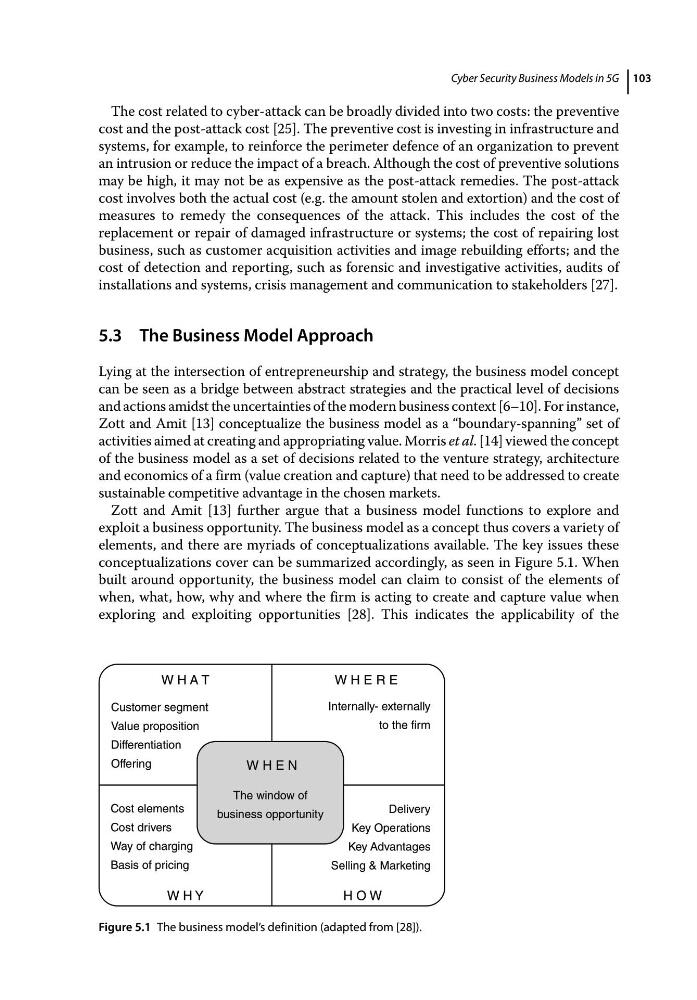
conceptualizations cover can be summarized accordingly, as seen in Figure 5.1. When
built around opportunity, the business model can claim to consist of the elements of
when, what, how, why and where the firm is acting to create and capture value when
exploring and exploiting opportunities [28]. This indicates the applicability of the
W H E R E
W H E N
Customer segment
Value proposition
Differentiation
Offering
Internally- externally
to the firm
The window of
business opportunity
Delivery
Key Operations
Key Advantages
Selling & Marketing
Cost elements
Cost drivers
Way of charging
Basis of pricing
W H Y
W H A T
H O W
Figure 5.1 The business model’s definition (adapted from [28]).
The cost related to cyber‐attack can be broadly divided into two costs: the preventive
cost and the post‐attack cost [25]. The preventive cost is investing in infrastructure and
systems, for example, to reinforce the perimeter defence of an organization to prevent
an intrusion or reduce the impact of a breach. Although the cost of preventive solutions
may be high, it may not be as expensive as the post‐attack remedies. The post‐attack
cost involves both the actual cost (e.g. the amount stolen and extortion) and the cost of
measures to remedy the consequences of the attack. This includes the cost of the
replacement or repair of damaged infrastructure or systems; the cost of repairing lost
business, such as customer acquisition activities and image rebuilding efforts; and the
cost of detection and reporting, such as forensic and investigative activities, audits of
installations and systems, crisis management and communication to stakeholders [27].
5.3 The Business Model Approach
Lying at the intersection of entrepreneurship and strategy, the business model concept
can be seen as a bridge between abstract strategies and the practical level of decisions
and actions amidst the uncertainties of the modern business context [6–10]. For instance,
Zott and Amit [13] conceptualize the business model as a “boundary‐spanning” set of
activities aimed at creating and appropriating value. Morris et al. [14] viewed the c oncept
of the business model as a set of decisions related to the venture strategy, architecture
and economics of a firm (value creation and capture) that need to be addressed to create
sustainable competitive advantage in the chosen markets.
Zott and Amit [13] further argue that a business model functions to explore and
exploit a business opportunity. The business model as a concept thus covers a variety of
elements, and there are myriads of conceptualizations available. The key issues these
conceptualizations cover can be summarized accordingly, as seen in Figure 5.1. When
built around opportunity, the business model can claim to consist of the elements of
when, what, how, why and where the firm is acting to create and capture value when
exploring and exploiting opportunities [28]. This indicates the applicability of the
W H E R E
W H E N
Customer segment
Value proposition
Differentiation
Offering
Internally- externally
to the firm
The window of
business opportunity
Delivery
Key Operations
Key Advantages
Selling & Marketing
Cost elements
Cost drivers
Way of charging
Basis of pricing
W H Y
W H A T
H O W
Figure 5.1 The business model’s definition (adapted from [28]).