

Cyber Security Business Models in 5G 101
5.2.1 Types of Cyber Threat
Cyber threats are classified differently in the literature, but the one most used is the
model that classifies “cyber threats” on five levels, based on the motivational factors
of the threat agents [17,18]. These are cyberactivism, cybercrime, cyber‐espionage,
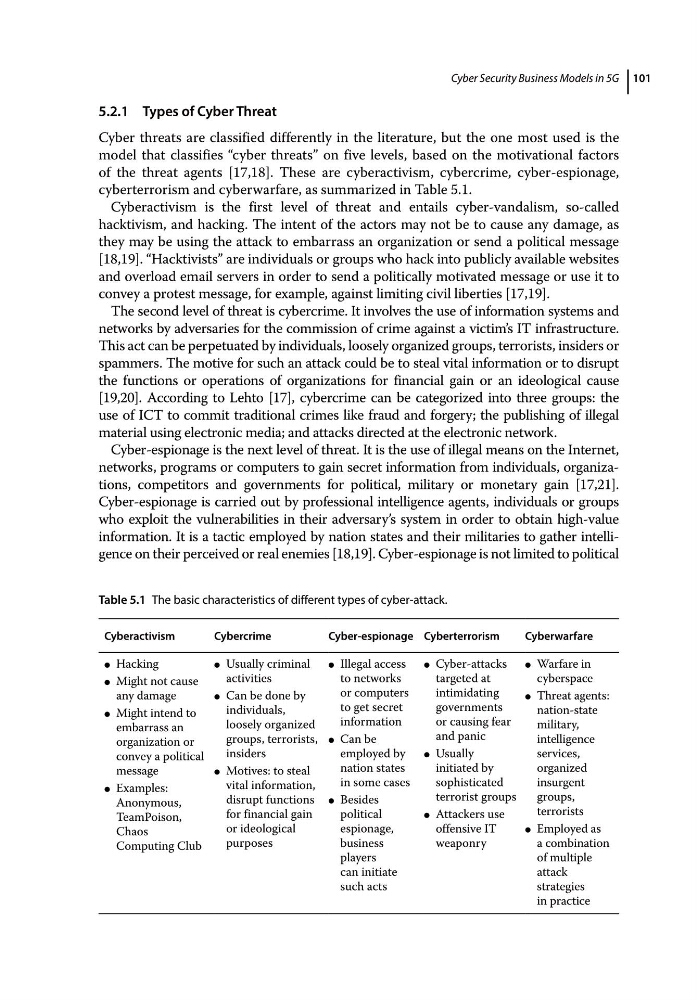
cyberterrorism and cyberwarfare, as summarized in Table 5.1.
Cyberactivism is the first level of threat and entails cyber‐vandalism, so‐called
hacktivism, and hacking. The intent of the actors may not be to cause any damage, as
they may be using the attack to embarrass an organization or send a political message
[18,19]. “Hacktivists” are individuals or groups who hack into publicly available websites
and overload email servers in order to send a politically motivated message or use it to
convey a protest message, for example, against limiting civil liberties [17,19].
The second level of threat is cybercrime. It involves the use of information systems and
networks by adversaries for the commission of crime against a victim’s IT infrastructure.
This act can be perpetuated by individuals, loosely organized groups, terrorists, insiders or
spammers. The motive for such an attack could be to steal vital information or to disrupt
the functions or operations of organizations for financial gain or an ideological cause
[19,20]. According to Lehto [17], cybercrime can be categorized into three groups: the
use of ICT to commit traditional crimes like fraud and forgery; the publishing of illegal
material using electronic media; and attacks directed at the electronic network.
Cyber‐espionage is the next level of threat. It is the use of illegal means on the Internet,
networks, programs or computers to gain secret information from individuals, organizations, competitors and governments for political, military or monetary gain [17,21].
Cyber‐espionage is carried out by professional intelligence agents, individuals or groups
who exploit the vulnerabilities in their adversary’s system in order to obtain high‐value
information. It is a tactic employed by nation states and their militaries to gather intelligence on their perceived or real enemies [18,19]. Cyber‐espionage is not limited to political
Table 5.1 The basic characteristics of different types of cyber‐attack.
Cyberactivism
Cybercrime
Cyber‐espionage Cyberterrorism
Cyberwarfare
● Hacking
● Might not cause
any damage
● Might intend to
embarrass an
organization or
convey a political
message
● Examples:
Anonymous,
TeamPoison,
Chaos
Computing Club
● Usually criminal
activities
● Can be done by
individuals,
loosely organized
groups, terrorists,
insiders
● Motives: to steal
vital information,
disrupt functions
for financial gain
or ideological
purposes
● Illegal access
to networks
or computers
to get secret
information
● Can be
employed by
nation states
in some cases
● Besides
political
espionage,
business
players
can initiate
such acts
● Cyber‐attacks
targeted at
intimidating
governments
or causing fear
and panic
● Usually
initiated by
sophisticated
terrorist groups
● Attackers use
offensive IT
weaponry
● Warfare in
cyberspace
● Threat agents:
nation‐state
military,
intelligence
services,
organized
insurgent
groups,
terrorists
● Employed as
a combination
of multiple
attack
strategies
in practice
5.2.1 Types of Cyber Threat
Cyber threats are classified differently in the literature, but the one most used is the
model that classifies “cyber threats” on five levels, based on the motivational factors
of the threat agents [17,18]. These are cyberactivism, cybercrime, cyber‐espionage,
cyberterrorism and cyberwarfare, as summarized in Table 5.1.
Cyberactivism is the first level of threat and entails cyber‐vandalism, so‐called
hacktivism, and hacking. The intent of the actors may not be to cause any damage, as
they may be using the attack to embarrass an organization or send a political message
[18,19]. “Hacktivists” are individuals or groups who hack into publicly available websites
and overload email servers in order to send a politically motivated message or use it to
convey a protest message, for example, against limiting civil liberties [17,19].
The second level of threat is cybercrime. It involves the use of information systems and
networks by adversaries for the commission of crime against a victim’s IT infrastructure.
This act can be perpetuated by individuals, loosely organized groups, terrorists, insiders or
spammers. The motive for such an attack could be to steal vital information or to disrupt
the functions or operations of organizations for financial gain or an ideological cause
[19,20]. According to Lehto [17], cybercrime can be categorized into three groups: the
use of ICT to commit traditional crimes like fraud and forgery; the publishing of illegal
material using electronic media; and attacks directed at the electronic network.
Cyber‐espionage is the next level of threat. It is the use of illegal means on the Internet,
networks, programs or computers to gain secret information from individuals, organizations, competitors and governments for political, military or monetary gain [17,21].
Cyber‐espionage is carried out by professional intelligence agents, individuals or groups
who exploit the vulnerabilities in their adversary’s system in order to obtain high‐value
information. It is a tactic employed by nation states and their militaries to gather intelligence on their perceived or real enemies [18,19]. Cyber‐espionage is not limited to political
Table 5.1 The basic characteristics of different types of cyber‐attack.
Cyberactivism
Cybercrime
Cyber‐espionage Cyberterrorism
Cyberwarfare
● Hacking
● Might not cause
any damage
● Might intend to
embarrass an
organization or
convey a political
message
● Examples:
Anonymous,
TeamPoison,
Chaos
Computing Club
● Usually criminal
activities
● Can be done by
individuals,
loosely organized
groups, terrorists,
insiders
● Motives: to steal
vital information,
disrupt functions
for financial gain
or ideological
purposes
● Illegal access
to networks
or computers
to get secret
information
● Can be
employed by
nation states
in some cases
● Besides
political
espionage,
business
players
can initiate
such acts
● Cyber‐attacks
targeted at
intimidating
governments
or causing fear
and panic
● Usually
initiated by
sophisticated
terrorist groups
● Attackers use
offensive IT
weaponry
● Warfare in
cyberspace
● Threat agents:
nation‐state
military,
intelligence
services,
organized
insurgent
groups,
terrorists
● Employed as
a combination
of multiple
attack
strategies
in practice