

Mobile Networks Security Landscape 71
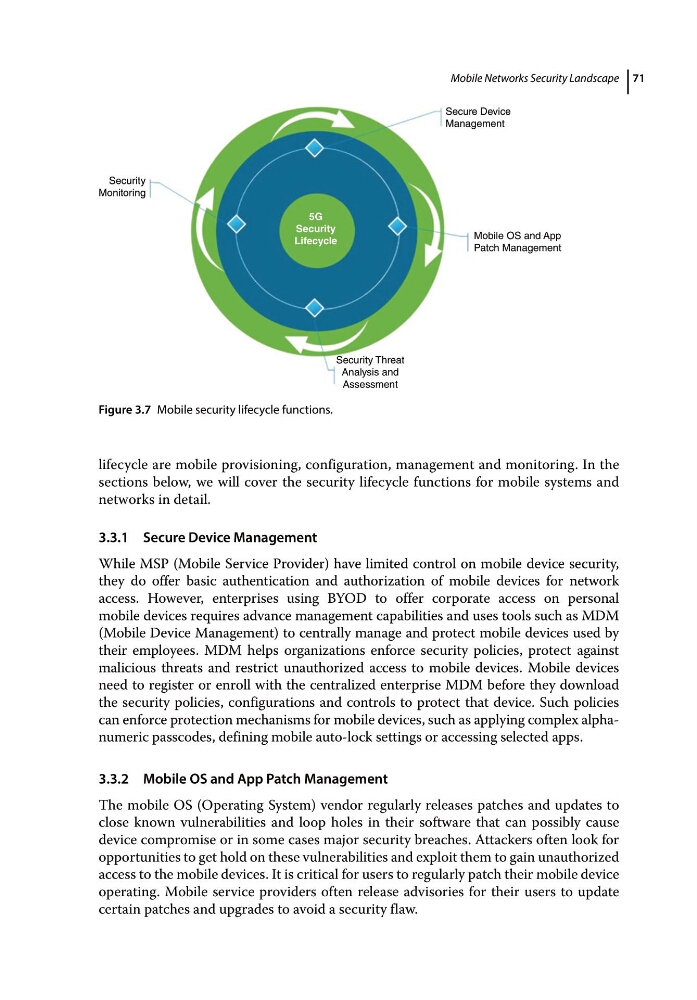
lifecycle are mobile provisioning, configuration, management and monitoring. In the
sections below, we will cover the security lifecycle functions for mobile systems and
networks in detail.
3.3.1 Secure Device Management
While MSP (Mobile Service Provider) have limited control on mobile device security,
they do offer basic authentication and authorization of mobile devices for network
access. However, enterprises using BYOD to offer corporate access on personal
mobile devices requires advance management capabilities and uses tools such as MDM
(Mobile Device Management) to centrally manage and protect mobile devices used by
their employees. MDM helps organizations enforce security policies, protect against
malicious threats and restrict unauthorized access to mobile devices. Mobile devices
need to register or enroll with the centralized enterprise MDM before they download
the security policies, configurations and controls to protect that device. Such policies
can enforce protection mechanisms for mobile devices, such as applying complex alphanumeric passcodes, defining mobile auto‐lock settings or accessing selected apps.
3.3.2 Mobile OS and App Patch Management
The mobile OS (Operating System) vendor regularly releases patches and updates to
close known vulnerabilities and loop holes in their software that can possibly cause
device compromise or in some cases major security breaches. Attackers often look for
opportunities to get hold on these vulnerabilities and exploit them to gain unauthorized
access to the mobile devices. It is critical for users to regularly patch their mobile device
operating. Mobile service providers often release advisories for their users to update
certain patches and upgrades to avoid a security flaw.
Secure Device
Management
Mobile OS and App
Patch Management
Security Threat
Analysis and
Assessment
Security
Monitoring
5G
Security
Lifecycle
Figure 3.7 Mobile security lifecycle functions.
lifecycle are mobile provisioning, configuration, management and monitoring. In the
sections below, we will cover the security lifecycle functions for mobile systems and
networks in detail.
3.3.1 Secure Device Management
While MSP (Mobile Service Provider) have limited control on mobile device security,
they do offer basic authentication and authorization of mobile devices for network
access. However, enterprises using BYOD to offer corporate access on personal
mobile devices requires advance management capabilities and uses tools such as MDM
(Mobile Device Management) to centrally manage and protect mobile devices used by
their employees. MDM helps organizations enforce security policies, protect against
malicious threats and restrict unauthorized access to mobile devices. Mobile devices
need to register or enroll with the centralized enterprise MDM before they download
the security policies, configurations and controls to protect that device. Such policies
can enforce protection mechanisms for mobile devices, such as applying complex alphanumeric passcodes, defining mobile auto‐lock settings or accessing selected apps.
3.3.2 Mobile OS and App Patch Management
The mobile OS (Operating System) vendor regularly releases patches and updates to
close known vulnerabilities and loop holes in their software that can possibly cause
device compromise or in some cases major security breaches. Attackers often look for
opportunities to get hold on these vulnerabilities and exploit them to gain unauthorized
access to the mobile devices. It is critical for users to regularly patch their mobile device
operating. Mobile service providers often release advisories for their users to update
certain patches and upgrades to avoid a security flaw.
Secure Device
Management
Mobile OS and App
Patch Management
Security Threat
Analysis and
Assessment
Security
Monitoring
5G
Security
Lifecycle
Figure 3.7 Mobile security lifecycle functions.