

Mobile Networks Security Landscape 69
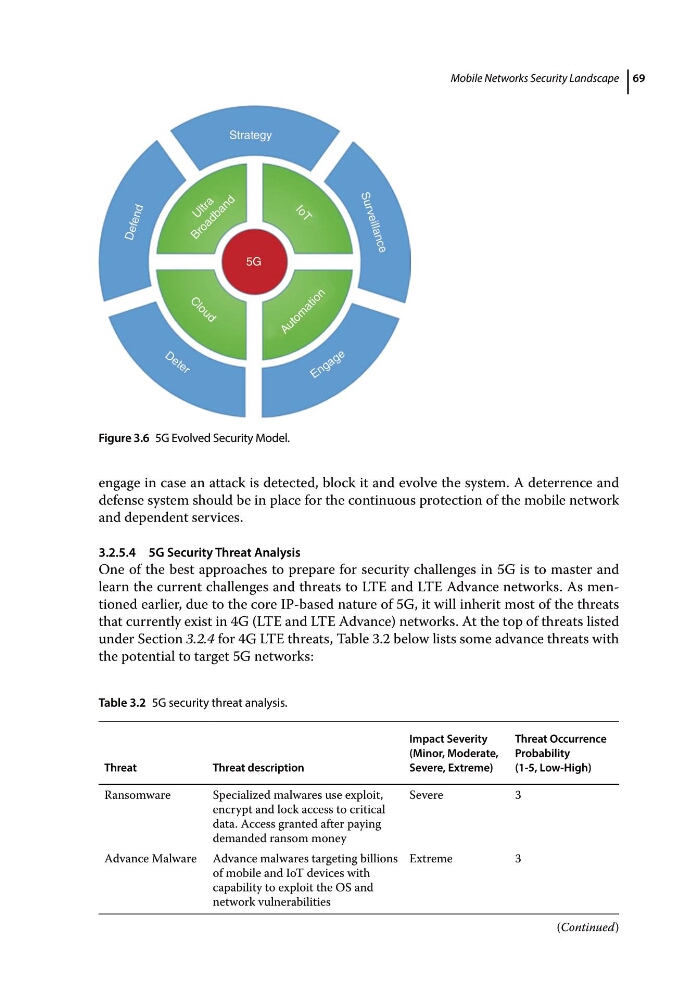
engage in case an attack is detected, block it and evolve the system. A deterrence and
defense system should be in place for the continuous protection of the mobile network
and dependent services.
3.2.5.4 5G Security Threat Analysis
One of the best approaches to prepare for security challenges in 5G is to master and
learn the current challenges and threats to LTE and LTE Advance networks. As mentioned earlier, due to the core IP‐based nature of 5G, it will inherit most of the threats
that currently exist in 4G (LTE and LTE Advance) networks. At the top of threats listed
under Section 3.2.4 for 4G LTE threats, Table 3.2 below lists some advance threats with
the potential to target 5G networks:
Strategy
5G
D e t e r
E n g a g e
A u t o m
a t i o n
C l o u d
D e fe n d
S u rv e il la n c e
I o T
U
l t r a
B r o a d b a n d
Figure 3.6 5G Evolved Security Model.
Table 3.2 5G security threat analysis.
Threat
Threat description
Impact Severity
(Minor, Moderate,
Severe, Extreme)
Threat Occurrence
Probability
(1‐5, Low‐High)
Ransomware
Specialized malwares use exploit,
encrypt and lock access to critical
data. Access granted after paying
demanded ransom money
Severe
3
Advance Malware Advance malwares targeting billions
of mobile and IoT devices with
capability to exploit the OS and
network vulnerabilities
Extreme
3
(Continued)
engage in case an attack is detected, block it and evolve the system. A deterrence and
defense system should be in place for the continuous protection of the mobile network
and dependent services.
3.2.5.4 5G Security Threat Analysis
One of the best approaches to prepare for security challenges in 5G is to master and
learn the current challenges and threats to LTE and LTE Advance networks. As mentioned earlier, due to the core IP‐based nature of 5G, it will inherit most of the threats
that currently exist in 4G (LTE and LTE Advance) networks. At the top of threats listed
under Section 3.2.4 for 4G LTE threats, Table 3.2 below lists some advance threats with
the potential to target 5G networks:
Strategy
5G
D e t e r
E n g a g e
A u t o m
a t i o n
C l o u d
D e fe n d
S u rv e il la n c e
I o T
U
l t r a
B r o a d b a n d
Figure 3.6 5G Evolved Security Model.
Table 3.2 5G security threat analysis.
Threat
Threat description
Impact Severity
(Minor, Moderate,
Severe, Extreme)
Threat Occurrence
Probability
(1‐5, Low‐High)
Ransomware
Specialized malwares use exploit,
encrypt and lock access to critical
data. Access granted after paying
demanded ransom money
Severe
3
Advance Malware Advance malwares targeting billions
of mobile and IoT devices with
capability to exploit the OS and
network vulnerabilities
Extreme
3
(Continued)