

Mobile Networks Security Landscape 67
The 5G threat vector will have no boundaries and will range from the end user
equipment such as mobile phones, industrial items, sensors, home automation,
automated cars, enterprise networks to mobile networks. With such a larger threat
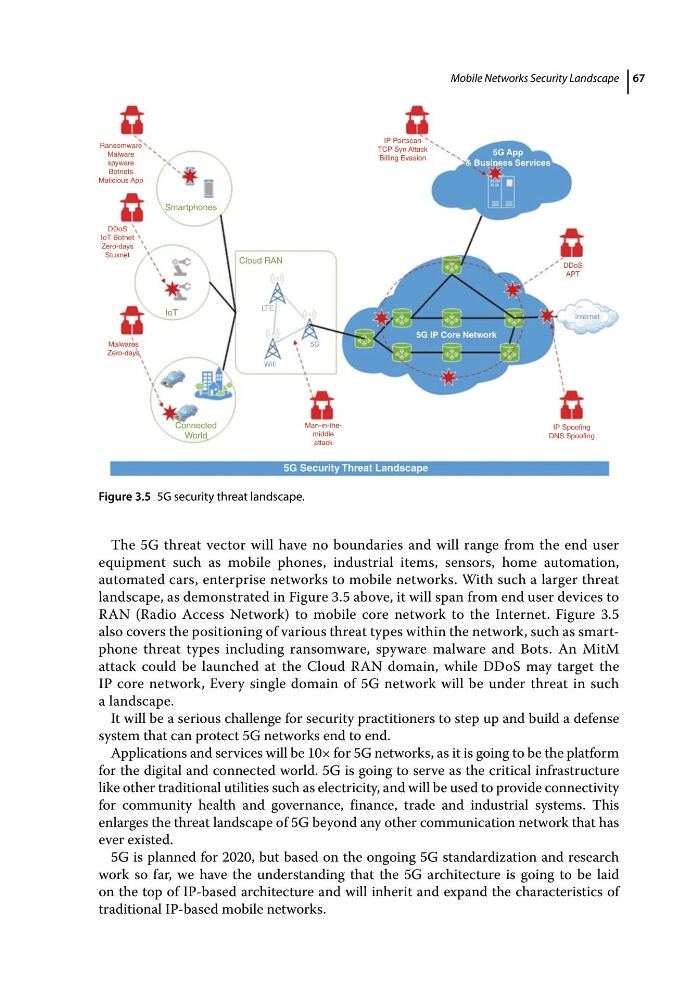
landscape, as demonstrated in Figure 3.5 above, it will span from end user devices to
RAN (Radio Access Network) to mobile core network to the Internet. Figure 3.5
also covers the positioning of various threat types within the network, such as smartphone threat types including ransomware, spyware malware and Bots. An MitM
attack could be launched at the Cloud RAN domain, while DDoS may target the
IP core network, Every single domain of 5G network will be under threat in such
a landscape.
It will be a serious challenge for security practitioners to step up and build a defense
system that can protect 5G networks end to end.
Applications and services will be 10× for 5G networks, as it is going to be the platform
for the digital and connected world. 5G is going to serve as the critical infrastructure
like other traditional utilities such as electricity, and will be used to provide connectivity
for community health and governance, finance, trade and industrial systems. This
enlarges the threat landscape of 5G beyond any other communication network that has
ever existed.
5G is planned for 2020, but based on the ongoing 5G standardization and research
work so far, we have the understanding that the 5G architecture is going to be laid
on the top of IP‐based architecture and will inherit and expand the characteristics of
traditional IP‐based mobile networks.
Ransomware
Malware
spyware
Botnets
Malicious App
IP Portscan
TCP Syn Attack
Billing Evasion
DDoS
IoT Botnet
Zero-days
Stuxnet
Malwares
Zero-days
LTE
Cloud RAN
Smartphones
IoT
Connected
World
Wifi
5G
Internet
Man-in-themiddle
attack
IP Spoofing
DNS Spoofing
DDoS
APT
5G App
& Business Services
5G Security Threat Landscape
5G IP Core Network
Figure 3.5 5G security threat landscape.
The 5G threat vector will have no boundaries and will range from the end user
equipment such as mobile phones, industrial items, sensors, home automation,
automated cars, enterprise networks to mobile networks. With such a larger threat
landscape, as demonstrated in Figure 3.5 above, it will span from end user devices to
RAN (Radio Access Network) to mobile core network to the Internet. Figure 3.5
also covers the positioning of various threat types within the network, such as smartphone threat types including ransomware, spyware malware and Bots. An MitM
attack could be launched at the Cloud RAN domain, while DDoS may target the
IP core network, Every single domain of 5G network will be under threat in such
a landscape.
It will be a serious challenge for security practitioners to step up and build a defense
system that can protect 5G networks end to end.
Applications and services will be 10× for 5G networks, as it is going to be the platform
for the digital and connected world. 5G is going to serve as the critical infrastructure
like other traditional utilities such as electricity, and will be used to provide connectivity
for community health and governance, finance, trade and industrial systems. This
enlarges the threat landscape of 5G beyond any other communication network that has
ever existed.
5G is planned for 2020, but based on the ongoing 5G standardization and research
work so far, we have the understanding that the 5G architecture is going to be laid
on the top of IP‐based architecture and will inherit and expand the characteristics of
traditional IP‐based mobile networks.
Ransomware
Malware
spyware
Botnets
Malicious App
IP Portscan
TCP Syn Attack
Billing Evasion
DDoS
IoT Botnet
Zero-days
Stuxnet
Malwares
Zero-days
LTE
Cloud RAN
Smartphones
IoT
Connected
World
Wifi
5G
Internet
Man-in-themiddle
attack
IP Spoofing
DNS Spoofing
DDoS
APT
5G App
& Business Services
5G Security Threat Landscape
5G IP Core Network
Figure 3.5 5G security threat landscape.