

Mobile Networks Security Landscape 61
(Distributed denial of service) and APT (Advance persistent threats) were the new realities for the mobile network, as impact to the service was critical with huge financial
losses as the result of such attacks. Attackers became more organized and started
following a systematic approach in their threat of execution. It has become harder to
detect their stealth presence in the mobile network, to protect and mitigate, with an
average attack consisting of months’ duration.
5G is coming forward with the promise of connecting billions of devices, phones over a
highly reliable, widely dense, bandwidth capable, fast and fault tolerant network infrastructure, which will service multiple sectors and industries. Key use cases for 5G are critical
infrastructure, IoT, smart cities and the connected world. With these use cases, 5G will be
an ideal target for attackers who may want to cause major economic and social disruption
within a minimal timeframe. 5G threats will be constituted around financial and politically
motivated gains, executed by groups of professionals and criminals with extensive technological knowledge and resources. The threat landscape for 5G will be dynamic and based
on sophisticated and complex threats, such as Stuxnet and flame malwares.
3.2.1 Security Threats and Protection for 1G
1G offered voice‐only services that were based on analogue technology, also referred to as
Advance Mobile Phone System (AMPS). It used separate frequencies by using the FDMA
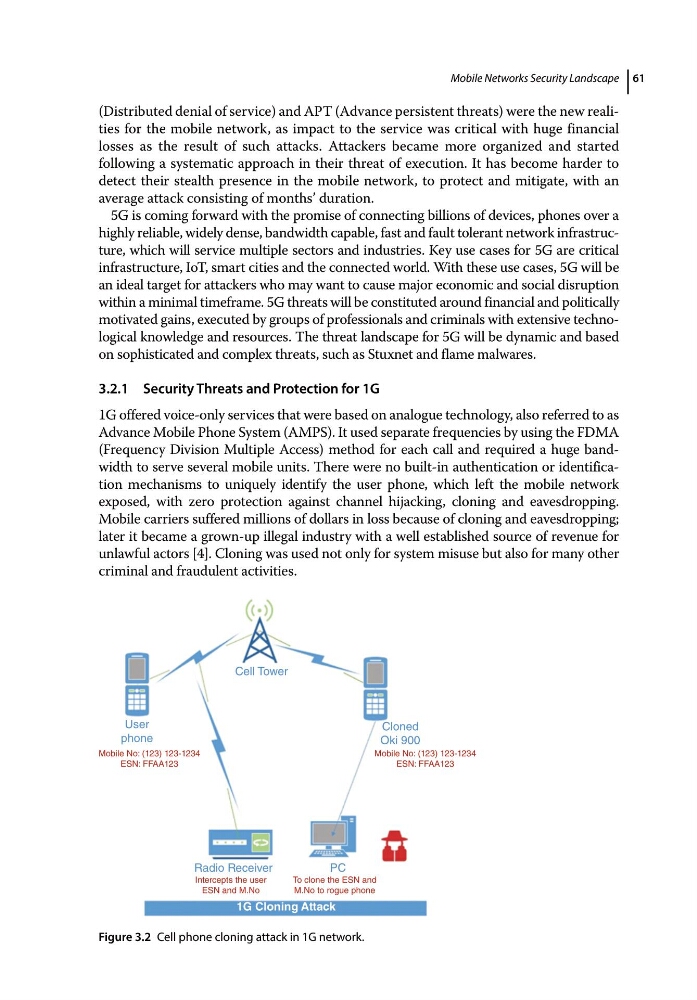
(Frequency Division Multiple Access) method for each call and required a huge bandwidth to serve several mobile units. There were no built‐in authentication or identification mechanisms to uniquely identify the user phone, which left the mobile network
exposed, with zero protection against channel hijacking, cloning and eavesdropping.
Mobile carriers suffered millions of dollars in loss because of cloning and eavesdropping;
later it became a grown‐up illegal industry with a well established source of revenue for
unlawful actors [4]. Cloning was used not only for system misuse but also for many other
criminal and fraudulent activities.
Cell Tower
PC
Radio Receiver
User
phone
Mobile No: (123) 123-1234
ESN: FFAA123
To clone the ESN and
M.No to rogue phone
Intercepts the user
ESN and M.No
Mobile No: (123) 123-1234
ESN: FFAA123
Cloned
Oki 900
1G Cloning Attack
Figure 3.2 Cell phone cloning attack in 1G network.
(Distributed denial of service) and APT (Advance persistent threats) were the new realities for the mobile network, as impact to the service was critical with huge financial
losses as the result of such attacks. Attackers became more organized and started
following a systematic approach in their threat of execution. It has become harder to
detect their stealth presence in the mobile network, to protect and mitigate, with an
average attack consisting of months’ duration.
5G is coming forward with the promise of connecting billions of devices, phones over a
highly reliable, widely dense, bandwidth capable, fast and fault tolerant network infrastructure, which will service multiple sectors and industries. Key use cases for 5G are critical
infrastructure, IoT, smart cities and the connected world. With these use cases, 5G will be
an ideal target for attackers who may want to cause major economic and social disruption
within a minimal timeframe. 5G threats will be constituted around financial and politically
motivated gains, executed by groups of professionals and criminals with extensive technological knowledge and resources. The threat landscape for 5G will be dynamic and based
on sophisticated and complex threats, such as Stuxnet and flame malwares.
3.2.1 Security Threats and Protection for 1G
1G offered voice‐only services that were based on analogue technology, also referred to as
Advance Mobile Phone System (AMPS). It used separate frequencies by using the FDMA
(Frequency Division Multiple Access) method for each call and required a huge bandwidth to serve several mobile units. There were no built‐in authentication or identification mechanisms to uniquely identify the user phone, which left the mobile network
exposed, with zero protection against channel hijacking, cloning and eavesdropping.
Mobile carriers suffered millions of dollars in loss because of cloning and eavesdropping;
later it became a grown‐up illegal industry with a well established source of revenue for
unlawful actors [4]. Cloning was used not only for system misuse but also for many other
criminal and fraudulent activities.
Cell Tower
PC
Radio Receiver
User
phone
Mobile No: (123) 123-1234
ESN: FFAA123
To clone the ESN and
M.No to rogue phone
Intercepts the user
ESN and M.No
Mobile No: (123) 123-1234
ESN: FFAA123
Cloned
Oki 900
1G Cloning Attack
Figure 3.2 Cell phone cloning attack in 1G network.