

Concretization and Morphware Networks 223
handling bespoke software. We also find ASICs, capable of handling
very particular real-time processes, such as signal-processing. Finally,
there are also a fairly large number of reconfigurable processors, so that
the necessary reconfigurations do not interfere with the processes
occurring in the node.
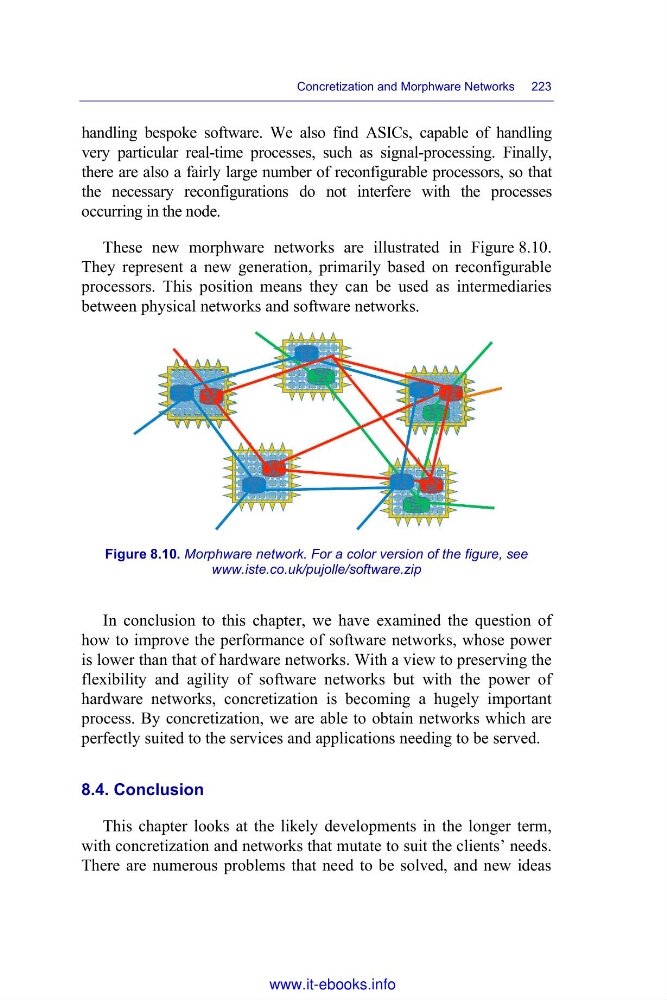
These new morphware networks are illustrated in Figure 8.10.
They represent a new generation, primarily based on reconfigurable
processors. This position means they can be used as intermediaries
between physical networks and software networks.
Figure 8.10. Morphware network. For a color version of the figure, see
www.iste.co.uk/pujolle/software.zip
In conclusion to this chapter, we have examined the question of
how to improve the performance of software networks, whose power
is lower than that of hardware networks. With a view to preserving the
flexibility and agility of software networks but with the power of
hardware networks, concretization is becoming a hugely important
process. By concretization, we are able to obtain networks which are
perfectly suited to the services and applications needing to be served.
8.4. Conclusion
This chapter looks at the likely developments in the longer term,
with concretization and networks that mutate to suit the clients’ needs.
There are numerous problems that need to be solved, and new ideas
www.it-ebooks.info
handling bespoke software. We also find ASICs, capable of handling
very particular real-time processes, such as signal-processing. Finally,
there are also a fairly large number of reconfigurable processors, so that
the necessary reconfigurations do not interfere with the processes
occurring in the node.
These new morphware networks are illustrated in Figure 8.10.
They represent a new generation, primarily based on reconfigurable
processors. This position means they can be used as intermediaries
between physical networks and software networks.
Figure 8.10. Morphware network. For a color version of the figure, see
www.iste.co.uk/pujolle/software.zip
In conclusion to this chapter, we have examined the question of
how to improve the performance of software networks, whose power
is lower than that of hardware networks. With a view to preserving the
flexibility and agility of software networks but with the power of
hardware networks, concretization is becoming a hugely important
process. By concretization, we are able to obtain networks which are
perfectly suited to the services and applications needing to be served.
8.4. Conclusion
This chapter looks at the likely developments in the longer term,
with concretization and networks that mutate to suit the clients’ needs.
There are numerous problems that need to be solved, and new ideas
www.it-ebooks.info