

138 Software Networks
In Figure 6.1, we also see two other directions taken by mobile
networks. The first is WiMAX, normalized by the IEEE 802.16
working group. However, this initiative failed – not so much from the
technological standpoint, but definitely so from the political
perspective, given the power of mobile networks operators who have
chosen the 3GPP as a standardizing body, and the trend visible across 1
to 5G. The second direction is Wi-Fi, which exhibits very promising
behavior, and sells hundreds of millions of components every single
day. The Wi-Fi family is currently expanding to include increasingly
high data rates and increasingly longer ranges. We are going to examine
these new standards in detail in this chapter.
6.1. 3GPP and IEEE
The 3GPP and the IEEE are the two main standardization bodies.
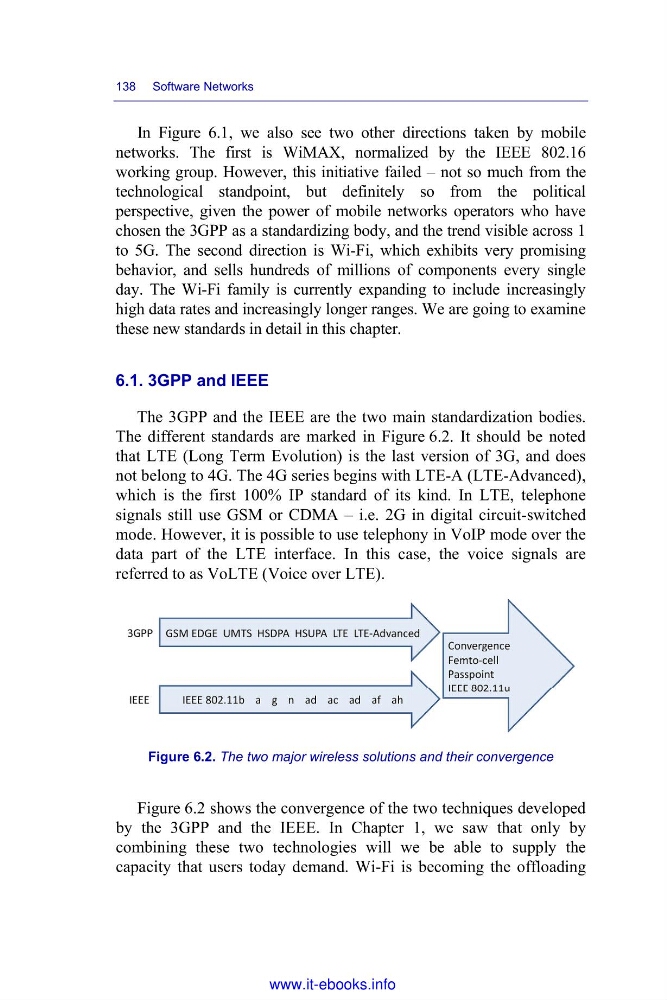
The different standards are marked in Figure 6.2. It should be noted
that LTE (Long Term Evolution) is the last version of 3G, and does
not belong to 4G. The 4G series begins with LTE-A (LTE-Advanced),
which is the first 100% IP standard of its kind. In LTE, telephone
signals still use GSM or CDMA – i.e. 2G in digital circuit-switched
mode. However, it is possible to use telephony in VoIP mode over the
data part of the LTE interface. In this case, the voice signals are
referred to as VoLTE (Voice over LTE).
Figure 6.2. The two major wireless solutions and their convergence
Figure 6.2 shows the convergence of the two techniques developed
by the 3GPP and the IEEE. In Chapter 1, we saw that only by
combining these two technologies will we be able to supply the
capacity that users today demand. Wi-Fi is becoming the offloading
www.it-ebooks.info
In Figure 6.1, we also see two other directions taken by mobile
networks. The first is WiMAX, normalized by the IEEE 802.16
working group. However, this initiative failed – not so much from the
technological standpoint, but definitely so from the political
perspective, given the power of mobile networks operators who have
chosen the 3GPP as a standardizing body, and the trend visible across 1
to 5G. The second direction is Wi-Fi, which exhibits very promising
behavior, and sells hundreds of millions of components every single
day. The Wi-Fi family is currently expanding to include increasingly
high data rates and increasingly longer ranges. We are going to examine
these new standards in detail in this chapter.
6.1. 3GPP and IEEE
The 3GPP and the IEEE are the two main standardization bodies.
The different standards are marked in Figure 6.2. It should be noted
that LTE (Long Term Evolution) is the last version of 3G, and does
not belong to 4G. The 4G series begins with LTE-A (LTE-Advanced),
which is the first 100% IP standard of its kind. In LTE, telephone
signals still use GSM or CDMA – i.e. 2G in digital circuit-switched
mode. However, it is possible to use telephony in VoIP mode over the
data part of the LTE interface. In this case, the voice signals are
referred to as VoLTE (Voice over LTE).
Figure 6.2. The two major wireless solutions and their convergence
Figure 6.2 shows the convergence of the two techniques developed
by the 3GPP and the IEEE. In Chapter 1, we saw that only by
combining these two technologies will we be able to supply the
capacity that users today demand. Wi-Fi is becoming the offloading
www.it-ebooks.info