

124 Software Networks
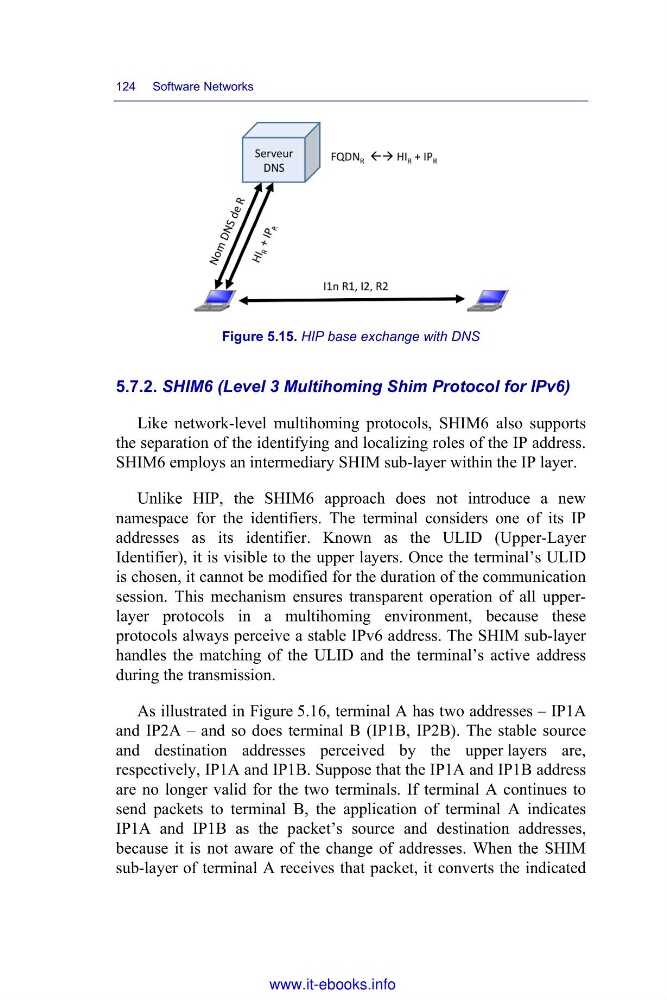
Figure 5.15. HIP base exchange with DNS
5.7.2. SHIM6 (Level 3 Multihoming Shim Protocol for IPv6)
Like network-level multihoming protocols, SHIM6 also supports
the separation of the identifying and localizing roles of the IP address.
SHIM6 employs an intermediary SHIM sub-layer within the IP layer.
Unlike HIP, the SHIM6 approach does not introduce a new
namespace for the identifiers. The terminal considers one of its IP
addresses as its identifier. Known as the ULID (Upper-Layer
Identifier), it is visible to the upper layers. Once the terminal’s ULID
is chosen, it cannot be modified for the duration of the communication
session. This mechanism ensures transparent operation of all upperlayer protocols in a multihoming environment, because these
protocols always perceive a stable IPv6 address. The SHIM sub-layer
handles the matching of the ULID and the terminal’s active address
during the transmission.
As illustrated in Figure 5.16, terminal A has two addresses – IP1A
and IP2A – and so does terminal B (IP1B, IP2B). The stable source
and destination addresses perceived by the upper layers are,
respectively, IP1A and IP1B. Suppose that the IP1A and IP1B address
are no longer valid for the two terminals. If terminal A continues to
send packets to terminal B, the application of terminal A indicates
IP1A and IP1B as the packet’s source and destination addresses,
because it is not aware of the change of addresses. When the SHIM
sub-layer of terminal A receives that packet, it converts the indicated
www.it-ebooks.info
Figure 5.15. HIP base exchange with DNS
5.7.2. SHIM6 (Level 3 Multihoming Shim Protocol for IPv6)
Like network-level multihoming protocols, SHIM6 also supports
the separation of the identifying and localizing roles of the IP address.
SHIM6 employs an intermediary SHIM sub-layer within the IP layer.
Unlike HIP, the SHIM6 approach does not introduce a new
namespace for the identifiers. The terminal considers one of its IP
addresses as its identifier. Known as the ULID (Upper-Layer
Identifier), it is visible to the upper layers. Once the terminal’s ULID
is chosen, it cannot be modified for the duration of the communication
session. This mechanism ensures transparent operation of all upperlayer protocols in a multihoming environment, because these
protocols always perceive a stable IPv6 address. The SHIM sub-layer
handles the matching of the ULID and the terminal’s active address
during the transmission.
As illustrated in Figure 5.16, terminal A has two addresses – IP1A
and IP2A – and so does terminal B (IP1B, IP2B). The stable source
and destination addresses perceived by the upper layers are,
respectively, IP1A and IP1B. Suppose that the IP1A and IP1B address
are no longer valid for the two terminals. If terminal A continues to
send packets to terminal B, the application of terminal A indicates
IP1A and IP1B as the packet’s source and destination addresses,
because it is not aware of the change of addresses. When the SHIM
sub-layer of terminal A receives that packet, it converts the indicated
www.it-ebooks.info