

Mobile Cloud Networking and Mobility Control 111
exceptions, we must move the decisions to the endpoints, and this
delocalization is done by local controllers. We again see the issue of
SDN on the periphery, which we have already touched on many times.
The OpenFlow protocol may play an important role in connecting the
client and the controller.
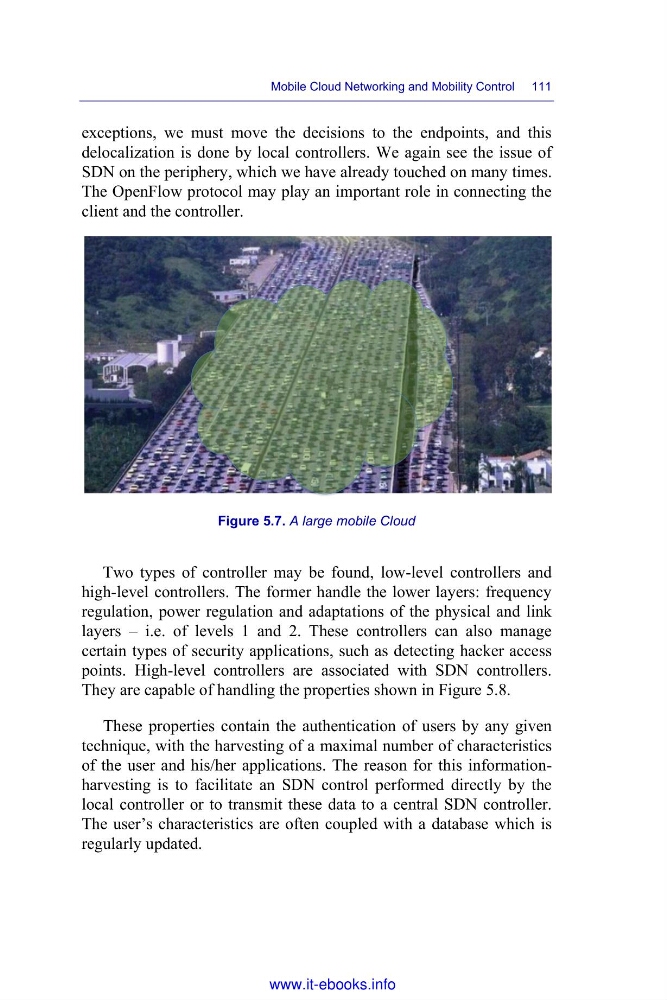
Figure 5.7. A large mobile Cloud
Two types of controller may be found, low-level controllers and
high-level controllers. The former handle the lower layers: frequency
regulation, power regulation and adaptations of the physical and link
layers – i.e. of levels 1 and 2. These controllers can also manage
certain types of security applications, such as detecting hacker access
points. High-level controllers are associated with SDN controllers.
They are capable of handling the properties shown in Figure 5.8.
These properties contain the authentication of users by any given
technique, with the harvesting of a maximal number of characteristics
of the user and his/her applications. The reason for this informationharvesting is to facilitate an SDN control performed directly by the
local controller or to transmit these data to a central SDN controller.
The user’s characteristics are often coupled with a database which is
regularly updated.
www.it-ebooks.info
exceptions, we must move the decisions to the endpoints, and this
delocalization is done by local controllers. We again see the issue of
SDN on the periphery, which we have already touched on many times.
The OpenFlow protocol may play an important role in connecting the
client and the controller.
Figure 5.7. A large mobile Cloud
Two types of controller may be found, low-level controllers and
high-level controllers. The former handle the lower layers: frequency
regulation, power regulation and adaptations of the physical and link
layers – i.e. of levels 1 and 2. These controllers can also manage
certain types of security applications, such as detecting hacker access
points. High-level controllers are associated with SDN controllers.
They are capable of handling the properties shown in Figure 5.8.
These properties contain the authentication of users by any given
technique, with the harvesting of a maximal number of characteristics
of the user and his/her applications. The reason for this informationharvesting is to facilitate an SDN control performed directly by the
local controller or to transmit these data to a central SDN controller.
The user’s characteristics are often coupled with a database which is
regularly updated.
www.it-ebooks.info